Why this is important.
Understanding public policy and being effective advocates for their institution are integral responsibilities of governing board members.
Public policy decisions play an influential role in higher education, and it is imperative for every college and university to continually make its own scan of the policy landscape, particularly with an eye toward evolving or emerging issues.
AGB empowers our members to provide informed, effective, and strategic board leadership that is focused on the public policy areas that can have the greatest impact on institutional vitality.
Source: Top Public Policy Issues for Higher Education 2021–2022, AGB 2021
Questions for boards.
Click below to reveal key questions for your board to consider:
Strategy
Consequential Questions:
- Does our board regularly discuss the implications of public policies (including funding) to the organization’s mission?
- Does our board have an advocacy or public policy strategy for the organization? Does some segment or committee of our board periodically review this strategy?
- To whom should the board look to for direction on public policy and strategy?
Source:
“Making Advocacy a Part of Your Board’s Culture,” The Guardians Initiative, AGB 2018
Board Advocacy
Consequential Questions:
- Are there board leaders who can speak to and connect with a broad cross-section of community needs and constituencies in support of the public policy strategy?
- Is the board provided training or guidance about how to engage effectively in advocacy efforts in collaboration with staff, to enable them to represent the organization’s mission and work with confidence?
- Is the board or institution affiliated with coalitions and organizations that may help to advance our advocacy strategy at the state or federal level?
Source:
“Making Advocacy a Part of Your Board’s Culture,” The Guardians Initiative, AGB 2018
Board Independence
Consequential Questions:
- Has the board defended its autonomy when challenges have occurred?
- Has the board’s capacity to fulfill its fiduciary responsibilities been impeded by external influences, including government, corporate, political, social, or religious interests?
- Has the board identified the key issues coming from outside the organization that could potentially divide board members? Does the board have a positive board structure and culture to sustain effectiveness if and when such situations arise?
Source:
“Making Advocacy a Part of Your Board’s Culture,” The Guardians Initiative, AGB 2018
Recommended resources.
We carefully curated these staff-picked resources for you:

“The Colorado Trustee Network”
Podcast
Morgan Alexander
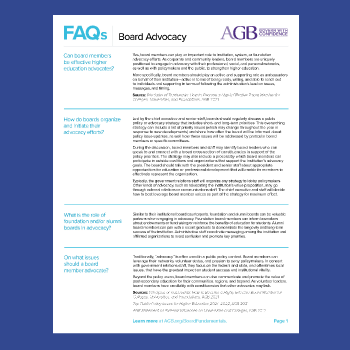
Board Advocacy
FAQs
AGB

Public Policy Alerts
Resource Hub
AGB
AGB’s 2021 Public Policy Priorities
Letters and Testimony
AGB

Advocacy & Public Policy
Resource Hub
AGB