
 Chat with AGB Board Bot
Acknowledgments
Thank you to AGB Subject Matter Specialist and Senior Fellow Ellen-Earle Chaffee, PhD, and AGB Senior Director of Research Lesley McBain, PhD, for analyzing the data and authoring this report.
Thank you also to John Cavanaugh, Jill Derby, Aileen Favilla, R. Barbara Gitenstein, Neal Hutchens, David Maxwell, Kristen Shahverdian, Tanya Spilovoy, PEN America, the Govern NOW Leadership Academy participants, and all the AGB staff who assisted with this project.
This publication was developed with support from the Mellon Foundation. The findings and conclusions contained within are those of the authors and do not necessarily reflect opinions or policies of the Mellon Foundation.
Key Takeaways for Boards, Presidents, and Board Professionals
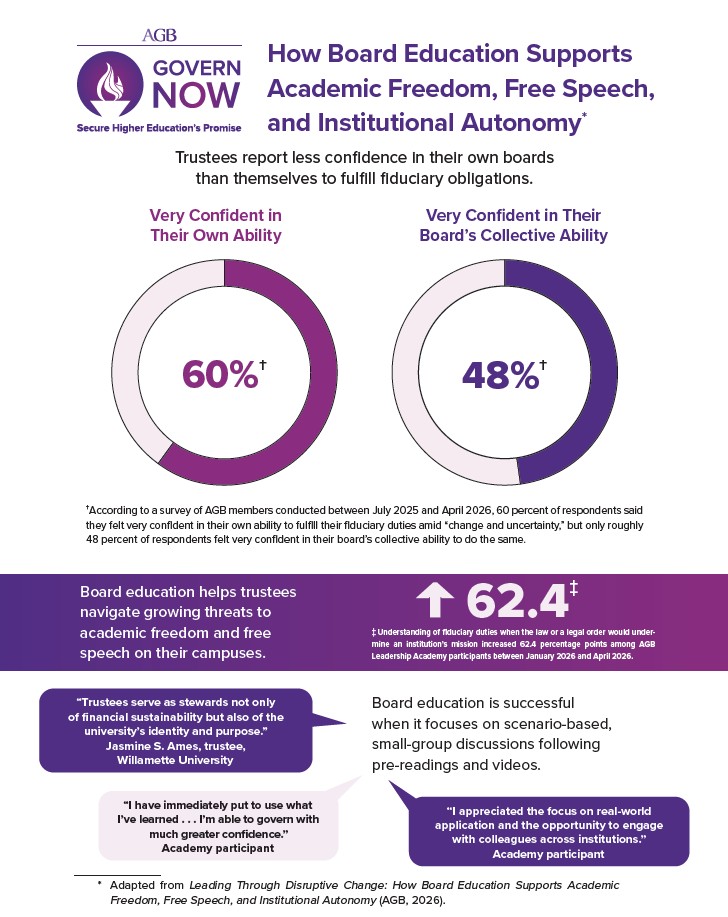
- Trustees report less confidence in their own boards than themselves to fulfill fiduciary obligations.
- Governing boards can be taught the strategic judgment they need to navigate growing threats to academic freedom and free speech on their campuses.
- Successful board education helps trustees articulate when they must defend academic freedom and free speech as core principles of higher education’s mission and understand the cost of inaction.
- Board education is also successful when it focuses not on lectures but on scenario-based, small-group discussions following pre-readings and videos.
More than half of U.S. college students now attend school in a state with at least one law restricting what can be taught or how campuses must operate.1 That statistic captures why the Association of Governing Boards of Universities and Colleges (AGB) spent 18 months on an unusual experiment: teaching trustees, in real time, how to govern when facing threats to academic freedom and free speech.
Starting in early 2025, AGB staff and consultants, drawing on AGB’s extensive library of higher education governance best practices, developed new tools, national conference sessions, Trusteeship magazine articles, videos, podcasts, and blog posts to address board independence, academic freedom, and free speech.
The result was the Govern NOW Leadership Academy (“the Academy”), funded by the Mellon Foundation and developed in partnership with PEN America, a nonprofit organization defending free speech and human rights. The Academy was a highly engaging multi-session curriculum and learning model to help governing boards meet the rising tide of unprecedented, destabilizing threats to institutions’ missions and viability. A pilot cohort of 26 trustees, presidents, and board professionals (AGB’s term for staff at a campus, system, or institutionally related foundation who support the governing board) spent 12 weeks working through the fiduciary, legal, and practical dimensions of these threats.
What Worked
The curriculum taught trustees how to prepare before a crisis by defining when a threat to academic freedom or free speech would trigger them to consider resistance or collective action. The Academy explored the costs of board inaction, the cultural considerations that involve more than compliance, the point where protected speech ends and obligations under Title VI of the Civil Rights Act of 1964 begin, and how to distinguish governance roles and responsibilities from management when a crisis hits.
Academy participants credited the interactive “flipped classroom format” in which participants studied pre-readings and videos at home that introduced substantive topics ahead of time so that the in-person virtual sessions freed up time for the scenario-based, small-group work that trustees said mattered most. They considered the in-person capstone, which featured scenario discussions, the single highest-value element of the experience. As one participant from a regional university put it, the Academy gave trustees “a better understanding of governance, fiduciary responsibilities, and especially the difference between academic freedom and freedom of speech.”
What Changed
As part of this project, AGB conducted multiple quantitative, anonymous surveys that offered a candid look at what board members understand, what they do not, and the best direction for the next round of trustee education.
The kind of judgment that boards need to manage the current crises can be taught. Governing boards that understand the difference between legitimate oversight and undue influence, and between governing and managing, do more than avoid headlines—they protect the space institutions need to keep teaching, researching, and questioning.
There is a noteworthy gap in confidence. AGB surveyed the full AGB membership regarding fiduciary governance, academic freedom, and free speech. When asked about their own ability to fulfill fiduciary duties amid “change and uncertainty,” 60 percent of respondents said they felt very confident. However, when asked the same question about their board’s collective ability, only 48 percent felt very confident. This suggests board members trust themselves more than they trust their boards as a unit. That gap is worth a special focus, because boards govern collectively or not at all.
The Govern NOW Leadership Academy moved the needle where it mattered most. AGB also conducted two quantitative surveys of Academy participants to gauge their knowledge of fiduciary governance, academic freedom, and free speech both before the Academy began and after its conclusion. The most striking result came from a single pre-test and post-test question asked of the Academy participants:
Does a trustee’s duty of loyalty and obedience require following a law or order even if it undermines the institution’s mission?
Before the Academy, only 15.4 percent of participants picked the legally correct answer: “it depends.” Afterward, 77.8 percent did. That 62-point swing suggests that nuanced fiduciary judgment is not intuitive; it has to be taught, and it can be.
Other gains were just as telling, if smaller. The number of participants who understood that academic freedom and freedom of expression rest on different constitutional foundations rose to 100 percent correct on one key survey item. Knowledge of academic freedom’s scope improved, though some confusion persisted about who holds it (faculty members do, not staff or students).
Introduction
A Sector in Peril
American higher education has entered a period of reckoning unlike any in living memory. Political attacks on campuses have hardened into law, restrictive new policy, and financial leverage faster than governing boards were prepared to confront such challenges.
Governments at multiple levels in the United States have disrupted long-standing systems on which students, faculty members, and university business models depend by canceling grant funds, restructuring federal financial aid, halting vital data-collection initiatives, and interfering with accreditation. Colleges and universities are confronting tradeoffs: produce research that supports government policy or lose research funding; use a particular politically endorsed curriculum or lose federal student aid; follow politically dictated admissions policies or face legal consequences.
These actions would strain any organization. PEN America, a nonprofit group defending free speech, has described this moment as a catastrophic time for higher education, marked by fear, self-censorship, and rising political intrusion. Governing boards, though not designed for a crisis like this, hold the fiduciary responsibility to work with administrative leaders to pull their institutions through to better times.
AGB’s Govern NOW work, including a creative 12-week Govern NOW Leadership Academy, received generous support from the Mellon Foundation to provide governing boards with knowledge and tools to protect institutional autonomy, academic freedom, and free speech. Starting in early 2025, AGB staff and consultants, drawing on AGB’s extensive library of higher education governance best practices, developed new tools, national conference sessions, Trusteeship magazine articles, videos, podcasts, and blog posts to address the current threats. AGB piloted a highly engaging multi-session curriculum and learning model to help governing boards meet the rising tide of unprecedented, destabilizing threats to institutions’ missions and viability.
This report summarizes the lessons learned from this 18-month initiative, along with many of the comments received from the board members, presidents, and board professionals who engaged with this work. We include data on trustees’ understanding of academic freedom, freedom of speech, shared governance, and their fiduciary duties in this current politically charged environment. We provide plans, strategies, and other takeaways that higher education leaders involved in trustee education and governance research can act on.
Governing boards that are prepared with a framework to guide their decisions and actions can uphold their fiduciary duties to their institution’s mission and values. Through this Govern NOW initiative, we highlight strategies for delivering learning to trustees and presidents to help them understand the role of governance in identifying and dealing with attempted restrictions on institutional autonomy, academic freedom, and free speech. At stake is the core premise of American higher education: Knowledge advances through evidence, debate, peer review, rational thought, and the open exchange of ideas—not through political control. Academic freedom is not a luxury; it is the lifeblood of learning and research in a democracy. Governing boards have no higher fiduciary responsibility than to protect and ensure academic freedom.
“More than half of U.S. college and university students now study in a state with at least one law or policy restricting what can be taught or how campuses can operate.”
PEN America
Don’t Worry. Prepare.
When a governing board lacks the preparation to respond effectively to new challenges, there are two common—and dangerous—mindsets that might lead those boards to failure.
The first is passivity: Boards might follow the instinct to keep their heads down, avoid confrontation, and hope the storm passes. That response, as experienced governance consultants warn, squanders the time a board needs to prepare for what comes next for that institution and, more broadly, to help the higher education sector recover.
Boards that are prepared … hold the line without overreaching. They support their presidents without abandoning institutional values. They protect their institutions’ autonomy.
The second is overreach and role confusion: Some trustees might step into management functions, take unilateral action, or allow partisan loyalties to override governance discipline. Eager to help, trustees reach for the lever closest at hand—and the closest lever is often someone else’s responsibility.
When boards avoid hard truths or intrude into management, the institution loses the one body whose job it is to lift its eyes from the immediate emergency and ask what the institution needs to become. This is something the institution cannot easily replace. Every board meeting consumed by fear, interference, or political firefighting is a board meeting not spent reimagining how the institution fulfills its mission for the next generation of students despite changing circumstances. The immediate crowds out the essential and the future, as well.
The cost of an unprepared board is now measured in headlines, in withdrawn grants or donor gift pledges, in presidential resignations, and in institutional missions quietly bent to the preferences of whoever holds power at the moment.
None of this is inevitable. Boards that are prepared—that have internalized their fiduciary obligations to the institution rather than to its exogenous political environment, that understand the distinction between legitimate oversight and undue influence, and that have practiced scenario responses before a crisis lands—respond differently. They hold the line without overreaching. They support their presidents without abandoning institutional values. They protect their institutions’ autonomy to fulfill the educational, civic, and economic roles that make higher education essential to what AGB describes as “vibrant higher education, inclusive democracy, and a flourishing society.”
Trustee Education: Recommendations for Higher Education Leaders
AGB gathered a wealth of strategic feedback from board members, presidents, and board professionals who participated in Govern NOW. These insights included strategies for institutions, systems, and foundations to employ to structure their own board education regarding academic freedom, free speech, and institutional autonomy.
The Govern NOW Leadership Academy included four 90-minute virtual recorded sessions for participants plus an in-person capstone seminar at the AGB National Conference on Trusteeship in March 2026. The topics of the four modules were “Board Governance NOW,” “Dealing with Political Pressure and Intrusion,” “Conceptual Foundations of Free Speech,” and “Academic Freedom.” Each was grounded in pre-readings, scenarios, and small-group discussions rather than didactic lectures. The faculty—John Cavanaugh, Ellen-Earle Chaffee, Jill Derby, R. Barbara Gitenstein, David Maxwell, Kristen Shahverdian, Aileen Favilla, and Neal Hutchens—are national experts in board governance, political intrusion, academic freedom, and free speech. The Academy’s sessions were supplemented by further relevant sessions at the 2026 AGB National Conference on Trusteeship, which took place immediately after the final Academy session.
Content Recommendations
The Academy’s curriculum emphasized that American higher education cannot function without academic freedom, and yet the differences between academic freedom and free speech are poorly understood. Academic freedom is also the most frequent and pervasive target of attack in these times. Shifting accreditation standards—in particular, proposed weakening of independent-governance requirements for accredited institutions—could also remove a key tool for governing boards to defend institutional autonomy.
Participants gave high ratings to the Academy’s curriculum and provided input to the faculty, making the following suggestions for ways to adopt Academy content and strategies for other future programs:
- Focus the curriculum in depth on fiduciary governance, academic freedom, and accreditation.
- Frame free speech law and policy as the floor, not the ceiling for board deliberations. Understanding the legal baseline is necessary but insufficient; explicitly teach the cultural and community work that goes beyond compliance.
- Teach the cost of inaction. The “keep our heads down” reflex is itself a precedent that empowers the next intrusion.
- Distinguish governance from management. Define the benefits and importance of governing without overstepping into management, especially now.
- Help boards articulate, before a crisis, the thresholds that would trigger them to consider resistance or collective action to respond to an intrusion.
- Discuss Title VI of the Civil Rights Act of 1964. Trustees need a working understanding of where protected speech ends and Title VI obligations begin.
Format Recommendations
For similar future initiatives, Academy participants appreciated the following components of the program:
- Emphasize a “flipped classroom format” with pre-session readings and pre-recorded content for participants to digest ahead of time to free up time for live interaction during virtual sessions with all participants. Participants strongly preferred conversation to content delivery, and setting the “cameras on, no distractions” norm (for example, not using cell phones or doing other work) early made the difference. The format produced peer-to-peer learning.
- Seek motivated participants who can integrate the Academy tools into existing professional development options for a variety of higher education audiences. Applicants faced live fiduciary challenges, which raised both engagement and the realism of every discussion.
- Promote cohort diversity. Mixing institution types, roles, and regions produced the cross-pollination that participants cited as transformative.
- Include an in-person capstone event. The face-to-face session at the National Conference on Trusteeship deepened the engagement, facilitated relationships, and produced conversations that virtual time did not. The capstone was the single most highly valued element in participants’ feedback.
- Include scenarios, case studies, and other frameworks rather than focusing on concepts. Sessions that emphasized application of frameworks and case studies or scenarios outperformed other sessions.
- Prioritize facilitators’ depth and credibility. Real leadership and governance experience across institutions, along with the PEN America content partnership, anchored the cohort’s trust in the curriculum.
- Incorporate learning into every board meeting. Constant board turnover and the fundamental nature of the issues for academic vitality mean this requires continuous education, at every meeting and every retreat, for every board.
Taken together, these lessons from Academy participants point in one direction: Focus the curriculum where the threats are sharpest, protect the design choices that made the pilot work, and build the follow-through that turns one cohort’s learning into lasting change across American higher education.
“The Academy is a powerful way to ‘unlock’ AGB’s impressive research and services. The syllabus, curated readings, and integration of timely articles and research, paired with discussion and case scenarios, has made the content come alive in a way that’s very practical and immediately applicable. It’s the kind of orientation I wish I had earlier when I was onboarding to the board, and something I wish our full board could experience.”
Academy participant, Hope College, mid-Academy survey
Govern NOW: Resources for Boards
Signs of escalating political and government dissatisfaction with higher education and a desire for change were clear by 2012, when the AGB Board of Directors produced the AGB Statement on External Influences on Universities and Colleges to guide trustees toward considering external input without yielding to interests that were inconsistent with their mission. By 2023, external influences had mounted to the point that the board developed a new AGB Board of Directors’ Statement on Influences Impacting Governing Board Independence and Leadership to highlight the growing instances of intrusion and provide tools for assessing and responding to them.
The environment for higher education governing boards continues to evolve. The mission of the Govern NOW initiative is to raise awareness and provide tools that empower fiduciary boards to uphold institutional autonomy and safeguard academic freedom and free speech—and thus ensure the continuing quality and integrity of American higher education.
In addition to the Leadership Academy, Govern NOW supported boards and trustees with a panoply of events and conferences, both virtual and on-site, as well as articles, blogs, op-eds, webinars, podcasts, videos, FAQs, tools, and toolkits to reach members by all available channels. AGB also conducted survey research of AGB members, including those who took part in the Leadership Academy and those who did not. This research sought to measure board members’ familiarity with governance concepts related to board autonomy, academic freedom, and free speech. It also solicited feedback on the topics themselves.
PEN America was an active partner with AGB in addressing issues of academic freedom and free speech, contributing to survey design, joint publications, and other resources. PEN America representatives co-developed the Leadership Academy, participated in all sessions, and delivered two of its virtual sessions. The Mellon Foundation’s investment made this partnership and content possible.
“My experience in the Leadership Academy reinforced the critical role governing boards play in protecting institutional mission. One key takeaway is that trustees serve as stewards not only of financial sustainability but also of the university’s identity and purpose.”
Jasmine S. Ames, trustee, Willamette University
Quantitative and Qualitative Findings
Context for the Research
To better understand the needs of AGB members in the current national climate, AGB collected descriptive data on what institutions are experiencing, how board governance is affected, and how boards are responding. This information will be useful for future professional development efforts and academic research on higher education board governance.
A good deal of applied research on governing boards and trustees focuses on demographic, descriptive, or historical information and case studies that put institutional stories into conceptual or usable context. Given the unprecedented nature of conditions now, other relevant research is scarce but is beginning to appear. For example:
- In 2020, The Chronicle of Higher Education found that almost 70 percent of the board members of 50 flagship public universities were appointed through a two-step process that was dominated by just one political party.2 For more context, see also AGB’s Policies, Practices, and Composition of Governing Boards of Colleges, Universities, and Institutionally Related Foundations 2021 survey report. Among respondents from public boards in the 2021 survey report, nearly 7 percent indicated their boards were appointed by state legislatures; just over 60 percent by their state governor with legislative confirmation; almost 10 percent by their state governor without legislative confirmation; and nearly 8 percent by popular election.3
- Faculty members saw more pressure to avoid negative publicity and more community concern about divisive topics, with harmful effects on the climate for academic freedom, according to a 2024 national study of faculty members by researchers at the American Association of Colleges and Universities.4
- In a mid-2025 national survey by the American Council on Education, “More than half of respondents (54 percent) indicated that state and/or federal policy involvement in academic freedom and institutional autonomy was a pressing concern. Among senior leaders, 53 percent were extremely concerned about this issue, while 24 percent were moderately concerned.”5
The questions underlying AGB’s research include:
- Do trustees understand fiduciary duty as it applies in a politically charged environment, including the duties of loyalty and obedience? Do they understand their authority?
- Can trustees distinguish academic freedom from freedom of speech and explain why each rests on a different legal foundation?
- Do trustees understand how the First Amendment applies differently to public and private institutions?
- Do trustees differentiate among board governance, shared governance, and institutional management?
- Do trustees feel prepared to apply governance strategies in real-world cases of intrusion, controversy, or crisis?
Overall Methodology
The research was conducted from April 2025 through mid-April 2026 using a mixed-methods format, in collaboration with PEN America. Quantitative survey methodology is discussed in conjunction with the specific results. The research included administration of two surveys, one for AGB’s general membership and the other for participants in the Govern NOW Leadership Academy. The member poll provided results for spring 2025 and spring 2026. A pre-test in January 2026 and a post-test in April 2026 assessed learning among participants in the Leadership Academy.
The application process for the Govern NOW Leadership Academy was open to all AGB members. Before applying, AGB advised its members they would need to commit to the following:
- Attending four virtual 90-minute Academy sessions and completing all pre-readings for the sessions;
- Attending a half-day in-person workshop at the 2026 AGB National Conference on Trusteeship; and
- Registering for and participating in the full AGB national conference (with registration and travel costs partially or fully offset by a stipend paid after registration).
The initial cohort of 26 members was selected from over 70 applications by an internal AGB committee based on applicants’ statement of interest and other considerations. These included position (preference was given to board members, presidents, and board professionals), geographic location, and institutional sector (public or private). A total of 24 participants completed the program, with at least one participant from every quadrant of the United States.6 Academy participants were board members (11 of 26) and board professionals (11 initially, 9 of whom completed the Academy). Some presidents/chief executives, as well as other administrators, also participated.
Five AGB senior consultants and two leading experts from AGB’s partner, PEN America, designed the curriculum and led all the class sessions. Each of the four virtual modules included pre-readings, scenarios, and small-group discussions rather than lectures. The modules were labeled:
- Board Governance NOW
- Dealing with Political Pressure and Intrusion
- Conceptual Foundations of Free Speech
- Academic Freedom
The Academy was a new kind of educational delivery option for AGB. It offered participants ongoing open access to seven experts in various aspects of board governance; multiple opportunities over a 12-week period to gather, explore, and digest new ideas; and deep discussions with peers who shared their interests and brought their unique perspectives to the table. They also left with lists of excellent resources and a new toolkit that enables participants to bring the Academy experience into their boardrooms without cost.
These results provide a valuable snapshot of how leaders of major universities and colleges understand these governance concepts and practices, which matter more in these times than ever before.
It is important to note that AGB gathered the pre-test and post-test data from a small number of participants and not all participants completed the post-test. Therefore, data were not matched and reported for each individual, but for the group. In addition, the Academy’s purpose and curriculum focused on meeting the highly diverse needs of participants from multiple sectors in a fluid time. The test questions reflected only a few of many potentially relevant topics. Thus, the data are not the sole measurement of participants’ learning.
Quantitative Survey Methodology
Multiple quantitative, anonymous surveys of the full AGB membership regarding fiduciary governance, academic freedom, and free speech were conducted as part of the project. AGB also administered separate surveys to Govern NOW Leadership Academy participants to gauge their knowledge of fiduciary governance, academic freedom, and free speech both before the Academy began and after its conclusion. These surveys are referred to as “pre-test” and “post-test” to differentiate them from the “membership” surveys administered on multiple occasions throughout the grant period.
AGB Membership Survey Methodology
As with the Academy pre-test and post-test instruments, AGB staff, PEN America staff, and AGB consultants collaborated in designing a multiple-choice survey instrument to measure a broad selection of anonymous AGB member respondents’ self-reported confidence in the following:
- Knowledge of institution/system free speech policies (affiliated foundation respondents were asked to answer regarding their partner institutions’ free speech policies)
- Understanding of the principle of academic freedom
- Their board’s ability to fulfill fiduciary duties in a higher education environment permeated by change and uncertainty
- Their own ability to fulfill fiduciary duties in a higher education environment permeated by change and uncertainty
All three iterations of the surveys sent to AGB members included space for survey-takers to share additional thoughts on the topics, as well as what AGB could do to help them and their institutions, systems, or institutionally related foundations be more confident in fulfilling their fiduciary duties regarding campus free speech and academic freedom.
In the July 2025 survey, AGB also asked respondents whether they had read, listened to, or watched AGB resources on fiduciary governance, free expression, or academic freedom within the past three months.
For the final survey, administered in April 2026 after the conclusion of the 2026 AGB National Conference on Trusteeship, respondents were also asked if they had attended the conference. If they had, the survey asked whether they attended concurrent or plenary sessions related to the Mellon grant. In addition, the survey provided space where they could share their thoughts on Mellon grant-related concurrent or plenary sessions.
Membership Survey Distribution and Timing
The three waves of links to anonymous surveys, with IP address tracking disabled, were included in previously scheduled news and information digests circulated to AGB membership-distribution lists. These lists, as per AGB standard practice, were first broadly grouped by sectors:
- institutionally related foundations
- independent (private for-profit and nonprofit) institutions
- public institutions and systems
The lists, again as per AGB standard practice, were then subdivided into what AGB refers to as institutional roles within those sectors:
- chief executives (for institutions and systems, this includes presidents and chancellors)
- board chairs
- board professionals (AGB’s term for staff at a campus, system, or institutionally related foundation who support the governing board)
- cabinet members/other roles (for example, chief financial officer or university counsel)
The survey links were sent in April 2025, July 2025, and April 2026. AGB’s list of members is dynamic, so the precise total and subtotal counts differed among the iterations. The collective population to which AGB sent the survey links totaled:
- approximately 2,100–2,800 individuals at institutionally related foundations
- approximately 7,500–8,900 individuals at independent institutions
- approximately 2,000–3,100 individuals at public institutions and systems
Leadership Academy Pre-Test and Post-Test Survey Methodology7
AGB staff, PEN America staff, and AGB consultants collaborated in designing a multiple-choice survey instrument to measure respondents’ knowledge and understanding of the following:
- board fiduciary duties and appropriate related behavior
- the principle of academic freedom
- the principle of freedom of expression and how it differs from academic freedom
The pre-test questions were designed as multiple-choice (with the option to choose one or more correct choices depending on the question) or true/false. Respondents were also asked a single free response question asking what they most wanted to learn about in the Academy course.
For the post-test survey, the main instrument questions were repeated to see whether responses had changed. Then a new set of free response questions was offered, first asking participants whether the Academy “led [them] to feel better prepared to help [their] institution, system, or foundation board deal with the rapidly emerging new landscape for higher education.” Other free response questions asked what participants still wanted to know about the topics and what they wanted AGB and the faculty to know about the Academy experience.
Results Summary: Leadership Academy and Member Surveys
The results of the five surveys administered—three of the general membership and a pre-test and post-test of Govern NOW Academy participants—produced some commonalities in terms of requests for AGB to provide more practical resources (for example, case studies/scenarios, model best practices, sample policies) concerning the often-abstract concepts of academic freedom, free speech, and board independence. Responses from both survey populations (general membership and Academy participants) also reinforced the need for nuance when discussing these complex, intertwined concepts.
This presents a practical problem in terms of scaling resources given the breadth of AGB membership. Members range from small private colleges to large university systems and affiliated foundations across the United States and some international institutions as well. Their geographic areas, regional cultures, and political environments all differ. Therefore, issues of academic freedom, free speech, and board independence do not present themselves identically across the membership.
Future resources AGB might provide would need to be tailored accordingly to help members grapple with the many governance issues that are evolving rapidly. AGB’s signature approach to this predicament is to incorporate questions for board members to consider. Often, they are framed to help them determine whether the information given applies directly to their institution and situation.
In addition, future qualitative research would be beneficial. This set of quantitative surveys can only touch on the complex perspectives and issues described in free responses by both Academy participants and respondents to the membership surveys.
Membership Survey Results
The three survey waves yielded a total of 266 usable responses, though the number of responses to individual questions sometimes varied. Unfortunately, survey fatigue is a consistent issue for AGB and others in the field of survey research. This is particularly true when trying to reach volunteer board members who are extremely busy professionals or retired professionals. The small number of responses from the AGB membership was made up for by lengthy, thoughtful, nuanced, and in some cases passionate comments in the free response sections of the surveys.
Another caveat when interpreting results is the anonymity factor. Sending the survey links anonymously to the entire membership more than once meant that some respondents may have taken the survey more than once. Although this possibility does not seem to have materially affected results, it is a caveat. It is also possible that anonymous respondents also participated in the Govern NOW Academy pre-test and post-test; again, no material effects on the results were observed after analyzing both surveys.
Demographics
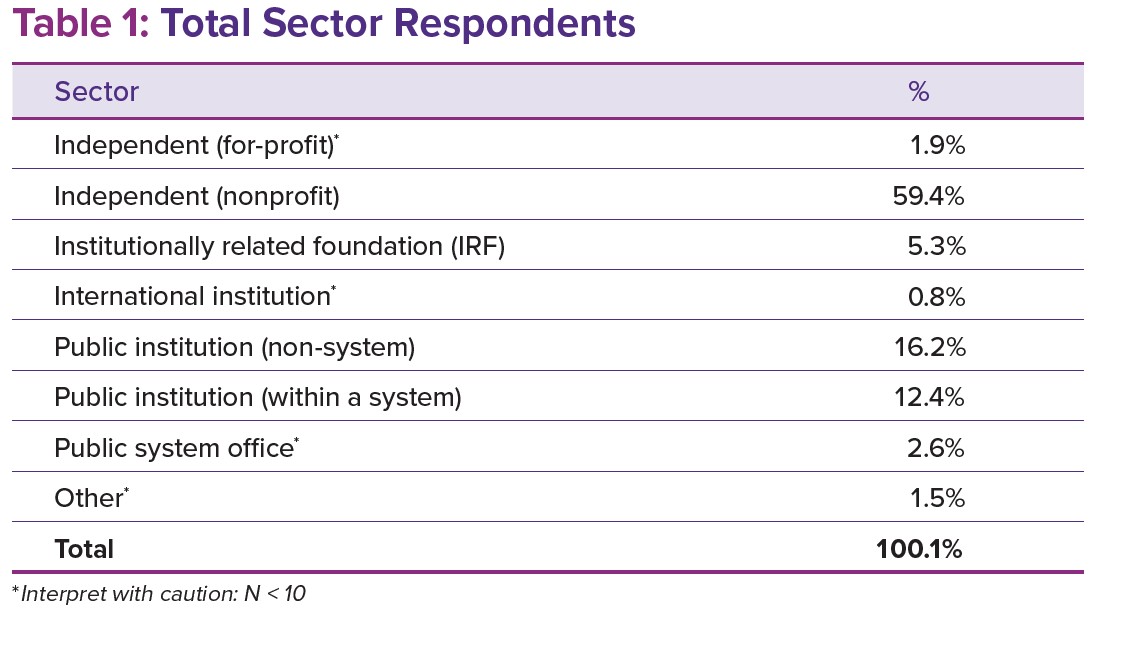
Most respondents (59.4 percent) were from independent nonprofit institutions, which corresponds to AGB’s overall membership. Another 16.2 percent indicated they were from public non-system institutions, and 12.4 percent served in roles at public institutions within a system. See Table 1 for complete results.
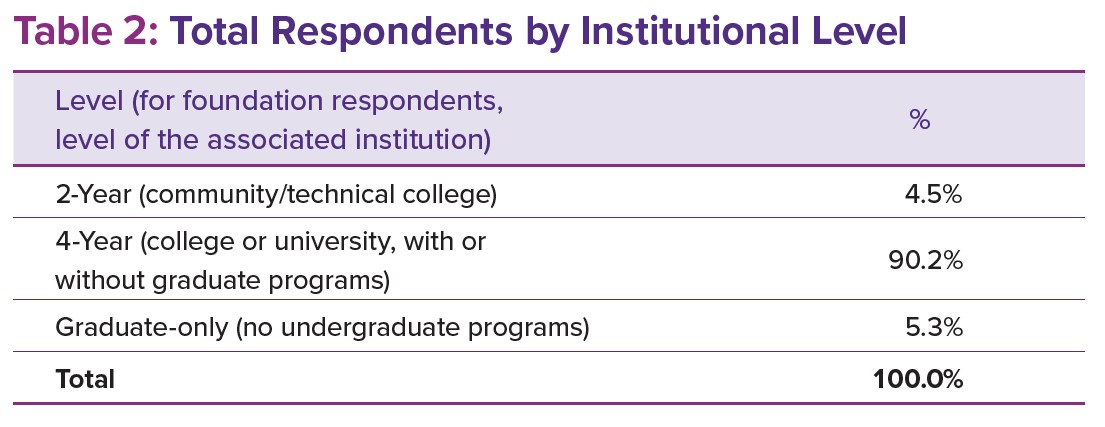
Most respondents (90.2 percent) were from four-year colleges or universities (either with or without graduate programs). Only 5.3 percent were from graduate-only institutions (not offering any undergraduate programs), and another 4.5 percent were from community/technical colleges.
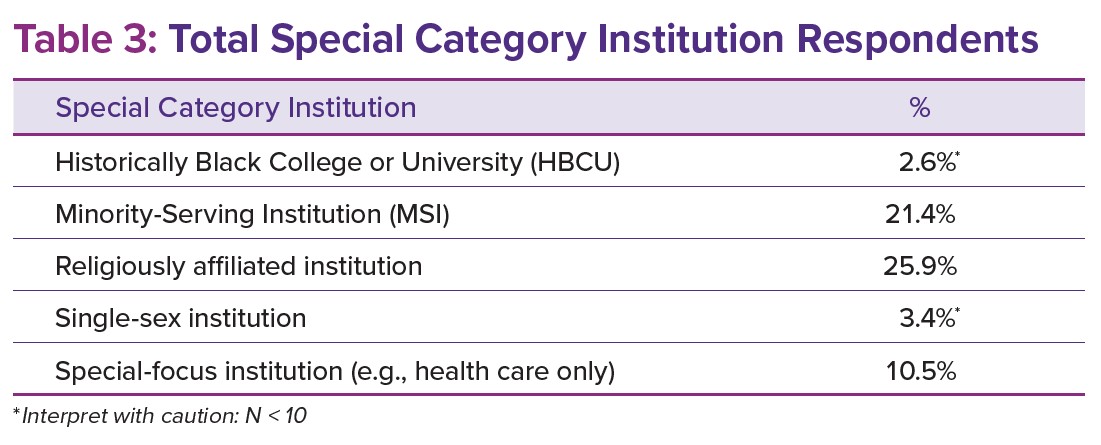
In terms of institutions in special categories, please see Table 3. Notably, 25.9 percent of respondents came from religiously affiliated institutions, 21.4 percent of respondents came from Minority-Serving Institutions, and 10.5 percent of respondents came from special-focus institutions (for example, health care only).
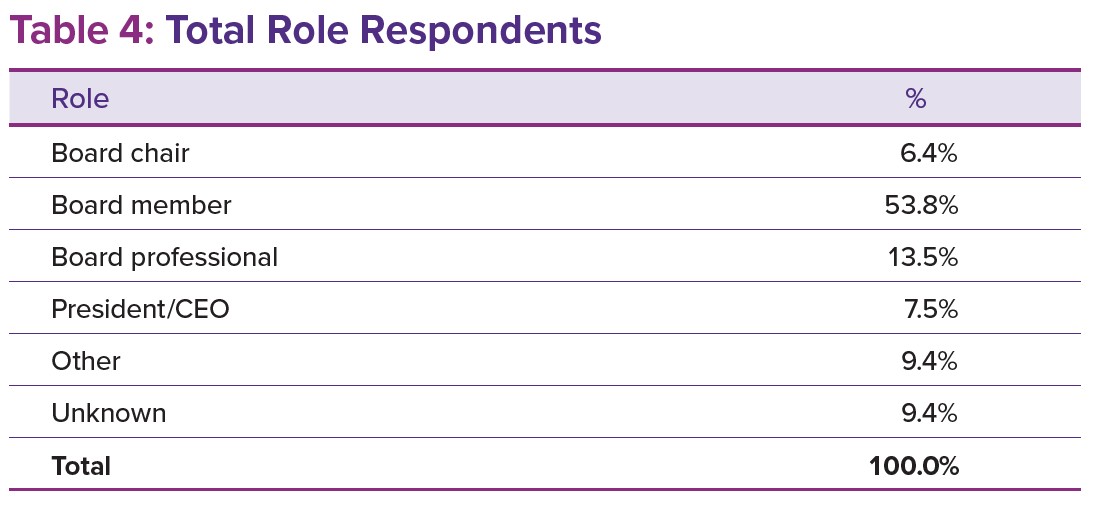
The question asking for respondents’ roles in relation to their institution, system, or related foundation was added partway through the first survey wave in April 2025 after resolving concerns about anonymity, given the sensitive topics of free speech and freedom of expression. Therefore, the data for the April 2025 iteration are incomplete. However, 53.8 percent of those answering the role question were board members. Another 13.5 percent were board professionals, and 7.5 percent were active presidents/CEOs. The “other” category (where responses could not be recoded, including from retired presidents/CEOs, faculty members, and administrators, for example) totaled 9.4 percent.
Note: Tables may not precisely total 100 percent due to rounding.
Knowledge of Free Speech Policy
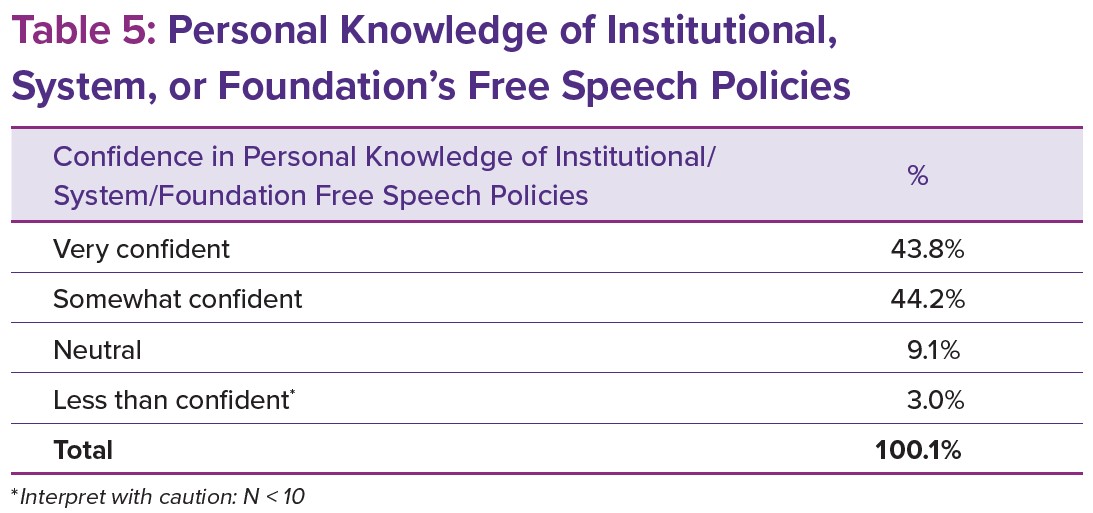
Respondents were asked, “How confident are you in your knowledge of your institution, system, or foundation’s free speech policies?” using a Likert scale ranging from very confident to not at all confident.
The majority of respondents were either very or somewhat confident in their knowledge (88 percent combined total). Interestingly, the “somewhat” (44.2 percent) portion was a touch higher (0.4 percentage points) than the “very” portion (43.8 percent) of the total.
Academic Freedom Knowledge
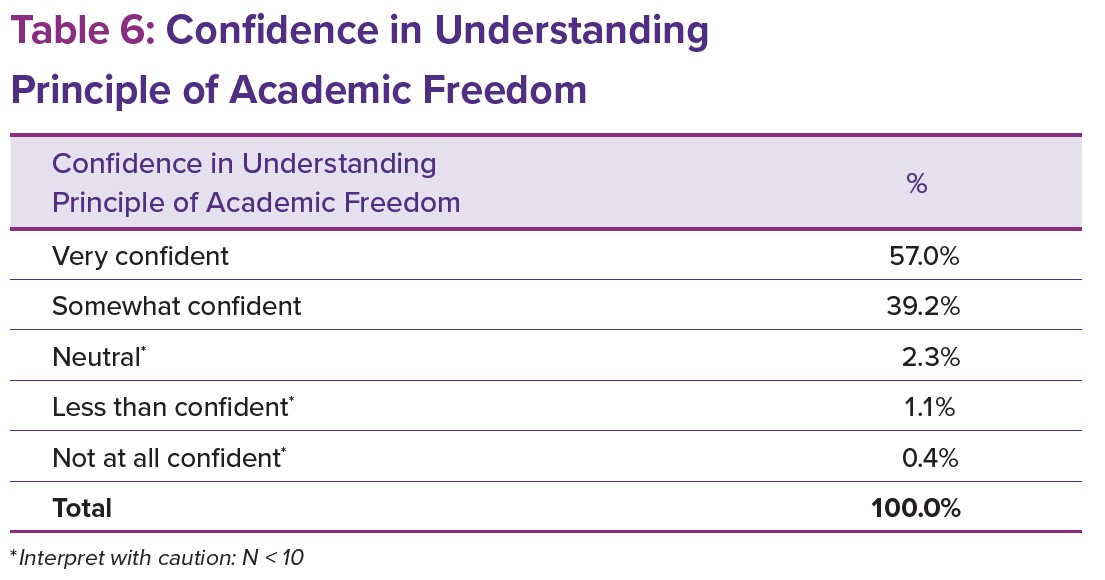
Respondents were then asked, “How confident are you in understanding the principle of academic freedom?” using the same Likert scale as in the question on knowledge of the institution’s free speech policy. While an overwhelming majority of respondents were once again either very or somewhat confident in their understanding (96.2 percent combined), the “very” portion was higher on this question than its companion question regarding free speech policies. Also, a fraction of respondents selected “Not At All Confident,” which no one selected in the previous question.
The free response questions produced a wealth of additional context that will be discussed separately. In some cases, these comments included disagreement with how other academic stakeholders defined “academic freedom” or with AGB’s materials on the topic. In others, they requested a wide variety of other guidance materials from AGB to address issues on their campuses.
Campus Restrictions on Free Expression or Academic Freedom
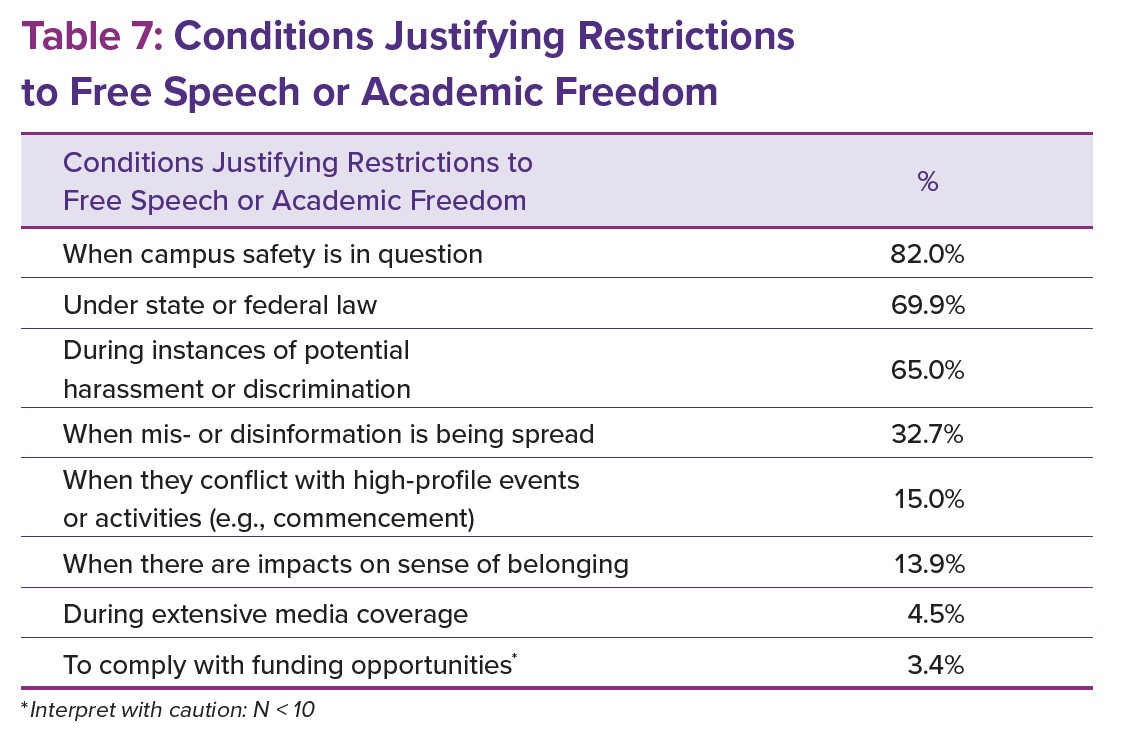
After setting the stage by asking about free speech policy and academic freedom, respondents were asked under which conditions, broadly speaking, they would consider campus restrictions on free expression or academic freedom justified. They could check off as many as they pleased. This question also generated considerable comment in the free response section, providing context and nuance to the responses following.
As a historical note on trustees’ views regarding campus free speech, the first AGB survey of trustees in 1969 asked trustees to select their political party preference and “political ideology” (neither of which is asked today). The majority of respondents in that survey identified as Republican (58 percent) and moderate (61 percent). However, 67 percent of those respondents thought faculty members “should have the right to express their opinions about any issue they wish in various channels of campus communication, including classroom, student newspapers, etc., without fear of reprisal.”8
Returning to 2025–2026, the top three answers from respondents regarding justifications for restrictions on free speech or academic freedom were campus safety (82.0 percent), state and federal legal restrictions (69.9 percent, possibly influenced during the fielding of the survey by various changes in state law regarding protest and free speech on campus), and circumstances potentially leading to harassment or discrimination (specified by some in the comment section as protests of the Israel-Hamas war leading to instances of anti-Semitism on campus).
Given the volatility of current events in the United States and abroad during the survey period, none of these data points are particularly surprising. One respondent commented, “Free speech isn’t as much the issue as the reaction to free speech—at times, physical and destructive.” Another respondent pointed out, “Free speech is necessary. However, organizations are also free to respond accordingly to free speech.” A different take on the topic was, “Free speech should be responsible and not cause societal disruption or harassment,” immediately juxtaposed with the next respondent’s comment that, “Freedom of speech is the essence of democracy.” But a few responses later, yet another respondent said, “I do not understand the third question on this page [the restrictions question]. I personally believe that academic freedom and/or free expression should never be curtailed! Period.”
Interestingly, “When mis- or disinformation is being spread” came in fourth in responses concerning justifications for restrictions, at 32.7 percent. The nature of such misinformation or disinformation was left unspecified. In fact, in the comment section, one respondent requested AGB’s assistance in interpreting free speech guidance from the American Association of University Professors (AAUP) based on a situation in which the respondent was less than confident that other stakeholders had provided an accurate explanation of AAUP’s guidance.
Confidence in Board and Individual Ability to Fulfill Fiduciary Duty
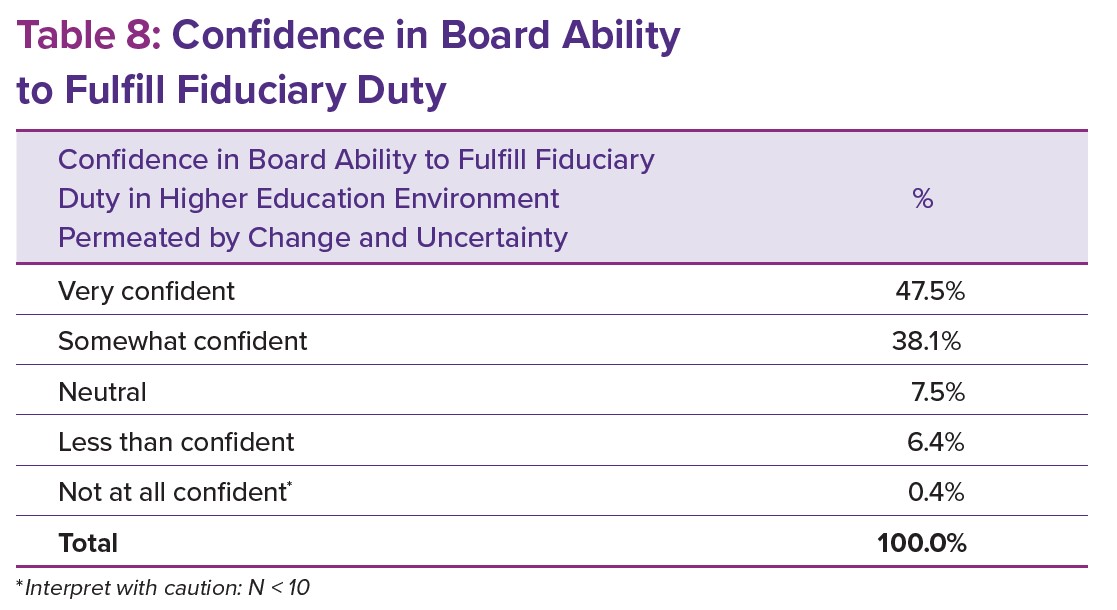
Fiduciary duties are core responsibilities of boards, so respondents were also presented with two questions about such duties. After the statement “Change and uncertainty permeate the higher education environment this year,” AGB respondents were asked how confident they were in their board’s ability to fulfill its fiduciary duties under the current circumstances. The same Likert scale was used as in previous questions.
Nearly 48 percent of respondents were very confident in their board’s ability to fulfill its fiduciary duties in a higher education environment permeated by change and uncertainty. However, answers to this question fell more evenly across the Likert scale than previous questions about respondents’ own understanding of free speech and academic freedom issues. Notably, 6.4 percent of respondents were less than confident in their board’s ability to fulfill its fiduciary duties. In previous questions, the “less than confident” answer choice was cited by fewer than 10 AGB respondents; here, the number was in double digits.
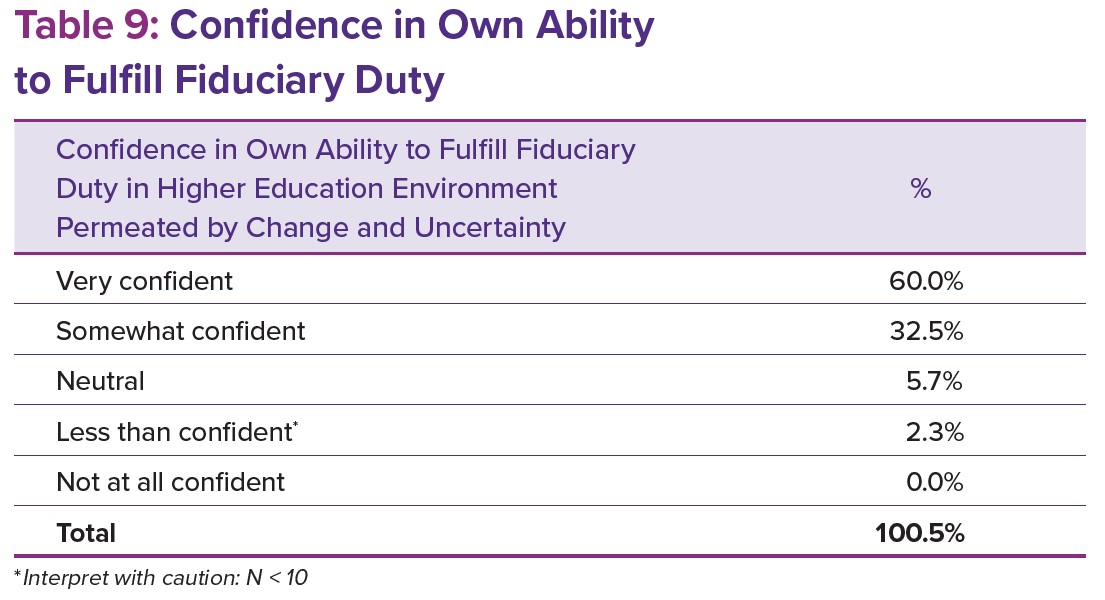
However, when asked the second question, about their own confidence in their ability to fulfill their fiduciary duties in the same circumstances, the data differed strikingly. The total selecting “very confident” was 60.0 percent. This was the greatest “very confident” response to any of the Likert scale questions assessing various areas of confidence. It was also 12.6 percentage points higher than the corresponding answer for their board’s collective ability to fulfill its fiduciary duties. Another 32.5 percent answered “somewhat confident,” making the total for “very” or “somewhat” confident responses 92.5 percent of respondents.
Nearly 48 percent of respondents were very confident in their board’s ability to fulfill its fiduciary duties … However, when asked about their own confidence in their ability to fulfill their fiduciary duties in the same circumstances, the total selecting “very confident” was 60.0 percent.
This skew seems to indicate that while respondents were confident in their own abilities, they were less confident in their board’s abilities. There were some hints as to why in free responses such as, “Boards rarely understand their collective nature. They are not individuals. They, some, do not love academic freedom.” Follow-up research with a qualitative focus group might yield more in-depth answers.
Familiarity with AGB Resources on Fiduciary Governance, Free Expression, or Academic Freedom
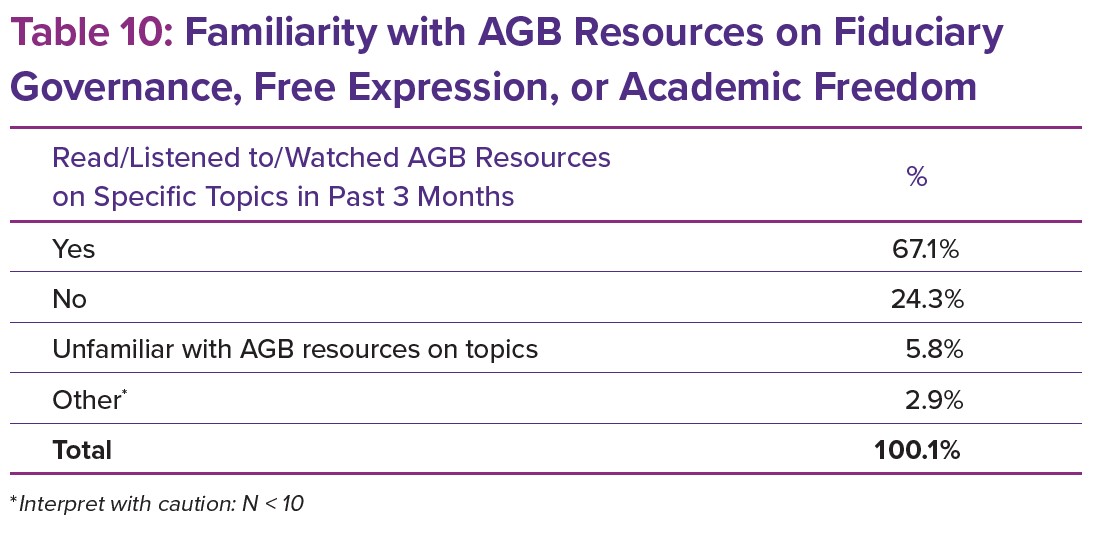
In the July 2025 survey, a question was added asking whether in the previous three months (in other words, after Mellon grant-related work had begun) respondents had read, listened to, or watched AGB resources on fiduciary governance, free expression, or academic freedom. The number of total responses was 173.
Just over 67 percent answered yes, though one respondent commented, “and they are not particularly useful” in combination with other free responses decrying AGB’s perceived “leftist” slant. (This issue will be discussed further in the section analyzing qualitative comments.) Another respondent commented, “Not always, so not a qualified yes.” Others noted they read AGB materials either concurrently with other organizations’ resources or “only as a secondary resource” (the primary resource[s] were left unspecified).
Attendance at AGB National Conference on Trusteeship and Mellon-Related Sessions
In the final April 2026 survey, respondents were asked if they had attended the 2026 AGB National Conference on Trusteeship. Fewer than 10 had (roughly 1 percent of overall survey respondents).
This is not unusual, given that AGB has, according to May 2026 website statistics, roughly 40,000 individual members. However, those who had attended the conference all attended sessions related to the Mellon grant’s work on academic freedom, free speech, and board independence. When asked to share comments regarding those sessions, only one of the three replied. The comment was, “Mellon Fdn [sic] is unfortunately not a trusted source unless it is paired with other organizations and most of your presentations are also not ‘neutral.’” The same respondent commented later in free responses, “AGB is incredibly left-leaning and NOT [sic] to be seen as a fair voice in this area. [S]imilarly, it is clear that the Mellon Fdn [sic] has a clear left-wing bias. If you REALLY [sic] want to help, you will also find center & [sic] center-right partners.” Although this was an uncommon opinion regarding the Mellon Foundation, it is noted to acknowledge the time the commenter took both to attend sessions and comment.
Qualitative Comments
Three areas for free responses were provided in the May 2026 survey, with two prompts:
- “Do you have other thoughts you would like to share on the topics of free expression or academic freedom?”
- “What can AGB do to help you and your institution become more confident fulfilling fiduciary duties when addressing campus free speech and academic freedom?”
It also included an invitation to provide a name and the email address used for AGB correspondence if interested in participating in future focus groups on the topics. Otherwise, the surveys were anonymous; IP address tracking was turned off.
There were 96 separate comments responding to the “other thoughts” question (a 36 percent response rate), and 92 separate comments responding to the “What can AGB do to help” question (a 35 percent response rate). Many comments were quite nuanced. For example, one respondent stated:
It is important to delineate that academic freedom is about the job and the freedom to determine course content, design, delivery, research, and scholarly activity within professionally accepted norms. Academic freedom is sometimes used as an umbrella term for free expression, but sometimes what counts as free expression is not relevant for the protections one needs to do their job as an academic.
On a related note, another respondent commented, “As long as expression is not seriously endangering members of the academic community, it should be allowed to the fullest extent of the Constitution.”
However, this was not a universally held view, as another respondent stated: “Free expression is essential and depends on civil discourse of all parties involved. Harassment, dis inviting [sic] speakers, occupying buildings illegally, etc., is not to be tolerated.”
Still another respondent stated in part, “Returning the academic to the political middle would reduce criticisms from outside the Academy…. Despite my concerns with the recent history of higher education’s approaches to free speech, the academic has a responsibility to defend free speech principles at all costs. Without academic freedom, there is no university.”
Other comments, ranging from “There should be no significant restriction on free speech based on ideology,” and “There are no circumstances in which restricting speech is acceptable,” to “There are limits to everything, speech included,” and “I wonder if the concept of academic freedom should always be linked to academic responsibility. What is freedom without responsibility?” were illustrative of divided thoughts on the topic.
Some respondents commented on what they saw as the relationship of fiduciary duty to the concepts of academic freedom and free speech. One wrote, “I believe the primary focus of a board is to uphold its strategic and fiduciary responsibilities, and while maintaining a focus on academic freedom and free speech is a given, it isn’t the board’s primary focus.” A related suggestion was, “Offer more clarity on how AGB connects fulfilling fiduciary duties with free speech and academic freedom. This issue is particularly gray and difficult to navigate with regard to academic program reductions.”
Another commented at length:
It is clear that the definition of these words [academic freedom and free speech] is no longer a shared definition in the academic environment. Another term that gets “tangled up” in this discussion is “shared governance.” The reality is that the governance system must be able to respond quickly to critical situations, and that boards must act as fiduciaries. There are pressures from many on campus to behave in ways that appear to conflict with fiduciary responses. This is particularly true when working on preserving the financial sustainability of the organization. The fiduciary point of view is not always well-represented and should be presented in discussions.
In other comments, some respondents criticized both AGB and the Mellon Foundation for having a “left-wing bias.” On the opposite side of the coin, other comments encouraged the association to “Find a way. Speak out. Way too quiet,” and “Speak up more, keep leading. Keep offering resources.” Yet another comment criticized AGB for “mealy-mouthed” guidance. This range offers a sampling of different opinions across the membership.
When asked what AGB could do to help respondents and their institutions, systems, or foundations become more confident in fulfilling fiduciary duties when addressing campus free speech and academic freedom, the responses partly mirrored those of the Govern NOW Academy participants and included:
- Continued information flow
- “Continue to publish/update reliable and timely info of what is happening on campuses throughout the U.S. Be our eyes and ears throughout the country.”
- “Continued dialogue and presentations on the topic. Keep the topic alive.”
- “Document spectrum of approaches among institutions on addressing issue.”
- Case studies/tabletop exercises
- “Construct case studies out of experiences like Columbia, aligned with key questions that can serve as discussions by boards. It would be an opportunity to explore the pros and cons of such actions, and more importantly, invite the question of ‘what if this were us?'”
- “Case studies, and perhaps tabletop exercises our board can conduct during a retreat, would be helpful too.”
- “How about some tabletop exercises for the board to discuss these issues in a real world [sic] type of way. Where do you draw lines etc. Practical ways of dealing with the faculty on these issues….”
Other suggestions included sample policies, examples of best practices, checklists, free webinars, forums, and local workshops. Some comments repeated the critique of AGB as being too “left-wing,” while others repeated the call for AGB to “Support, support, support—speak out for all campus free speech and academic freedom!”
The qualitative free responses as a whole provide rich insights into the complicated issues facing all the stakeholders who answered the survey—and the rest of higher education.
Leadership Academy Pre-Test and Post-Test Survey Results
The pre-test and post-test surveys were not matched by respondent because the pre-test (N = 26) was completed by more participants than the post-test (N = 18).
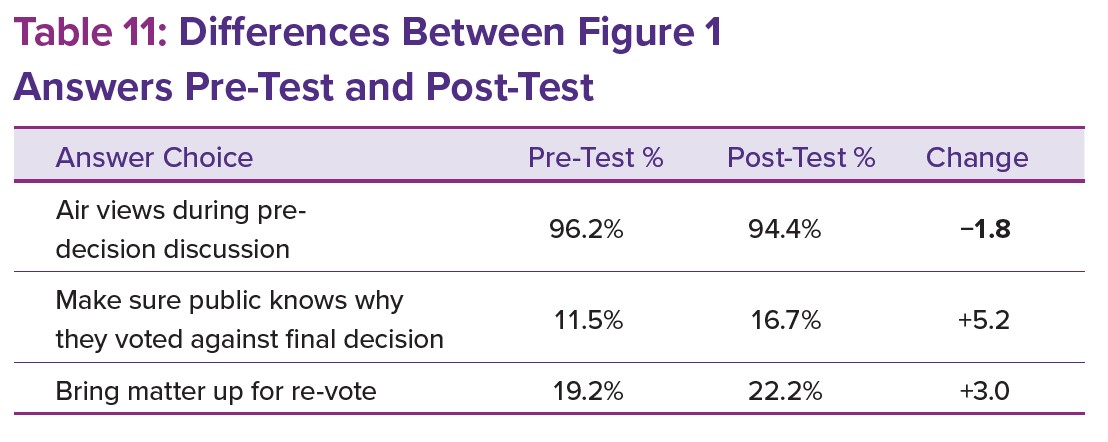
The first question, a true/false question asking if “Fiduciary duties legally apply to both individual board members and the board as a whole” (correct answer “true”) was answered correctly by 96.2 percent of participants in the pre-test and 88.9 percent in the post-test. Although incorrect answers therefore mathematically increased by 7.3 percentage points, it should be noted that the combination of only one or two incorrect answers in both the pre-test and post-test and the lower number of post-test takers skewed this result.
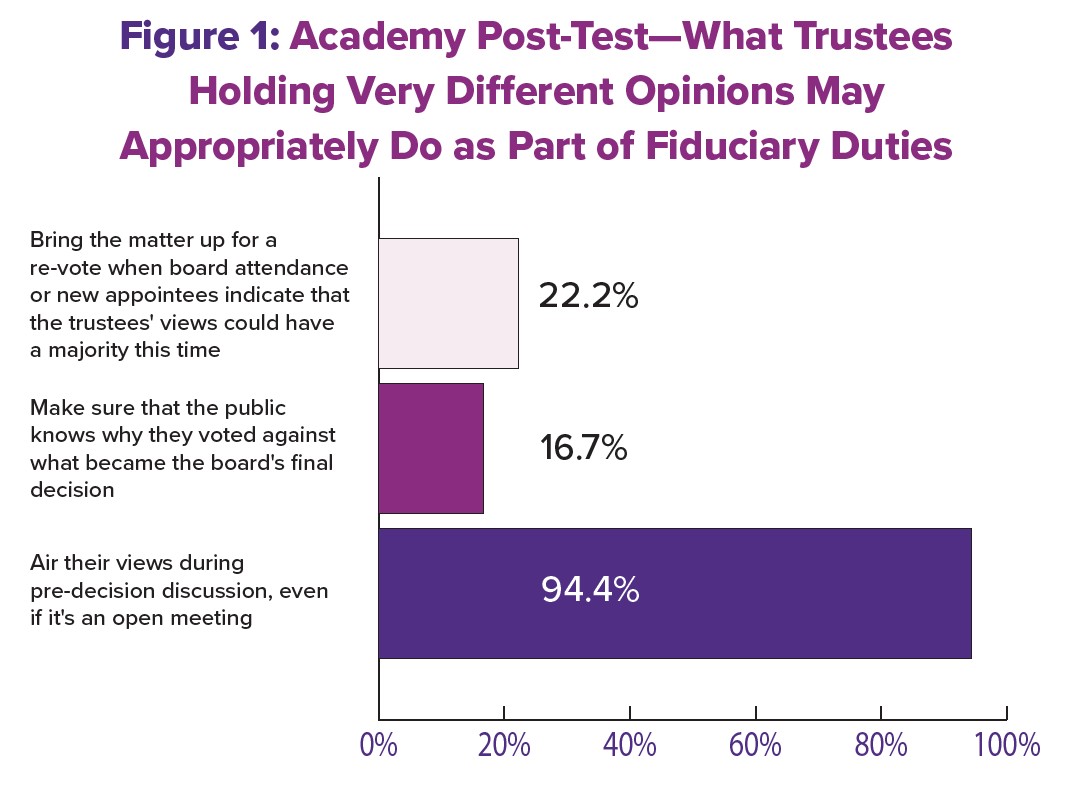
An interesting change occurred in responses to the second question, which was a multiple-choice question focusing on what trustees holding very different opinions (topic left deliberately unspecified) from many of their colleagues may appropriately do in line with principles of trusteeship. The correct answers were “Air their views during pre-decision discussion, even if it’s an open meeting” and “Bring the matter up for a re-vote when board attendance or new appointees indicate that the trustees’ views could have a majority this time.”
However, in the post-test, the incorrect answer of “Make sure the public knows why they voted against the final decision” increased by 5.2 percentage points, from 11.5 to 16.7 percent. The reason for this is unclear. The prompt did not clearly indicate that it was referring to post-decision commentary. Many board members do explain their intended votes during board discussions, but to do so after the decision is final undermines the appearance of board unity about the final decision. The program’s emphasis on trustee engagement and initiative, along with board transparency, might have affected how participants read the option.
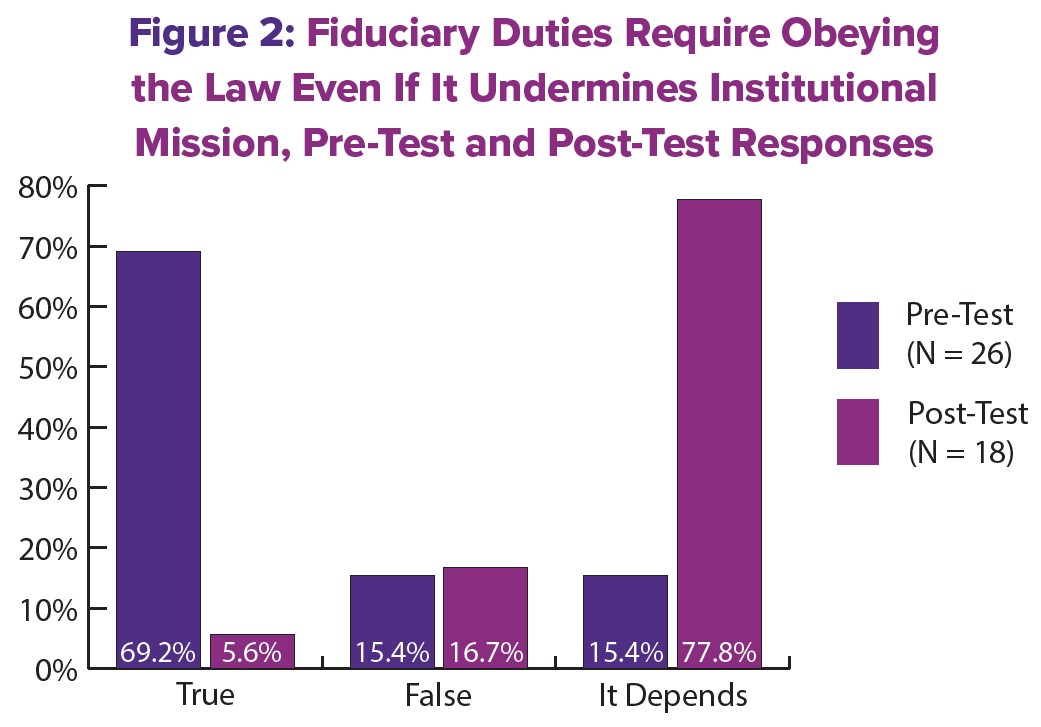
Comparing pre-test and post-test answers to the third multiple-choice question, “A trustee’s fiduciary duties of loyalty and obedience require them to obey the law or legal order, even if doing so will undermine the institution’s ability to fulfill its mission,” showed the effects of the Academy curriculum most clearly.
In the post-test, 77.8 percent picked the correct answer (“It depends”) to the third multiple-choice question, “A trustee’s fiduciary duties of loyalty and obedience require them to obey the law or legal order, even if doing so will undermine the institution’s ability to fulfill its mission.” This was an increase of 62.4 percentage points.
In the pre-test, only 15.4 percent selected the correct answer choice, “It depends,” rather than “True” or “False.” However, in the post-test, 77.8 percent picked the correct answer—an increase of 62.4 percentage points. See Figure 2 for details. This result illustrates the need for trustees and presidents to make sense of the unprecedented conditions they face time after time that will shape the institutions they lead in an unknowable future.
Many people “automatically” obey the law, especially if they are seeking to perform a fiduciary duty. When the ability to fulfill the institution’s mission is at stake, closer scrutiny is highly justified. Is it a law or an executive order? Does it apply directly to us, without doubt? Do we have room to negotiate? Even routine assumptions may not apply in a volatile, uncertain, complex, and ambiguous time.
The fourth question offered respondents the chance to select multiple reasons why “Boards must be independent, not subject to undue influence.” Correct choices were “The institution needs the board’s support as a buffer against undue influence, not a conveyor of undue influence” and “Helping institutions discern how best to fulfill their mission now and for years to come requires that trustees listen to diverse perspectives but not cede their authority to others.” These options were selected respectively by 66.7 percent and 94.4 percent of respondents in the post-test.
However, in the post-test (though the number was under 5), an incorrect answer choice of “Outsiders have no business telling leaders what to do” was selected by 16.7 percent of respondents after not having been selected at all in the pre-test. See Table 12 for all changes from pre-test to post-test.
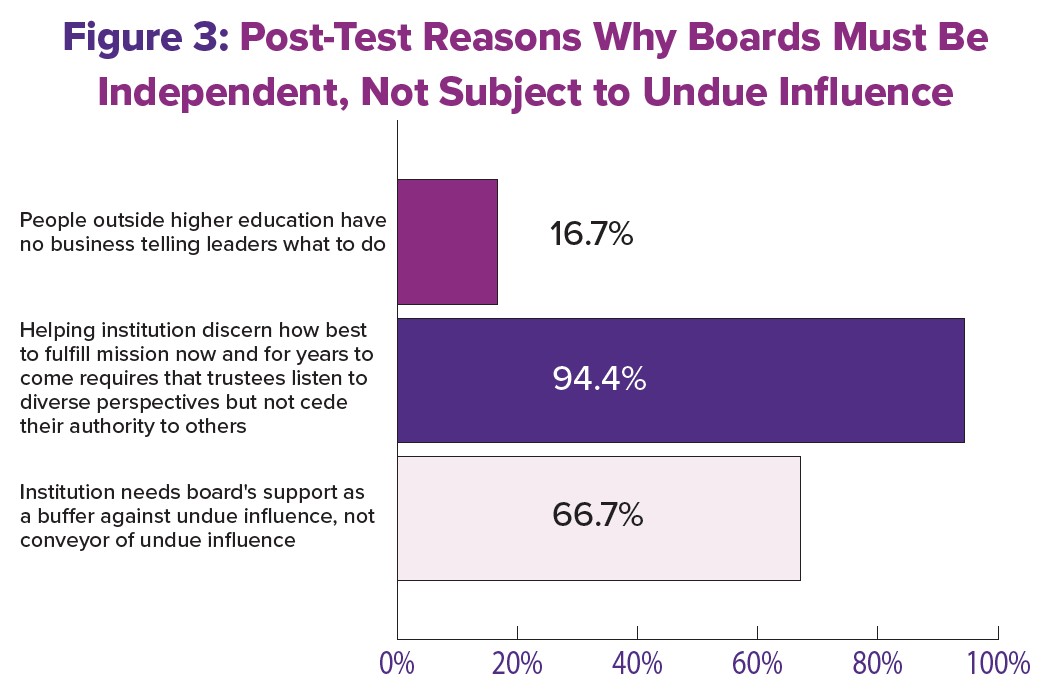
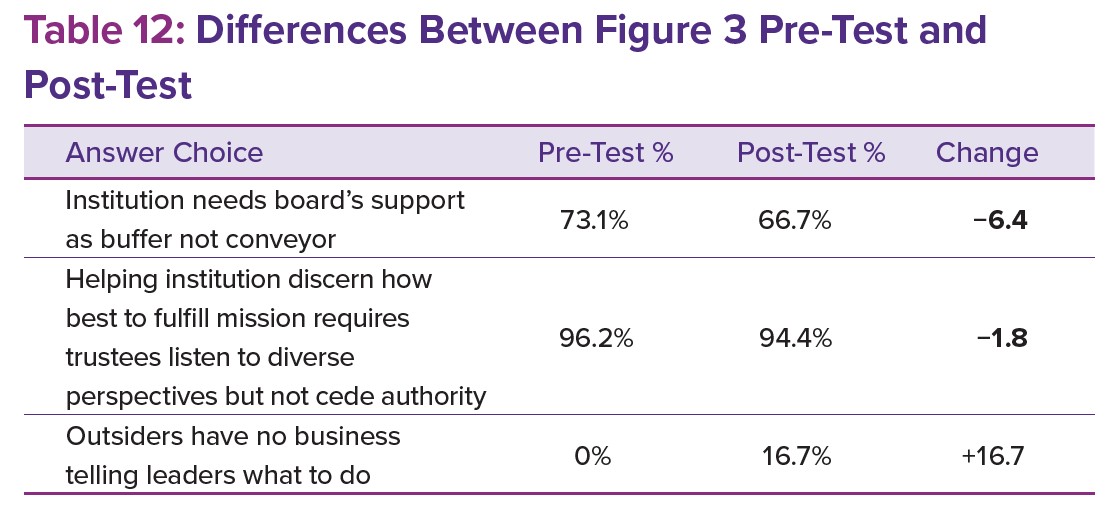
Differences between the pre-test and post-test overall (note different numbers of respondents influence results, and the handful [fewer than five respondents] choosing the option “Outsiders have no business telling leaders what to do”) might reflect the Academy’s emphasis on the board assuming and fulfilling its fiduciary responsibilities to protect the institution against harm. Best practice continues to support seeking and considering responsible outside views.
The pre-test and post-test answer to the fifth question revealed an area of mixed results from the Academy. This question offered only a true/false option for “Good governance means being ready to step into an institutional crisis with expertise and sound management skills to advise and work with the president. That’s what ‘support the president’ means: stepping up with hands-on assistance.”
The correct answer was false, as signaled by “management skills” and “hands-on assistance.” This response was selected by 57.7 percent of pre-test participants and 66.7 percent of post-test participants—a gain of 9.0 percentage points. However, 33.3 percent of post-test participants still answered incorrectly. This indicates some need for additional education on the appropriate governance role of trustees during an institutional crisis.
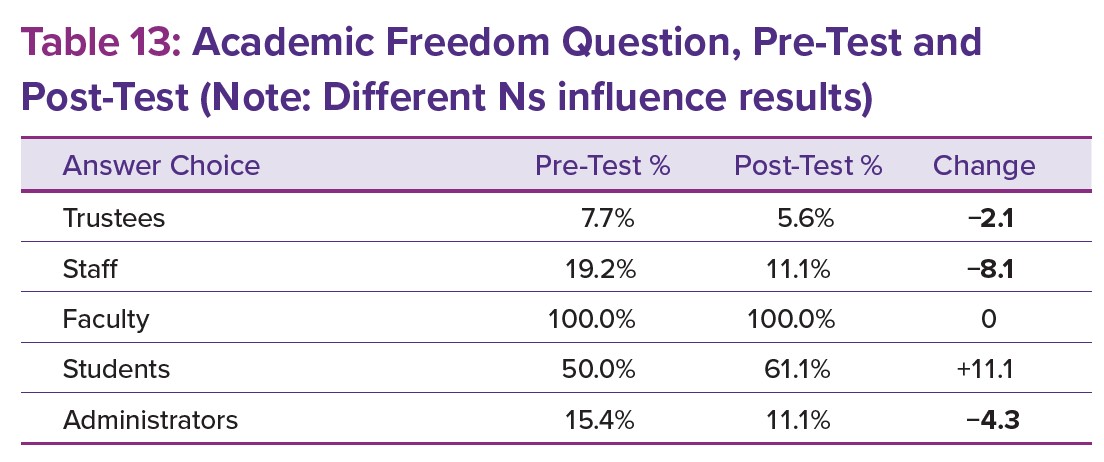
Another area of mixed results occurred in the sixth question, which allowed participants to select multiple answers to the question “Who has academic freedom?” The only correct choice was “faculty.” While fewer than five participants chose other individuals (trustees, staff, students, and administrators), their selection in the post-test also indicates a need for additional education. (Note that some of participants’ free responses at the end of the post-test asked AGB to provide more content/education on academic freedom.) The increase in “students” from 50.0 percent in pre-test to 61.1 percent in post-test, though influenced by small numbers of responses, indicates the need for additional education as well.
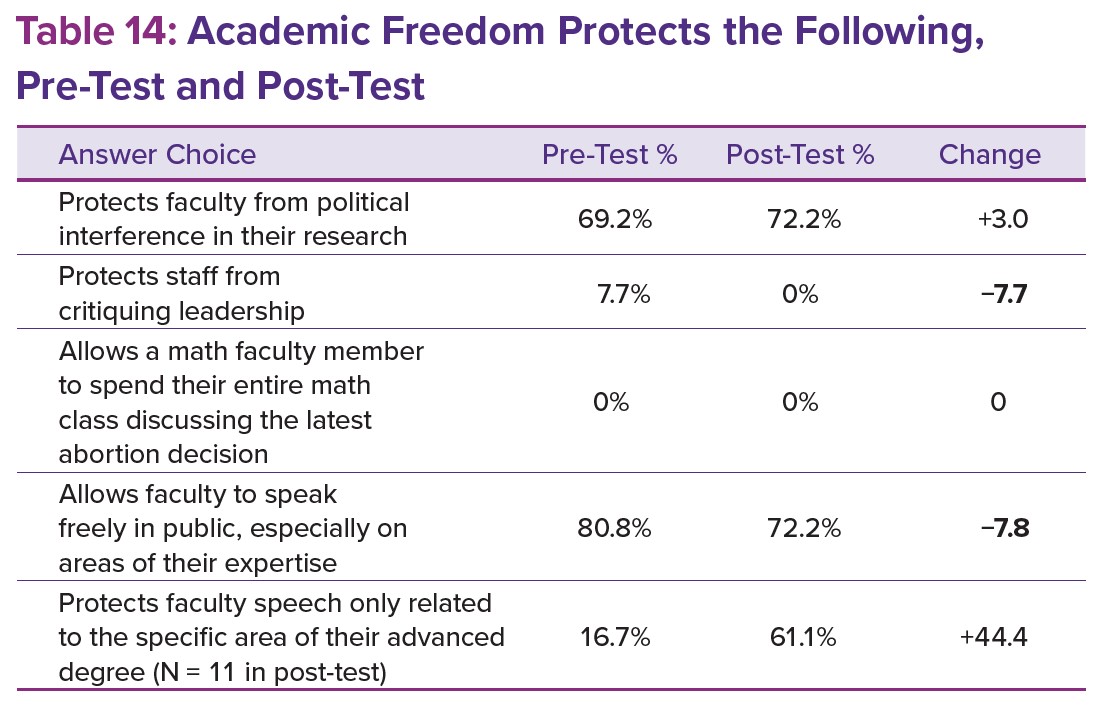
Another question on academic freedom immediately followed this one, instructing respondents to choose all correct answers to the statement, “Academic freedom protects the following:”
a) protects faculty from political interference in their research
b) protects staff from critiquing leadership
c) allows a math faculty member to spend their entire math class discussing the latest abortion decision
d) allows faculty to speak freely in public, especially on areas of their expertise
e) protects faculty speech only related to the specific area of their advanced degree.
The only correct answers were “a” and “d.”
As can be seen in Table 14, the changes between pre-test and post-test responses were mixed, not only because of different numbers of respondents. While there was a 3.0-percentage-point gain in correct answers to “a” and a 7.7-percentage-point decrease in incorrect answers to “b” (resulting in no respondents choosing this option in the post-test), the decrease in the correct answers to “d” and increase by 11 answers, or 44.4 percentage points, in incorrect answers to “e” is puzzling.
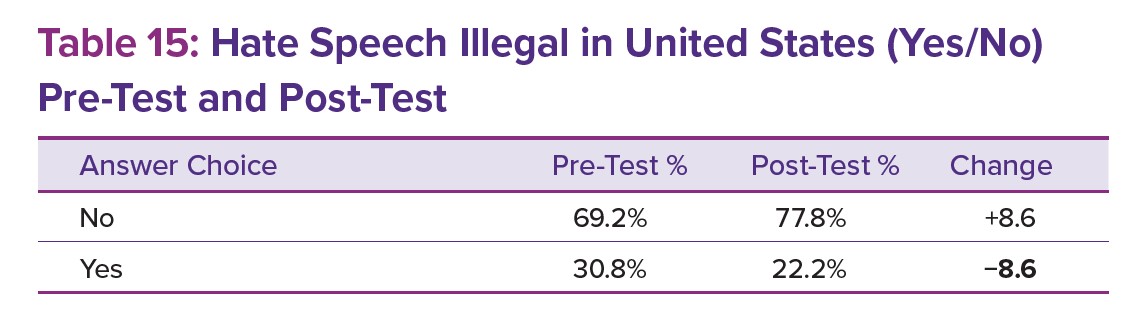
The next-to-last quantitative question, “Is hate speech illegal speech in the United States?” (offering a yes/no answer choice), showed improvement between the pre-test and post-test. The correct answer was “no.” As can be seen in Table 15, the percentage of respondents choosing the correct answer increased from 69.2 percent in the pre-test to 77.8 percent in the post-test. Also, the low number of incorrect answers (fewer than five) in the post-test affects the percentage displayed; in the pre-test, the number was fewer than 10. However, even a few respondents’ incorrect answers in the post-test shows need for improved understanding.
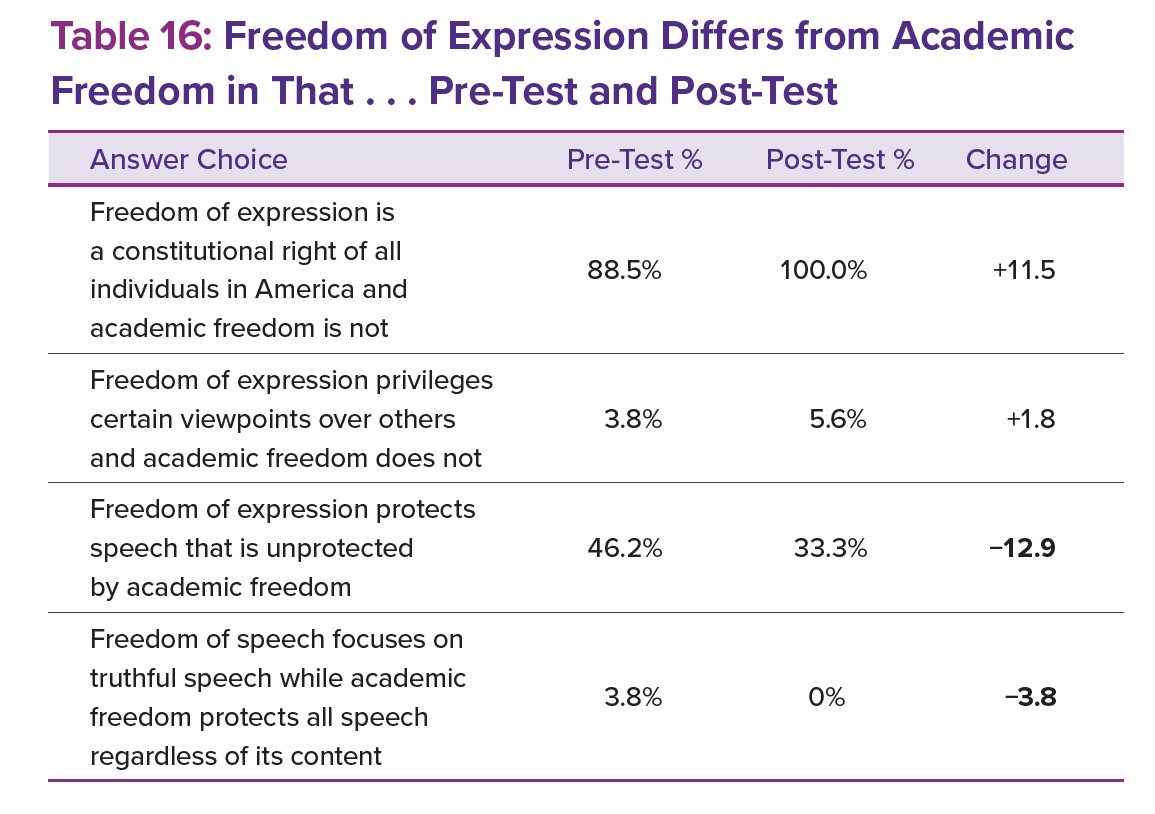
The final quantitative question addressed the difference between freedom of expression and academic freedom. Respondents were instructed to choose all correct answers from the following:
a) Freedom of expression is a constitutional right of all individuals in America and academic freedom is not.
b) Freedom of expression privileges certain viewpoints over others and academic freedom does not.
c) Freedom of expression protects speech that is unprotected by academic freedom.
d) Freedom of speech focuses on truthful speech while academic freedom protects all speech regardless of its content.
Only “a” and “c” were correct.
Again, the data were mixed between the pre-test and post-test, even allowing for different numbers of respondents influencing the results. While those selecting the correct “a” choice increased from 88.5 percent in the pre-test to 100.0 percent in the post-test (an increase of 11.5 percentage points), those selecting the correct “c” choice decreased from 46.2 percent to 33.3 percent (a decrease of 12.9 percentage points). Those selecting the incorrect “b” choice increased from 3.8 to 5.6 percent, but those selecting the incorrect “d” choice went from 3.8 percent to none.
Academy Pre-Test and Post-Test Qualitative Responses
Pre-Test Survey Qualitative Responses
The pre-test survey simply asked, “What do you most want to know about in the Govern NOW Leadership Academy?”
There were 20 responses, ranging from highly concrete (using words such as “tools” and “practical skills”) to more nuanced (using words such as “culture” and “constructive dialogue”). Some excerpts include:
- “I want to come away with some sense as to how to advise our board in the current climate. Is it a heroic charge or defensive survival, or something in between [sic]?”
- “I’m most interested in practical guidance on how boards exercise sound judgment during moments of controversy or crisis—balancing fiduciary responsibility, academic freedom, public accountability, and presidential support without crossing into management.”
- “How to square intelligent, clearly stated and explained, and unobjectionable AGB best practice guidelines with a far, far, messier lived reality, especially in public universities…”
- “How boards can effectively govern their institutions and fulfill their fiduciary duties while dealing with undue political pressure from state and/or federal government entities—especially when the state and federal demands may be in conflict with one another.”
- “From a practical skills level, I would like to know how to ask the right questions for strategic oversight, how to assess institutional performance, and how to support leadership appropriately while avoiding micromanagement. I would like to know what tools exist for evaluating policies, budgets, and strategic plans through a governance lens.”
- “Best practices and proper governance mechanics for navigating tensions among board independence and free expression. … I’d also love to further hone governance boundaries of when boards should engage (and how deeply) vs. relying on the administration to run with things….”
Post-Test Survey Qualitative Responses
The post-test asked three free response questions. A follow-up to the pre-test question, “What do you still want to know about these topics?” yielded the following categories across 11 responses:
- Case studies/tabletop exercises
- “Examples of scenarios and responses written out and not theoretical.”
- “I am interested in more case-based examples of how boards, especially at private institutions, have successfully managed the topics discussed and what other aspects we should prepare for.”
- “I’d be interested in learning how I could conduct tabletop scenario planning with members of the board to increase their awareness and their understanding of their duties.”
- More nuanced discussion of freedom of speech and academic freedom
- “I want to lean in more on freedom of expression.”
- “I think I’d want to spend a little more time on the concept of academic freedom and its relation to and comparison with freedom of speech.”
- “More conversation about the nuances of academic freedom. The overlap of free speech and academic freedom is very nuanced. … Viewpoint diversity, how it shows up in the classroom and how it shapes students and how they problem-solve with one another is also something.”
- Dealing with current environment
- “How to respond when Board [sic] leadership adopts a stance of ‘see no evil’ passivity.”
- “Like to continue to have conversations about how to respond to state and federal legislation that is being proposed or passed that are [sic] in conflict with institutional values.”
Two questions were asked about the Academy itself to help gauge its effectiveness. The first was “Has the Leadership Academy led you to feel better prepared to help your institution, system, or foundation board deal with the rapidly emerging new landscape for higher education?”
The 15 responses were overwhelmingly positive, including the following:
- “100% I feel ready to be more proactive and engage in constant governance reviews while also putting together more crisis management plans given the environment and what’s to come over time.”
- “Absolutely! Govern NOW has given actionable frameworks to handle political intrusion and better protect institutional autonomy. I find myself constantly sharing with my colleagues on the board some of the lessons and discussions from our group.”
- “Absolutely. … I have immediately put to use what I’ve learned from the Academy and find that I’m able to govern with much greater confidence, as well as bring this knowledge and best practices [sic] back to my institution.”
- “Yes, helped me in framing critical issues to bring back to the board for discussion. I particularly liked the scenario planning.”
- “Yes. This experience has strengthened my understanding of governance, fiduciary responsibilities, and especially the difference between academic freedom and freedom of speech. It also raised questions for me that I hadn’t thought of as a board member.”
The final qualitative question was “What do you want us to know about the Leadership Academy experience?”
There were 13 responses, broken down into the following categories:
- Gratitude for AGB running the Academy/requests that it continue
- “… I found myself being challenged in a way that I feel has made me a better leader and regent within my system. I am incredibly grateful to have been given the opportunity to participate in this program. Thank you, truly, for the investment in me.”
- “I am very grateful and hoping it continues as this is a really great experience for new and experienced board members.”
- “I think this should be required for every board member.”
- “The Leadership Academy experience was absolutely invaluable as it has significantly improved my confidence and my ability to serve as a trustee and executive committee member at my institution. I am incredibly grateful for this opportunity and have been using what I’ve learned in every meeting I’ve had with my institution since I started. The Leadership Academy has been a leadership accelerant for myself and has unlocked more of what I’m able to contribute to my institution. I wish that my entire Board [sic] could go through this experience and I am interested in bringing AGB to my institution for some sort of formalized training so that more of my Board [sic] can be exposed to all the greater knowledge and resources from AGB.”
- Specific suggestions for future versions of the Academy
- “… I would have liked opportunities to get together with cohort members outside of the 4 sessions to discuss topics more in depth and to network and learn from one another. I understand this may not be feasible….”
- “… One recommendation for future opportunity—consider using an LMS course shell to manage the module content, provide opportunity for internal (private) group discussions amongst the cohort during and after the experience, and serve as a repository for later reference.”
- Other comments
- “All the session[s] were well planned out and used the time wisely. Appreciated being able to interact with other trustees from a variety of institution types.”
- “I appreciated the focus on real-world application and the opportunity to engage with colleagues across institutions especially during the AGB conference. …”
- “Discussing the various scenarios for each module was one of the most helpful portions of the experience.”
- “Case studies and peer to peer [sic] networking were incredibly helpful to me.”
- “I really enjoyed the small groups and scenarios. I thought this was a good way to apply the readings.”
- “It was very well planned and managed.”
- “… It is important to continue engaging in discussions about diversity, equity, inclusion, belonging, and access within the context of their essential role in higher education. There remains a need for greater clarity and shared understanding of these terms—particularly equity, inclusion, and belonging—among members. These concepts are critical to advancing the university’s mission, responding to the current moment, preparing students for leadership and workforce readiness, and ensuring the long-term sustainability of higher education.”
Conclusion
The Govern NOW Leadership Academy equipped a diverse cohort of board members, presidents, and board professionals to help their institutions, systems, and foundations better govern with clarity in a highly pressurized political environment.
As a result of the Academy, participants governed differently. Several stepped into expanded fiduciary roles on their boards, led executive committee efforts to modernize governance practices, and introduced Academy frameworks into their own meeting agendas. Participants increased their engagement with AGB resources and services, a practical signal that Govern NOW helped them understand how to find solutions to their governance challenges.
The Academy also helped bring AGB’s extensive resources on board independence, academic freedom, and free speech to the attention of all members. The Govern NOW theme reverberated beyond the Academy cohort at the National Conference on Trusteeship, the Foundation Leadership Forum, the Board Professionals Conference, and an event at the National Press Club. Since the conference, consultants working with non-Academy boards have reported a measurably higher baseline awareness of fiduciary duty, board independence, and institutional autonomy than in past years, and they credit Govern NOW programming for the shift.
Cross-institutional networks formed and held. Participants reported sustained peer connections across public, private, large, and small institutions, and described the cohort variety as central to stretching their governance thinking.
In addition to strong statements from Academy participants about what they learned, knowledge gains were measurable. Pre-test and post-test results showed strong gains on the most consequential fiduciary question (the share answering correctly that the duty to obey law is not automatic and immediate in every case rose from 15.4 percent to 77.8 percent) and on the constitutional-status distinction between freedom of expression and academic freedom.
This research indicates that board members and board professionals need and want to better understand some basic elements of their work—fiduciary duties, academic freedom, free speech, and board independence. To most effectively navigate current conditions, board members and presidents would do well to invest as much in learning about good governance as they do about institutional challenges. The Govern NOW project strengthened AGB’s resources to help boards invest in good governance, making the resources more accessible for ongoing local board education, more specific to today’s unique challenges, and more hands-on to increase engagement.
“Peer insights across institution types underscored the importance of disciplined, values-anchored communication that frames every decision in terms of student success and stewardship of the public trust.”
Mackenzie Wilfong, executive director and secretary of the University of Oklahoma Board of Regents
Appendix: Leadership Academy and Membership Survey Instruments
AGB Govern NOW Leadership Academy Pre-Test
As part of your participation in the Govern NOW Leadership Academy, AGB and PEN America request that you complete a short pre-Academy survey regarding your knowledge of and opinions about board independence, academic freedom, and free expression. It should take you roughly 10 minutes to complete.
Your results will help guide the Academy faculty in shaping the upcoming virtual presentations and breakout groups. However, your individual responses remain confidential and will NOT be shared with other participants. Aggregated data may be used for AGB research purposes but no individuals will be identified in any AGB research report. [Note: AGB Research policy is not to identify survey respondents. In a separate process, Academy participants who chose to be quoted by name or institution consented in writing.]
Please complete and submit the survey by January 12, 2026 so that your answers can be incorporated into the January 16, 2026 initial session. Technical questions about the survey may be directed to research@agb.org. Please do NOT click through the survey to see the questions or the survey will automatically submit. [Secure URL to download blank survey PDF]
Thank you very much for your participation in the Govern NOW Leadership Academy!
Q1 Fiduciary duties legally apply to both individual board members and the board as a whole.
o True
o False
Q2 Trustees who hold opinions that are very different from many of their colleagues may appropriately (check all that apply):
☐ Air their views during pre-decision discussion, even if it’s an open meeting.
☐ Make sure that the public knows why they voted against what became the board’s final decision.
☐ Bring the matter up for a re-vote when board attendance or new appointees indicate that the trustees’ views could have a majority this time.
Q3 A trustee’s fiduciary duties of loyalty and obedience require them to obey the law or legal order, even if doing so will undermine the institution’s ability to fulfill its mission.
o True
o It depends
o False
Q4 Boards must be independent, not subject to undue influence, because (check all that apply):
☐ The institution needs the board’s support as a buffer against undue influence, not a conveyor of undue influence.
☐ Helping the institution discern how best to fulfill its mission now and for years to come requires that trustees listen to diverse perspectives but not cede their authority to others.
☐ People outside higher education have no business telling leaders what to do.
Q5 Good governance means being ready to step into an institutional crisis with expertise and sound management skills to advise and work with the president. That’s what “support the president” means: stepping up with hands-on assistance.
o True
o False
Q6 Who has academic freedom? (Choose all the correct answers.)
☐ Trustees
☐ Staff
☐ Faculty
☐ Students
☐ Administrators
Q7 Academic freedom protects the following (choose all the correct answers):
☐ Protects faculty from political interference in their research
☐ Protects staff from critiquing leadership
☐ Allows a math faculty member to spend their entire math class discussing the latest abortion decision
☐ Allows faculty to speak freely in public, especially on areas of their expertise
☐ Protects faculty speech only related to the specific area of their advanced degree
Q8 Is hate speech illegal speech in the United States?
o Yes
o No
Q9 Freedom of expression differs from academic freedom in that (choose all the correct answers):
☐ Freedom of expression is a constitutional right of all individuals in America and academic freedom is not.
☐ Freedom of expression privileges certain viewpoints over others and academic freedom does not.
☐ Freedom of expression protects speech that is unprotected by academic freedom.
☐ Freedom of expression focuses on truthful speech while academic freedom protects all speech regardless of its content.
Q10 What do you most want to know about in the Govern NOW Leadership Academy?
________________________________________________________________
________________________________________________________________
________________________________________________________________
________________________________________________________________
________________________________________________________________
This is the end of the pre-test. Once you click past this box, you will submit your pre-test and will not be able to change your responses.
You will be able to download a copy of your answers once you click past and submit the pre-test. If you have problems downloading or have other technical questions, please email research@agb.org. Thank you very much!
AGB Govern NOW Leadership Academy Post-Test
As part of your participation in the Govern NOW Leadership Academy, AGB and PEN America request that you complete a short post-Academy survey. It should take you roughly 10 minutes to complete.
Your results will help shape the research report presented to the Mellon Foundation and future AGB offerings on the topics of free speech, academic freedom, and freedom of expression. However, your individual responses remain confidential and will NOT be shared with other participants. Aggregated data may be used for AGB research purposes but no individuals will be identified in any AGB research report. [Note: AGB Research policy is not to identify survey respondents. In a separate process, Academy participants who chose to be quoted by name or institution consented in writing.]
Please complete and submit the survey by April 13, 2026 so that your answers can be incorporated into the final research report. Technical questions about the survey may be directed to research@agb.org. Please do NOT click through the survey to see the questions or the survey will automatically submit. [Secure URL to download blank survey PDF]
Thank you very much for your participation in the Govern NOW Leadership Academy!
Q1 Fiduciary duties legally apply to both individual board members and the board as a whole.
o True
o False
Q2 Trustees who hold opinions that are very different from many of their colleagues may appropriately (check all that apply):
☐ Air their views during pre-decision discussion, even if it’s an open meeting.
☐ Make sure that the public knows why they voted against what became the board’s final decision.
☐ Bring the matter up for a re-vote when board attendance or new appointees indicate that the trustees’ views could have a majority this time.
Q3 A trustee’s fiduciary duties of loyalty and obedience require them to obey the law or legal order, even if doing so will undermine the institution’s ability to fulfill its mission.
o True
o It depends
o False
Q4 Boards must be independent, not subject to undue influence, because (check all that apply):
☐ The institution needs the board’s support as a buffer against undue influence, not a conveyor of undue influence.
☐ Helping the institution discern how best to fulfill its mission now and for years to come requires that trustees listen to diverse perspectives but not cede their authority to others.
☐ People outside higher education have no business telling leaders what to do.
Q5 Good governance means being ready to step into an institutional crisis with expertise and sound management skills to advise and work with the president. That’s what “support the president” means: stepping up with hands-on assistance.
o True
o False
Q6 Who has academic freedom? (Choose all the correct answers.)
☐ Trustees
☐ Staff
☐ Faculty
☐ Students
☐ Administrators
Q7 Academic freedom protects the following (choose all the correct answers):
☐ Protects faculty from political interference in their research
☐ Protects staff from critiquing leadership
☐ Allows a math faculty member to spend their entire math class discussing the latest abortion decision
☐ Allows faculty to speak freely in public, especially on areas of their expertise
☐ Protects faculty speech only related to the specific area of their advanced degree
Q8 Is hate speech illegal speech in the United States?
o Yes
o No
Q9 Freedom of expression differs from academic freedom in that (choose all the correct answers):
☐ Freedom of expression is a constitutional right of all individuals in America and academic freedom is not
☐ Freedom of expression privileges certain viewpoints over others and academic freedom does not.
☐ Freedom of expression protects speech that is unprotected by academic freedom.
☐ Freedom of expression focuses on truthful speech while academic freedom protects all speech regardless of its content.
Q10 Has the Leadership Academy led you to feel better prepared to help your institution, system, or foundation board deal with the rapidly emerging new landscape for higher education?
________________________________________________________________
________________________________________________________________
________________________________________________________________
________________________________________________________________
________________________________________________________________
Q11 What do you still want to know about these topics?
________________________________________________________________
________________________________________________________________
________________________________________________________________
________________________________________________________________
________________________________________________________________
Q12 What do you want us to know about the Leadership Academy experience?
________________________________________________________________
________________________________________________________________
________________________________________________________________
________________________________________________________________
________________________________________________________________
This is the end of the post-Academy survey. Once you click past this box, you will submit the survey and will not be able to change your responses.
You will be able to download a copy of your answers once you click past and submit the survey. If you have problems downloading or have other technical questions, please email research@agb.org. Thank you very much!
AGB Membership Survey
The following is an example of one of the iterations of the survey sent to all AGB members.
Fiduciary Governance, Academic Freedom, and Free Speech Survey—April 2026
As part of the Mellon Foundation grant AGB has received about fiduciary governance in support of academic freedom and free speech in higher education (see AGB press release), we are asking for assistance with a short, anonymous survey regarding fiduciary governance, academic expression and free speech. If you would like to participate in future discussions, you may fill out your name and the email address you use for AGB correspondence at the end of the survey.
Please do not click through the survey to see the questions, as this will automatically submit the survey.
Questions regarding the survey can be directed to research@agb.org.
Thank you very much!
Q1 What sector of higher education do you represent?
o Independent (nonprofit)
o Independent (for-profit)
o Public institution (non-system)
o Public institution (within a system)
o Public system office
o Institutionally related foundation (IRF)
o International institution
o Other __________________________________________________
Q1a Is your institution (or the institution your foundation serves) primarily:
o 2-year (community/technical college)
o 4-year (college or university, with or without graduate programs)
o Graduate institution ONLY (no undergraduate programs at all)
Q1b Please check off any/all that apply to your institution:
☐ HBCU
☐ Minority-Serving Institution (MSI) status
☐ Religiously affiliated institution
☐ Single-sex institution
☐ Special-focus institution (e.g., health care only)
Q1c What role best describes your relationship with your institution, system, or foundation? (This will only be used to develop appropriate material for different audiences.)
o Board chair
o Board member
o Board professional
o President/CEO
o Other (please specify) __________________________________________________
Q2 How confident are you in your knowledge of your institution or system’s free speech policies? If you are with an affiliated foundation, how confident are you in your knowledge of your partner institution’s free speech policies?
o Very confident
o Somewhat confident
o Neutral
o Less than confident
o Not at all confident
Q3 How confident are you in understanding the principle of academic freedom?
o Very confident
o Somewhat confident
o Neutral
o Less than confident
o Not at all confident
Q4 Broadly speaking, under what conditions are restrictions to free expression or academic freedom justified? (Please select all that apply.)
☐ During instances of potential harassment or discrimination
☐ When there are impacts on sense of belonging
☐ Under state or federal law
☐ During extensive negative media coverage
☐ When they conflict with high-profile events or activities (e.g., commencement)
☐ When campus safety is in question
☐ When mis- or disinformation is being spread
☐ To comply with funding opportunities
Q5 Change and uncertainty permeate the higher education environment this year. How confident are you in your board’s ability to fulfill its fiduciary duties in these circumstances?
o Very confident
o Somewhat confident
o Neutral
o Less than confident
o Not at all confident
Q6 Change and uncertainty permeate the higher education environment this year. How confident are you in your own ability to fulfill your fiduciary duties in these circumstances?
o Very confident
o Somewhat confident
o Neutral
o Less than confident
o Not at all confident
Q7 In the past three months, have you read/listened to/watched AGB resources on fiduciary governance, free expression, or academic freedom?
o Yes
o No
o Unfamiliar with AGB resources on fiduciary governance, free expression, or academic freedom
o Other (please specify) __________________________________________________
Q8 Do you have other thoughts you would like to share on the topics of fiduciary governance, free expression, or academic freedom?
________________________________________________________________
________________________________________________________________
________________________________________________________________
________________________________________________________________
________________________________________________________________
Q9 What can AGB do to help you and your institution, system, or foundation become more confident fulfilling fiduciary duties when addressing campus free speech and academic freedom?
________________________________________________________________
________________________________________________________________
________________________________________________________________
________________________________________________________________
________________________________________________________________
Q10 Did you attend the 2026 AGB National Conference on Trusteeship?
o Yes
o No
Q10a If you attended the 2026 AGB National Conference on Trusteeship, did you attend any concurrent or plenary sessions related to the Mellon Foundation grant on academic freedom, free speech, and board independence?
o Yes
o No
Q10b Is there anything else you would like AGB to know regarding the concurrent or plenary sessions related to the Mellon Foundation grant on academic freedom, free speech, and board independence?
________________________________________________________________
________________________________________________________________
________________________________________________________________
________________________________________________________________
________________________________________________________________
Q11 If you would like to participate in future discussion opportunities on these topics, please provide your name and email address you use for AGB correspondence. Otherwise, your survey will be anonymous.
________________________________________________________________
________________________________________________________________
________________________________________________________________
________________________________________________________________
“Govern NOW has given actionable frameworks to handle political intrusion and better protect institutional autonomy. I find myself constantly sharing with my colleagues on the board some of the lessons and discussions from our group.”
Academy Participant
Artificial Intelligence tools assisted in the development of portions of this report. Quotations attributed to individuals identified by name or institution are reproduced with their permission.
1. “PEN America Warns of Expanding Web of Control as Politicians Escalate Campaign to Censor U.S. Colleges and Universities,” PEN America, January 15, 2026, https://pen.org/press-release/pen-america-warns-of-expanding-web-of-control-as-politicians-escalate-campaign-to-censor-u-s-colleges-and-universities/.
2. Lindsay Ellis, Jack Stripling, and Dan Bauman, “Partisan College Governance: 5 Takeaways,” The Chronicle of Higher Education, September 25, 2020, https://www.chronicle.com/article/partisan-college-governance-5-takeaways.
3. Policies, Practices, and Composition of Governing Boards of Colleges, Universities, and Institutionally Related Foundations 2021 (AGB, 2021), Table 48, 33.
4. Ashley P. Finley and Hans-Jörg Tiede, Academic Freedom and Civil Discourse in Higher Education: A National Study of Faculty Attitudes and Perceptions (American Association of Colleges and Universities, 2025), Figures 2–9, https://dgmg81phhvh63.cloudfront.net/content/user-photos/AACU_AcademicFreedomReport_010825_PUBLISHED.pdf.
5. Julia Napier and Danielle Melidona, “2025 Fall Term Pulse Point Survey,” American Council on Education, 3, https://www.acenet.edu/Documents/Pulse-Point-Survey-Fall2025.pdf.
6. The quadrants represented the Northeast, Northwest, Southeast, and Southwest regions of the United States. Each quadrant included approximately a quarter of the total landmass of the United States.
7. See Appendix for survey instruments.
8. M.A. Rauh, “The trustees of higher education: A survey report,” AGB Reports 11, no. 5 (January 1969).
RELATED RESOURCES

Tools and Toolkits
How to Govern for Institutional Autonomy

Trusteeship Magazine Article
Preserving Academic Freedom in Turbulent Times