
 Chat with AGB Board Bot
Listen to this article on the AGB Soundboard App

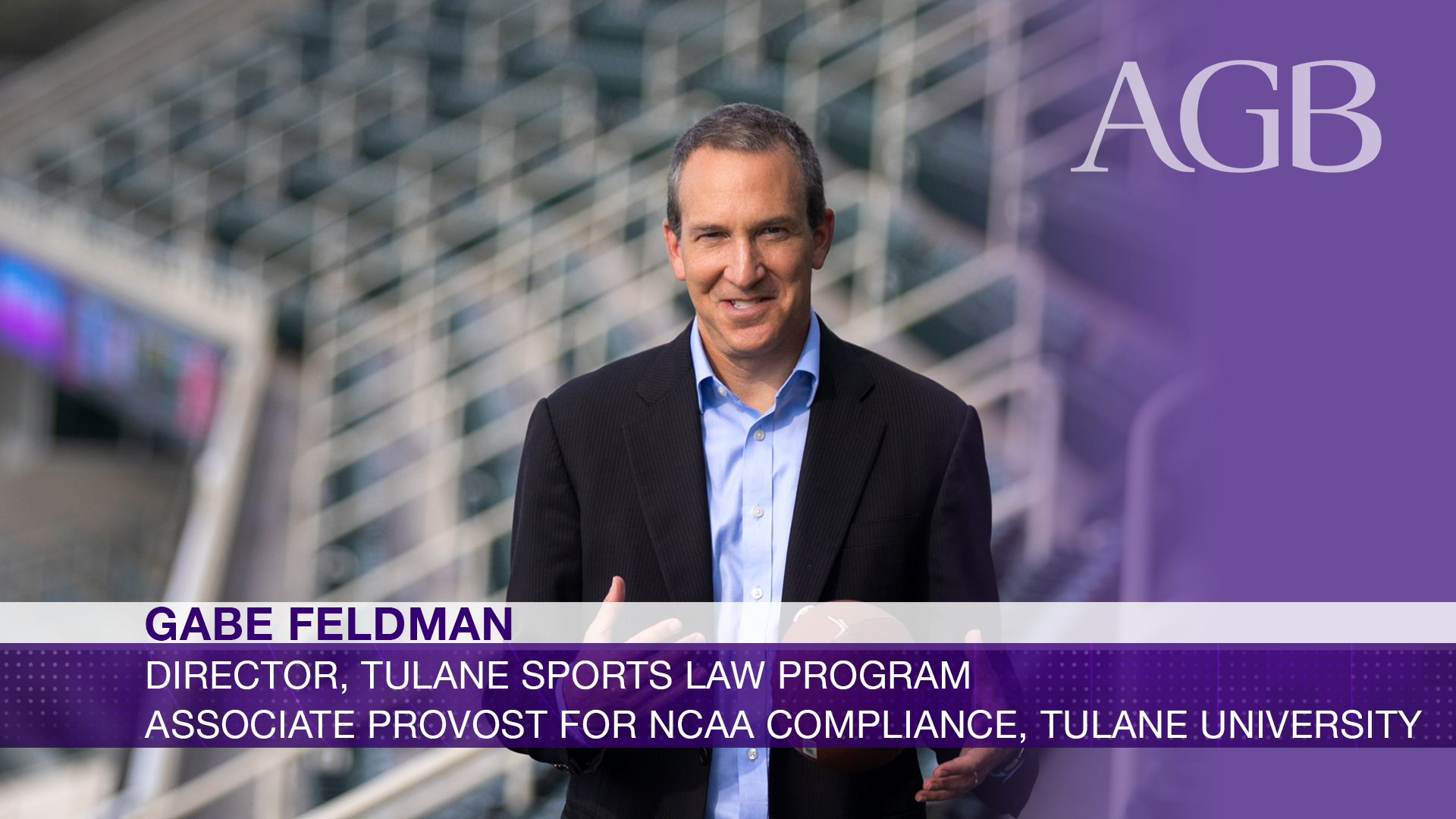
Photo courtesy of Gabe Feldman
An interview with Gabe Feldman
Gabe Feldman, JD, director of the Tulane Sports Law Program and Tulane University’s associate provost for NCAA compliance, is one of the leading voices in the country in the growing field of sports law. He is the Sher Garner Professor of Sports Law and the Paul and Abram B. Barron Professor of Law, and the co-founder and co-director of the Tulane Center for Sport.
How can boards of trustees and campus presidents ensure the success of collegiate athletics in this new era at their institutions, regardless of size, division, or conference?
The overall analysis in my mind would be “what is success today? Or the next 20 years for your athletics program?” It may be different than what success was 20 years ago. And it’s up to schools to figure out what it means to be successful in athletics. And maybe that means being the best in a more academic-focused conference. Maybe that means looking at who is treating athletics like you do as part of the academic mission and less like a separate professional entity. Not that there’s anything wrong with that separate professional entity, but maybe it makes more sense to compete against those who are more academically aligned to you, more aligned in terms of your overall mission and your spending and your budget. Maybe we want to say we’re going to treat football as one thing and all of our other sports as another thing. Or maybe you just say, “Can we have a school of sport? Can we take the academic value that actually comes from playing a sport, from learning the plays, from reading the playbook, from studying film, from crunching the stats?” There’s an opportunity for some ambitious schools at any level to say, “Yeah, let’s see if we can better integrate athletics into academics and then try to compete for championship at that level.”
There needs to be an acknowledgement, particularly in football, that the disparity in spending is going to grow so large that you might be able to compete on any given Saturday. But to consistently win, I don’t know if that’s going to be realistic for more than the top 20 or 30 schools, because that’s been the case for the last 100 years. And that that gap is only going to potentially widen.
What steps can an institution take to ensure legal compliance of its athletics programs?
Rules are changing, sometimes on a daily basis, depending on how lawsuits are playing out and whether injunctions are granted or not. The question of whether that impacts only the students in that case, only the students in that jurisdiction, does it affect students nationally? Cases are being appealed, injunctions are being tried to be stopped and then restarted. And there is a lot of genuine uncertainty. There is a lot where it is not clear what the rules are. If it’s clear right now, it might not be clear in a week or a month. Every school that is involved in at least Division I athletics needs to be following or have someone for them following these daily events because they’ll get guidance from the conference and they’ll get guidance from the NCAA itself, but ultimately, each individual school has a right to decide within other areas of the law who they admit and what they want to pay.
On the institutional mission side, there’s a real opportunity here for schools to reset and say we can’t afford or choose not to afford to compete in this new environment because the costs are too high. That doesn’t mean sports are less of a priority, but you might need to prioritize it a different way or operationalize that priority in a different way. Things have changed so much that a school that’s been doing something for a hundred years has a reason to say, “we’re going to stop today.” And that reason is because of all these changes going on. It’s not only the legal compliance area but also figuring out when you make one move here, is the whole tower going to fall down because you started paying athletes, but did it raise Title IX issues? Did it raise potential employment issues? Are there tax issues? There are lots of issues that could be impacted by this.
It’s a real chance to have candid conversations about whether this is the path you want to continue. Maybe the top football programs can do one thing, and then other schools can do something else, either with their football program or maybe just with their other sports. But we don’t have to treat every sport exactly alike.
–Interview by Justine Ballard, Trusteeship assistant editor
Watch: Successful College Athletics Programs Have a Clear “Why”
RELATED RESOURCES

Tools and Toolkits
Executive Briefing: Intercollegiate Athletics and Board Oversight

Reports and Statements
Top Public Policy Issues Facing Governing Boards in 2025–2026:
Intercollegiate Athletics