
 Chat with AGB Board Bot
Listen to this article on the AGB Soundboard App

Cover Image Credit: AMBER THARPE/VIRGINIA TECH
Intercollegiate athletics is at a crossroads.
Football and basketball draw big crowds and big money but other, smaller sports, including those that produce the talent for U.S. Olympic squads, are in danger of being crowded out. Universities in powerhouse conferences with billion-dollar television contracts spend hundreds of millions on athletics, whether they make money or lose it. The National Collegiate Athletic Association (NCAA), stung by losses in antitrust lawsuits, is seen as a paper tiger unable to enforce rules, put a brake on spending, and slow the professionalization of college sports.
Perplexed colleges are trying to figure out their next move. It usually involves not spending less but raising more money.
Virginia Tech is among the schools trying to emerge at the top of the heap. Its glory days as a football power are in the past. It sank to a 3–9 record in 2025, the worst in decades. At the board of visitors annual retreat in August 2025, then-Athletic Director Whit Babcock laid out what it would take to rebound and compete with the football behemoths.
The board listened and when Babcock finished, trustee Jim Miller (now rector of the Virginia Tech Board of Visitors) posed a question: “What’s the ask?”
Taking their cue, President Tim Sands, Babcock, and other senior officials quickly drew up a plan. Weeks later the board of visitors by a vote of 13–1 approved the $229 million “Invest in Winning” blueprint to get back in the game. (One trustee objected to raising student athletics fees to cover $21 million of the cost.) In short order the Hokies hired ex-Penn State coach James Franklin with a salary of $8 million a year and got anonymous gifts of $20 million and most of a record $75 million donation for athletics.
Sands, who is retiring after 12 years during which he raised more than $2 billion and doubled applications to Virginia’s land grant university, said this is not just about winning on the field, but elevating the schools’ stature and bolstering its academic strengths.
The trustees “understand that athletics expands the value of the institutional brand and, in today’s demographic-cliff reality, our brand value can be the difference between growing and shrinking for the institution as a whole,” Sands said in an interview.
What Virginia Tech is doing is part of the chain of events that has shaken up the world of athletics for the 365 schools in the NCAA’s Division I and those that compete for the national football championships. Thanks to a unanimous Supreme Court ruling in 2021 and the $2.8 billion House v. NCAA settlement of an antitrust lawsuit brought by athletes, colleges can now pay $21 million in salaries directly to players—mostly football and basketball stars—and the standout athletes can reap tens of thousands and even millions of dollars in so-called Name, Image, and Likeness (NIL) money paid mostly by wealthy donors. The players don’t even have to appear in ads for local car dealers to pocket the money. There is effectively no lid on the NIL money.
Havoc With Players’ Jumping From School to School
The transfer portal that the NCAA opened after its 9–0 loss in the Supreme Court in 2021 has created havoc, with athletes free to jump schools each year and play immediately instead of sitting out a year.
“The phrase ‘academically ineligible’ has effectively disappeared from the vocabulary of this enterprise,” Larry Benz, chair of the University of Louisville Board of Trustees, said at a meeting last May of the Knight Commission on Intercollegiate Athletics, an independent panel of academic and athletic leaders that has toiled for decades to preserve the student-athlete model.
With all the red ink, from a fiduciary standpoint that means athletics “is being kept upright by transfers from academic budgets … money that should be used for financial aid, money we should be using for scholarships, research, and for staff and faculty raises,” Benz said.
“The model is broken,” he added.
Benz wrote a broadside last year with University of Louisville President Gerry Bradley and Vice President and Athletic Director Josh Heird laying bare the financials of the Cardinals’ program and calling for an end to “the arms race in coaching salaries and transfer portal bidding wars.” Their essay, titled “College Athletics Is Running Out of Time,” pointed out how vital the university’s sports are to their city, region, and state, generating an estimated $1.3 billion in economic impact while the school ran a $12.5 million deficit on its own $167 million athletics budget.
“What we are experiencing in Louisville is what athletic directors, presidents, and trustees across the country are experiencing right now, whether they are saying so publicly or not,” they wrote in the white paper.

Geoffrey Kirwa, Elsingi Kipruto and Ian Kibiwot celebrate with each other after crossing the fishline at ACC Cross Country Championships in Louisville, Kentucky on October 31, 2025.
Credit: Taris Smith
“This is the paradox: a system designed to help college athletes is, in practice, concentrating resources among a few, while eroding support for the many. Nationally, women’s sports and non-revenue Olympic sports are the most vulnerable. These are the programs that provide life-changing opportunities for the high jumper at Washington State, the softball player at Fresno State, and the cross-country runner at Louisville—opportunities that matter just as much as those afforded to any football player at any program in the country,” they wrote.
“Almost a third of the athletes who jump into the transfer portal never find another college team to play for,” Benz said at a Knight Commission meeting in May 2026.
“These facts are an indictment of the current model. They are the moral case for reform that runs deeper than any financial argument we could ever make,” the University of Louisville chair said.
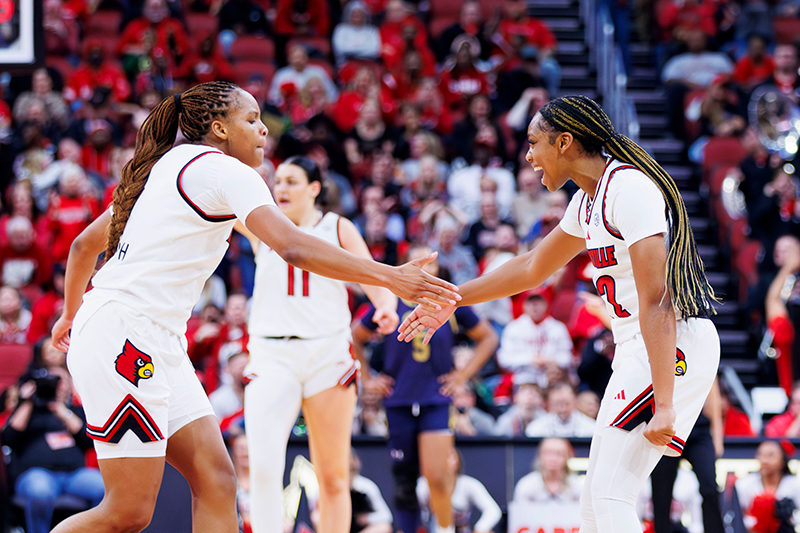
Tajianna Roberts and Mackenly Randolph celebrate during the game against Notre Dame at the KFC YUM Center on March 1, 2026.
Credit: Taris Smith
Colleges and conferences are clamoring for Congress to step in and pass legislation that would give the NCAA or a newly established governing body an antitrust exemption and the power to enforce rules on NIL and limit the transfer portal. But as in years past, attempts to legislate a solution have bogged down. A U.S. Representatives House bill, the SCORE Act, sponsored solely by Republicans, has not advanced to a vote, while a bipartisan bill in the Senate, the Protect College Sports Act, has made it through committee but not to the floor. If the lawmakers do not do something by the end of December, they’ll have to start over in 2027.
The Southeastern (SEC) Conference and the Big Ten (now 18 after such big-time athletic schools such as UCLA and the University of Southern California bolted from the old Pac-12 on the West Coast) make the most money for their TV rights. Smaller conferences believe they could land more money, even billions, if Congress changed the law to let them bargain collectively.
‘Saving College Sports’
President Donald Trump has issued two executive orders to “save college sports,” including provisions to protect money-losing Olympic sports, but it’s unlikely those alone can get the job done.
Cody Campbell, a billionaire Texas oilman and chair of the Texas Tech University System Board of Regents who has the president’s ear, created an organization called Save College Sports that has run a spate of television ads during football games to push for changes. “Congress has to act to solve the problem now,” he said on ESPN’s Pat McAfee Show last December.
“Schools are going to have to make a choice of either using tuition dollars to pay for these deficits, taxpayer dollars, or they are just going to start cutting sports that don’t make money: women’s sports and Olympic sports,” he said.
“Most people think money’s falling from trees. It’s absolutely not. We’re going broke as a system and we’ve got to fix it,” said Campbell, a former Red Raiders lineman who played a season in the National Football League before making his fortune in the Texas oil fields.
Benz, the University of Louisville chair and founder of a chain of physical therapy centers, said in an interview: “We’re encouraging people to be very much more transparent about what is happening at their university. We felt there was a lot of chatter around college sports and everything related to NIL and revenue sharing, but you weren’t hearing much from presidents or athletic directors or certainly board chairs.”
“Trustees should be sounding the alarm on this because while it’s only eight to 10 percent of the (university) budget, it’s 90 percent of the optics,” said Benz.
More Scholarships, Fewer Spots on Rosters
The House settlement lifted limits on how many athletic scholarships Division I schools can award—all athletes now are eligible—but imposed hard roster caps on how many players can be on any team, from football to baseball to wrestling to field hockey. That creates a serious problem for colleges that long have counted on attracting students with the possibility they can walk onto varsity teams.
Among three dozen sports, football now has a roster limit of 105, baseball 34, basketball 15 each for men and women, swim 30 each, golf nine each, and tennis 10. It makes headlines when a college drops a sport, but it is difficult to get precise numbers especially since colleges add sports all the time or move up to Division I from the two lower divisions.
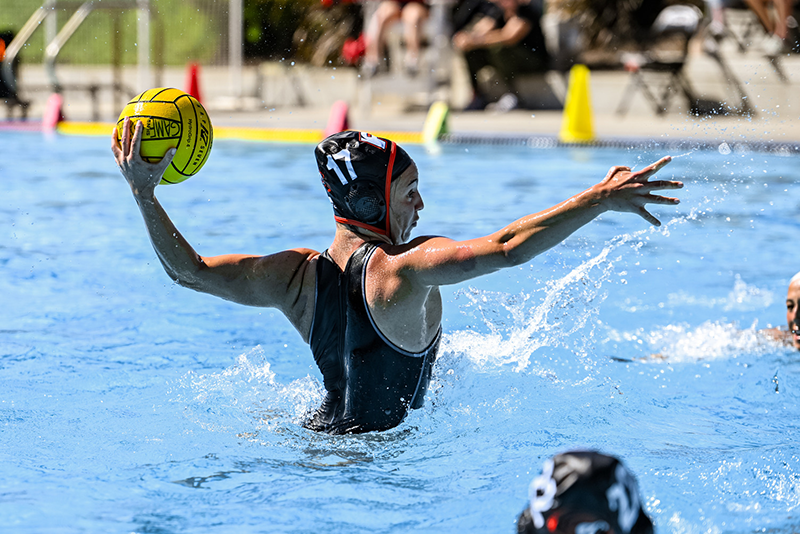
Laia Ortega, Pacific Women’s Water Polo player, gets elevation in the Chris Kjeldsen Pool as she attempts a shot in a women’s water polo match during the 2026 season.
Credit: Justin Gomes
At the University of the Pacific in Stockton, California, the roster caps meant “we were going to have to say goodbye to 36 student athletes” most of whom were paying their way to attend over and above partial scholarships, said Adam Tschuor, the athletic director. “That was going to be a tremendous problem for the university.” The roster for the men’s water polo team fell from 36 to 24. That team has produced Olympians. Pacific is also the alma mater of veteran Dutch tennis pro Sem Verbeek ’16, who walked onto the tennis team at Pacific and last year won mixed doubles at Wimbledon.
Rather than cutting sports, Pacific went in the other direction, adding two new sports, men’s cross country and men’s track and field, and expanding three others, men’s and women’s diving, and expanding track field events for women. Some 320 of its 3,000 undergraduates were athletes two years ago, 390 in 2025–26, and an expected 453 this academic year.
For a small-to-mid-sized university, “if you add a couple hundred students, that changes the enrollment equation significantly,” said University of the Pacific President Christopher Callahan.
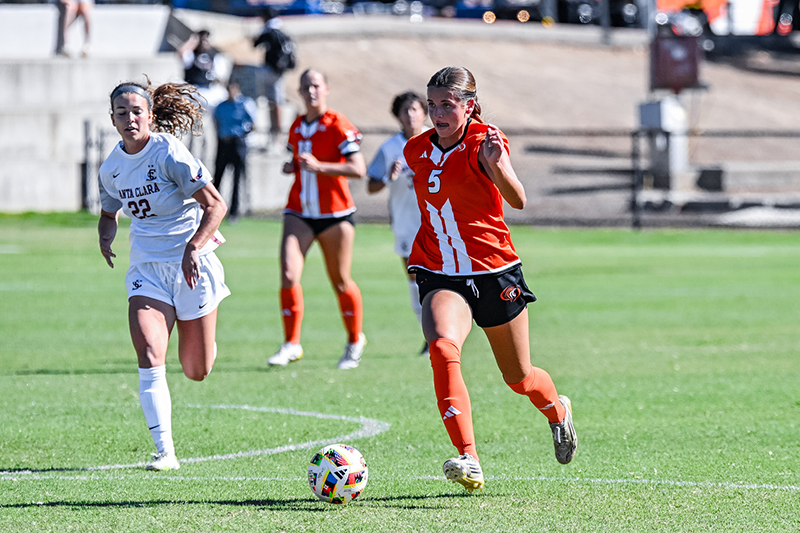
Whitney Garn, Pacific Tigers number 5, dribbles the ball past a defender on Knoles Field during a Women’s Soccer contest at the University of the Pacific.
Credit: Justin Gomes
Even on partial scholarships, “they produce significant revenue,” he said. “These are students typically who would not have come to Pacific (otherwise). They wanted to run, they wanted to play volleyball, they wanted to participate in stunt, and they wanted to do it at Division One level.” (Stunt is an increasingly popular cheer sport with a whopping roster cap of 65.)
Callahan got strong backing for the strategy from his Board of Regents, including Mary-Elizabeth Eberhardt ’76, the just-retired chair, who was a physical education major at a time when there were only intramurals for women. She helped grow women’s sports before turning to a career in banking.
It may make sense for schools with long wait lists to save money on coaches’ salaries, team travel, and other costs of competition, but “there are fewer and fewer schools out there that are not concerned about their enrollment,” said Callahan.
Loyola Marymount University in Los Angeles axed six of its 20 sports in 2024, affecting 115 athletes. The sports were: men’s cross country, men’s rowing, men’s and women’s track and field, women’s rowing, and women’s swimming. Dealing with NIL was among the reasons. “Our goal is to provide the best student-athlete experience possible, and we are better positioned to achieve our objectives when we concentrate our finite resources on fewer programs,” Athletic Director Craig Pintens said then. “The NCAA landscape is changing rapidly, and schools of all sizes must adapt … LMU is no different.”
Tennis and swimming and diving teams are among the most frequent casualties. Volleyball is also vulnerable.
“It’s a David and Goliath situation,” said Samantha Barany, executive director of College Swimming & Diving Coaches Association of America. “Every dollar spent somewhere else is one dollar not spent on football.”
The closures ignore that these student athletes “are great ambassadors for the entire university … They improve enrollment and retention, strengthen alumni engagement, expand philanthropic support, and connect universities to their communities,” said Barany, who swam at James Madison University (JMU) on a scholarship.
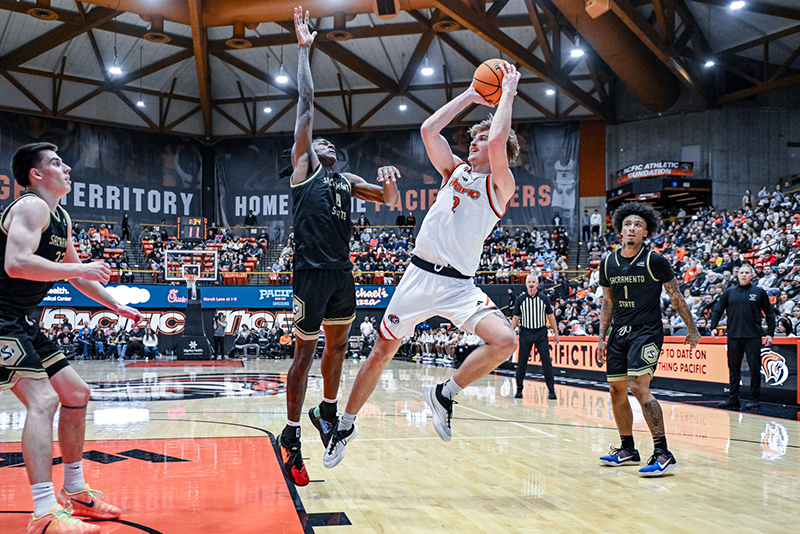
Elias Ralph drives to the hoop and pulls up for a jump shot against Sacramento State on November 29 inside the Alex G. Spanos Center.
Credit: Justin Gomes
James Madison has reaped the benefits of a meteoric rise in the football ranks. The Dukes won two national championships in the NCAA’s second tier for football before jumping to Division I in 2021, joining the Sun Belt Conference and making the 12-team national college playoffs in 2025. (Their former coach, Curt Cignetti, led the Indiana University to an undefeated season and the NCAA championship that season.) A quarter of James Madison’s athletic budget in 2024–2025 was spent on football, but the team also generated that much revenue. Steep student fees for intercollegiate athletics, now $2,581 a year, helped fuel its rise up the football ranks.
‘One of the things AI cannot replace’
Jonathan Alger, president of James Madison University from 2012 to 2024, said athletics did more for the university than simply ring up victories on the gridiron. Athletics is a way to attract not only athletes but students who want “that kind of environment and atmosphere on campus,” said Alger. James Madison had 44,000 applications in 2026, up 76 percent since 2015.
“The fundamental question is: Why do you offer high-level athletics in higher education? And the answer has to be: It’s not about entertainment, it’s not about commercialism, it’s about the skill sets that students are developing, the sense of teamwork and leadership. When you think about it, in this age of artificial intelligence, athletic performance is one of the things that AI cannot replace,” he said.
Still, Alger worries about the threat to Olympic and women’s sports from “the tremendous pressure on athletic departments” to spend whatever it takes to win in football and basketball. “Most presidents that I know feel that the system is out of control. It makes no sense that Division I has fewer spending guardrails than professional sports. There’s an overwhelming desire for change, for limitations financially and otherwise, to provide, if not a level playing field, at least a semblance of to that concept.”
“Advice-wise, one of the things I would say to boards is don’t think of athletics in a vacuum. You should incorporate it into your overall strategic planning, and that means having goals, doing regular assessments, holding yourself accountable, and thinking about both the short and long term, just like you do with everything else at the university,” said Alger.
In the scramble to reach or stay at the top in athletics, strange things can happen. The University of Virginia’s women’s swim program regularly produces some of the fastest swimmers in the world, including Olympians Gretchen Walsh and Kate Douglas. But when it won its sixth consecutive national championship in March 2026, it did so without any divers. It needed no points from the diving events to romp over Stanford.
Coaches summoned the Cavaliers divers to a meeting last year and informed them they would no longer be part of the squad after the 2024–2025 season. “The changing landscape of college athletics … required the University of Virginia swimming and diving program to make strategic and difficult decisions regarding its roster and staff,” an athletics department spokesman told The Cavalier Daily, the student newspaper. He called it a suspension, not a complete abandonment of diving.
Tennis is also in a precarious position. Twenty thousand students play tennis for their colleges across all three NCAA divisions. Over 60 percent of those at Division I schools are international students, recruited to play on scholarships in the United States. Dave Mullins, chief executive officer of the Intercollegiate Tennis Association, was himself an Irish student who played for Fresno State University in California and later became head coach at the University of Oklahoma.
Women’s tennis teams flourished after Title IX was enacted in 1972, but now there’s a plethora of other sports women can play, said Mullins. “I think you’ve got athletic departments in certain parts of the country that are maybe questioning just how popular tennis is when … emerging sports, whether it’s lacrosse or flag football or stunt, are showing probably greater participation numbers that can drive enrollments.”
Tennis facilities also are expensive to run and maintain, and Mullins thinks there’s been “a lack of imagination or creativity” about opening the facilities up to the community and charging hourly rates or membership fees.
Questions Boards Should Ask About Athletics
- Is our athletic program attracting students and enhancing the institution’s reputation or creating problems the board should address? Do we understand how our athletics budget impacts students? How much do they pay in athletics fees?
- Should we have a committee focused on athletics?
- How is information about NIL, revenue sharing, and other athletics issues conveyed to the board? How frequently? Which committee oversees athletics?
- For campus and system boards, how do we protect and monitor the admissions standards, academic progress, and welfare of our student athletes?
- Are our policies aligned with current laws and NCAA or NAIA rules?
- Should our board draft or revise our policies to clarify our level of involvement and risk tolerance?
- How do the recent developments impact our fundraising and donor relations? Do they change how we align these efforts with other priorities?
- If we have an institutionally related foundation, does the athletics department collaborate closely with the foundation to ensure that prospective donors are properly stewarded and that gift funds are used for charitable purposes in compliance with donor intent?
- How are we supporting ongoing education for members of the board, staff, and other stakeholders? Are we educating these groups about managing risks and best practices in our athletics programs?
An Uproar in Arkansas
The University of Arkansas faced an uproar last spring when it abruptly announced it was dropping both men’s and women’s tennis. Arkansas said tennis coaches’ salaries, travel, and other expenses were costing $2.4 million and bringing in negligible revenues. Tennis alumni quickly raised money and three weeks later the university decided to keep the program for another year. But Vice Chancellor and Athletic Director Hunter Yurachek, said, “Looking ahead, a significant endowment remains the only feasible long-term solution to ensure the sustainability of our tennis programs.”
Colleges that compete for NCAA championships are not free to cut sports willy nilly. Division I football powers must field at least 16 sports or 14 for other Division I institutions. Division II institutions are required to have 14 teams, and Division III, which offer no athletic scholarships and hew closer to preserving the ideal of the student athlete, must field 10 or 12 teams depending on enrollment.
Amy Privette Perko, chief executive officer of the Knight Commission, said that since the House settlement, close to 40 sports teams have been dropped, but some colleges have added sports, sometimes at the same schools cutting others. “We’re in this tricky period of time,” said Perko. “Athletic directors are reassessing what sport offerings make the most sense in this new era for their particular institution.”
“The NCAA approved new championship in women’s wrestling, tumbling and acrobatics, and Stunt over the past year. There’s also growth with women’s flag football,” which 17 Division I schools have added and will be an Olympic sport at the Games in Los Angeles in 2028, she said.
Oliver Luck, a former star quarterback and athletic director at the University of West Virginia who sits on the West Virginia Board of Governors, believes college football and basketball programs should keep trying to bring in as much revenue as possible so they can continue to subsidize the other sports. He notes that colleges offer a wide range of academic programs, from business schools that are profitable to departments teaching languages that draw few majors.
“That model of football and the other revenue-producing sports subsidizing the Olympic sports was well accepted on campuses, and I think for most schools it’d be silly to jettison that approach,” said Luck, who’s been a successful executive atop professional and collegiate sports leagues.
Kevin White, the now-retired Duke University athletic director, has long been involved in seeking to protect Olympic sports, including eight years on the board of the U.S. Olympic and Paralympic Committee. White, who now consults for the Huron group advising colleges on their athletic programs, believes that amid growing enrollment challenges, “they’re recognizing like never before that intercollegiate athletics is a good value proposition.”
In his experience at Duke and before that in running the athletic programs at Notre Dame, Arizona State, Tulane, and Maine, the members of their boards “were absolutely critical to any success that those institutions and their athletic programs enjoyed during my tenure,” he said.
Seventy-five percent of the U.S. team at the 2024 Summer Olympics in Paris were current or former players at U.S. colleges. Many international athletes who played for their countries did, too. The United States is alone among major countries that do not subsidize training for Olympic athletes and relies heavily on colleges to groom Olympians for many sports including track, field hockey, swimming, and now flag football, a fast-growing women’s sport that will be contested for the first time at the 2028 Summer Olympics in Los Angeles.
Athletes No Panacea for Enrollment Decline
Recruiting more athletes did not save Lourdes University, a small Catholic institution in Sylvania, Ohio. The Chronicle of Higher Education reported that it went from fielding eight teams to more than 20 over a dozen years, with the percentage of varsity athletes rising from 11 percent of the student body in 2012 to more than 70 percent in 2022. It didn’t work. Full-time enrollment plunged from 1,885 to 691, despite a 74 percent tuition discount for the athletes, The Chronicle said. “We are heartbroken,” the Sylvanian Sisters of St. Francis and the board said in the February 2026 announcement of the closure. “This was an extremely difficult decision to make, and we wish finances and enrollment and any of the other variables pointed to a sustainable solution. After months of intense effort, we realized that there was no way forward.”
More than 80 percent of private colleges that enroll between 500 and 3,000 students brought in more athletes between 2012 and 2022, but more than half suffered enrollment declines anyway, according to a Chronicle analysis of federal data.
Meanwhile, some universities are outsourcing the commercial side of their athletic business including handling NIL to new entities, some financed by private venture capital. (Luck is leading those efforts for Rutgers University and Clemson University.)
Patrick Kramer, vice chancellor for institutional advancement at Texas Tech University and chief executive officer of the Texas Tech Foundation, said that for most larger universities, “I think the question will be, ‘Can we raise enough money to support revenue share (with the athletes) or do we go outside? And if we do go outside into a venture capital market, ‘Are we really throwing away our future revenue?’ That’s the biggest concern.”

Goodbye to Old, Regional Conferences and Rivalries
In the football world, change can happen almost overnight to the benefit of some programs and detriment of others. Ten schools deserted the venerable Pac-12 on the West Coast in 2023 for greener pastures, including UCLA and the University of Southern California which went to the Big Ten in chase of bigger payouts from its lucrative television contracts.
There are winners and losers in these games as well as on the field.
At Washington State, its share of Pac-12 revenues plummeted from $35 million a year to $12 million, said Kirk Schulz, its now-president emeritus. It had to cut the athletic budget by $10 million and just this past June the board of regents voted to shift $20 million to the program to cover deficits. They called it a one-time only transfer. “It is a call to action to our donors,” said Regent Marty Dickinson before the vote. “We need them to double down with us right now.”
The century-old conference still calls itself the Pac-12 but this year has nine members, seven of them new.
Boards Must Keep an Eye on the Ball
Schulz, who retired in 2025, has served on both the NCAA Board of Directors and the Knight Commission. He believes boards must pay closer attention to their athletic programs and not just give their blessings to the overall budget and hiring the athletic director or football coach.
“At many boards, nobody has laid out in my mind clear guidelines on who does what,” he said. “You can’t just wait until your football coach leaves and then start trying to figure out overnight who’s going to be in charge of doing what. Boards and presidents need to have very difficult and challenging conversations about what’s the board involvement going to be?”
Senator Maria Cantwell, D-Wash., cosponsor with Senator Ted Cruz, R-Texas, of the Protect College Sports Act, said the Sports Broadcasting Act must be changed to allow colleges to pool media rights. That 1961 law gave professional sports leagues but not colleges an antitrust exemption to do so.
“Just since 2023, over 100 programs and more than 1,000 athletic scholarships and roster [spots] in women and Olympic sports have been eliminated, and it’s going to get worse,” Cantwell said at a hearing in June.
“Kansas, Colorado, Rutgers, and Washington State—my home state—beloved institutions with strong alumni bases and storied histories are getting hollowed out. And even if the universities are not cutting sports programs, they are taxing students who are not athletes and taking money out of their general funds to cover ballooning athletic program deficit,” the senator said. Under the Protect Act, if colleges opt into pooling rights, they’d be bound to maintain scholarships and funding for women’s and Olympic sports.
But with the schools with the deepest pockets unwilling to accept curbs on spending and lose their place at the top of the athletic heap, change may not be coming soon.
This all compels boards to pay closer attention to exercising their fiduciary responsibility over athletic programs, Tim Sands, the Virginia Tech president, believes. “Whether they like it or not, this is part of their job now,” he said.
Christopher Connell is a Washington, D.C.-based education writer and frequent contributor to Trusteeship.
AGB is convening trustees, presidents, chancellors, athletic directors, chief financial officers, foundation leaders, and industry experts for a timely discussion on the future of intercollegiate athletics and its governance implications.
RELATED RESOURCES


Tools and Toolkits
Executive Briefing: Intercollegiate Athletics and Board Oversight

Reports and Statements
Top Public Policy Issues Facing Governing Boards in 2025–2026:
Intercollegiate Athletics