
 Chat with AGB Board Bot
A nonpartisan policy framework for effective governance.
As public boards face increasing pressure and politicization, trustees must have a strong understanding of their governance duties and boundaries. However, media reporting and an AGB pulse survey highlight significant gaps in trustee confidence.
43%
of trustees are not fully confident in their own or their board’s understanding of fiduciary responsibilities and governance boundaries, according to a March 2026 AGB pulse survey.
When roles are unclear:
- Governance and management lines blur
- Presidential instability increases
- Institutional autonomy weakens
- Mission stewardship is undermined
- Responsibility to the citizens of the state erodes
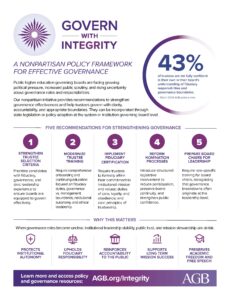
Clarify roles and strengthen governance with five recommendations.
The nonpartisan Govern with Integrity Initiative is a national effort to strengthen governance integrity, board independence, and institutional autonomy across public higher education. At its core are five recommendations, which can be legislated or adopted as board or system-level policy:
 STRENGTHEN TRUSTEE SELECTION CRITERIA
Prioritize candidates with fiduciary, governance, and civic leadership experience to ensure boards are equipped to govern effectively.
 MODERNIZE TRUSTEE TRAINING
Require comprehensive onboarding and continuing education focused on:
- Fiduciary duties
- Governance vs. management boundaries
- Institutional autonomy
- Ethical leadership
 IMPLEMENT FIDUCIARY CERTIFICATION
Require trustees to formally affirm their commitment to:
- Institutional mission and values
- Duties of care, loyalty, and obedience
- Core principles of trusteeship
 REFORM NOMINATION PROCESSES
Introduce structured legislative involvement to:
- Reduce politicization
- Preserve board continuity
- Strengthen public confidence
 PREPARE BOARD CHAIRS FOR LEADERSHIP
Require role-specific training for board chairs, recognizing that governance breakdowns often originate at the leadership level.
Why these recommendations matter.
 PROTECT INSTITUTIONAL AUTONOMY
 UPHOLD FIDUCIARY RESPONSIBILITY
 REINFORCE ACCOUNTABILITY TO THE PUBLIC
 SUPPORT LONG-TERM MISSION SUCCESS
 PRESERVE ACADEMIC FREEDOM AND FREE SPEECH
Take the Next Step.
Public Institutions
Public institutions are on the front lines. When governance breaks down, the consequences are immediate—leadership instability, mission derailment, and erosion of public trust.
How you can help
State policymakers are far more likely to engage when they hear directly from leaders in their own state.
We’re asking you to help move this initiative forward:
- Share these recommendations with key contacts. Forward the recommendations to legislators, governor’s office staff, or system officials you know. Share tangible next steps for your contact, such as the one-pager, sample bill text, and legislative framework below with lawmakers.
- Offer to connect your key contacts with AGB. We will brief policymakers, provide context, and serve as a neutral resource.
- Raise this in your networks. Flag this issue with peer institutions, associations, or coordinating boards in your state.
- Access tools that serve your mission. Effective governance depends on trustees understanding fiduciary duties, governance boundaries, institutional mission stewardship, and the respective responsibilities of governing boards and institutional leadership.
Independent Institutions
These policies focus on public institutions, but their implications are much broader. When governance standards weaken in one sector, it affects public trust, policymaker assumptions, and regulatory pressure for all institutions.
Strong governance—clear roles, fiduciary discipline, and independent oversight—is essential for every institution.
How you can help
State policymakers are far more likely to engage when they hear directly from leaders in their own state.
We’re asking you to help move this initiative forward:
- Share these recommendations with key contacts. Forward the recommendations to legislators, governor’s office staff, or system officials you know. Share tangible next steps for your contact, such as the one-pager, sample bill text, and legislative framework below with lawmakers.
- Offer to connect your key contacts with AGB. We will brief policymakers, provide context, and serve as a neutral resource.
- Raise this in your networks. Flag this issue with peer institutions, associations, or coordinating boards in your state.
- Access tools that serve your mission. Effective governance depends on trustees understanding fiduciary duties, governance boundaries, institutional mission stewardship, and the respective responsibilities of governing boards and institutional leadership.
Systems
The framework is particularly relevant for states in which institutions operate with institution-level governing boards. However, many of the principles—including trustee orientation, fiduciary education, governance boundary clarification, and ongoing board development—are also applicable to statewide systems seeking to strengthen governance practices through their own established processes and educational programs.
Statewide systems may find elements of the framework useful as a reference for strengthening trustee orientation, governance education, and role clarity through system-led policies, board development programs, or administrative practices without requiring statutory changes.
How you can help
State policymakers are far more likely to engage when they hear directly from leaders in their own state.
We’re asking you to help move this initiative forward:
- Share these recommendations with key contacts. Forward the recommendations to legislators, governor’s office staff, or system officials you know. Share tangible next steps for your contact, such as the one-pager, sample bill text, and legislative framework below with lawmakers.
- Offer to connect your key contacts with AGB. We will brief policymakers, provide context, and serve as a neutral resource.
- Raise this in your networks. Flag this issue with peer institutions, associations, or coordinating boards in your state.
- Put these principles into practice as system-level policy. Effective governance depends on trustees understanding fiduciary duties, governance boundaries, institutional mission stewardship, and the respective responsibilities of governing boards and institutional leadership. These resources may be especially valuable for statewide systems seeking to strengthen governance effectiveness through system-directed trustee education rather than legislative mandates.
Systems taking a close look at their own board composition can use AGB’s Sample Public System Board Composition Matrix as a starting point.
Institutionally Related Foundations
When institutional governance falters, foundations feel it quickly:
- Leadership turnover disrupts fundraising.
- Strategic priorities shift unpredictably.
- Donor confidence can weaken.
Strong, stable governance at the institutional level is essential to your foundation’s long-term success.
How you can help
Foundation leaders often have strong relationships with policymakers and community leaders. That influence matters here.
We’re asking you to help move this initiative forward:
- Share these recommendations with key contacts. State officials, donors, and civic leaders need to understand what strong governance looks like. Share tangible next steps, such as the one-pager, sample bill text, and legislative framework below, with lawmakers.
- Advocate for stability and continuity. Help reinforce that governance quality directly impacts institutional performance and public confidence.
- Make introductions. Connect AGB with policymakers or influencers in your state who are shaping higher education policy.
- Access tools that serve your mission. Effective governance depends on board members understanding fiduciary duties, governance boundaries, and institution-foundation alignment.
Lawmakers and Advocates
Governance integrity is not partisan; it is structural. States have an interest in ensuring that governing board members are selected, trained, and supported in a manner consistent with sound governance practice and the long-term interests of students, institutions, and the public.
Enacting the principles in this initiative strengthens public trust in higher education and builds accountability to the citizens of the state.
How you can help
Use your voice and/or your position to push for legislation that promotes these governance recommendations.
- Get started with ready-to-implement policy resources. Get started with the sample bill text or broader legislative framework below.
- Connect with AGB. We will brief policymakers, provide context, and serve as a neutral resource.
- Get the message out. Share this web page or the one-page fact sheet to build political willpower.
Download policy resources.
Higher Education Governance Integrity Legislative Framework
Policy Design & Consensus Building

This legislative framework provides a practical, adaptable strategy to strengthen governance, clarify trustee roles, and restore public accountability in higher education and responsibility to the citizens of the state. Designed as a policy blueprint for state leaders, governing boards, and higher education stakeholders, it can assist early-stage policy development, including key components such as training, certification, and nominations.
Higher Education Governance Integrity Sample Bill Text
Legislative Action & Implementation

The Higher Education Governance Integrity and Public Trust Act bill text translates the Initiative into clear, actionable legislative language, providing a ready-to-use statutory model for states prepared to move from concept to implementation. The model also enables policymakers to benchmark against existing statutes, identify gaps in current governance laws, and advance comprehensive, credible reforms that strengthen board governance and responsibility to the people of the state.
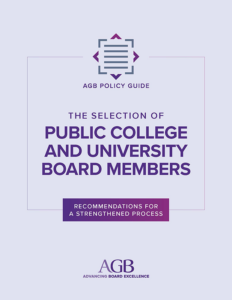
The Selection of Public College and University Board Members
Recommendations for a Strengthened Process
Tool (February 2026)
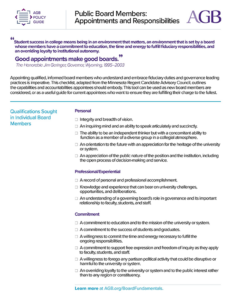
Public Board Members: Appointments and Responsibilities
Tool (February 2026)
Explore governance resources.

Principles of Trusteeship
How to Become a Highly Effective Board Member for Colleges, Universities, and Foundations
Book

AGB Knowledge Center
Explore All Governance Resources
Explore resources tailored to each recommendation.
STRENGTHEN TRUSTEE SELECTION CRITERIA
MODERNIZE TRUSTEE TRAINING
IMPLEMENT FIDUCIARY CERTIFICATION
REFORM NOMINATION PROCESSES
PREPARE BOARD CHAIRS FOR LEADERSHIP
More advocacy resources.
Explore all advocacy and public policy resources AGB offers, including:
- Primers on the top public policy issues facing boards
- Timely policy alerts, podcasts, and other updates
- Tools to boost strategic advocacy
- Letters and testimony
Explore resources related to institutional autonomy and board independence:
- Download a practical guide to governing with autonomy.
- Explore programs and events.
- Read the latest insights and news.
- Get involved.