

 Chat with AGB Board Bot
“Red lines” are guardrails prohibiting actions or decisions that, if taken, would clearly and unequivocally violate general ethical or legal boundaries that underlie the institution’s mission or values, thus placing the institution’s integrity at serious risk. It is the point at which boards and executive leaders say, “this far, no farther”—the point beyond which there is no more flexibility to comply, bend, or negotiate.
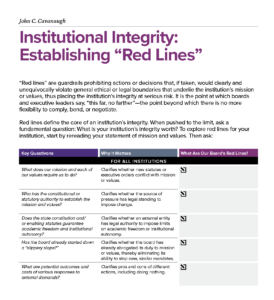
Red lines define the core of an institution’s integrity. When pushed to the limit, ask a fundamental question: What is your institution’s integrity worth? To explore red lines for your institution, start by rereading your statement of mission and values. Then ask:
| Key Questions | Why It Matters | What Are Our Board’s Red Lines? |
|---|---|---|
| For All Institutions | ||
| What does our mission and each of our values require us to do? | Clarifies whether new statutes or executive orders conflict with mission or values. | |
| Who has the constitutional or statutory authority to establish the mission and values? | Clarifies whether the source of pressure has legal standing to impose change. | |
| Does the state constitution and/or enabling statutes guarantee academic freedom and institutional autonomy? | Clarifies whether an external entity has legal authority to impose limits on academic freedom or institutional autonomy. | |
| Has the board already started down a “slippery slope?” | Clarifies whether the board has already abrogated its duty to mission or values, thereby eliminating its ability to stop new, similar mandates. | |
| What are potential outcomes and costs of various responses to external demands? | Clarifies pros and cons of different actions, including doing nothing. | |
| For Public Institutions Only | ||
| Does the institution uphold the constitutional and subsequent U.S. Supreme Court decisions regarding free speech? | Clarifies whether certain proposed limits conform to current interpretations of free speech rights. | |
| For Private Institutions Only | ||
| Does the institution uphold its official policies regarding speech rights? | Clarifies whether certain proposed limits conform to current institutional policy. | |
| For Religious-Based Institutions Only | ||
| Are there specific requirements in the sponsorship agreements or tenets of the affiliated religion that require certain decisions, actions, organizational structures, or student/faculty member requirements that must supersede statutory mandates (for example, social justice, inclusive admissions and financial aid, or missionary work)? | Clarifies whether there may be a religious exemption to an externally imposed mandate. | |

Selected Examples of Red Lines
Red lines are especially necessary to establish in four areas: institutional autonomy, freedom of speech, academic freedom, and finances. Here are some examples:
- The board is the sole entity empowered to establish policies governing this institution. (Institutional Autonomy)
- The institution will not accept any funding from individuals or organizations connected to the following: (list various categories of crimes, illegal activities, and so forth). In the event such funds were obtained before the discovery of facts that would otherwise have made the funds impermissible, the funds shall be returned. (Finances)
- The board will not engage in determining specific course content. (Institutional Autonomy, Academic Freedom)
- Speech that falls within constitutional definitions and U.S. Supreme Court decisions (for public institutions) or within board policies regarding speech (for private institutions) is fully supported and protected. (Freedom of Speech)
- Before consideration by the board, decisions and actions are subjected to two tests: How will the decision/ action further the mission? How will the decision/action reflect each of its core values? Political considerations are not a core consideration. (Institutional Autonomy)
To explore red lines for institutional autonomy, freedom of speech, academic freedom, and finances, start by asking these questions:
| Issue | Key Questions | What Are Our Board’s Red Lines? |
|---|---|---|
| Institutional Autonomy | What is the board’s process for determining whether the source of an external demand has legal standing? What are the next steps for the board to determine a response/action? | |
| Freedom of Speech | What is the board’s process for determining institutional compliance with relevant legal protections for speech? Are there conditions under which the board is willing to ignore them? | |
| Academic Freedom | What is the board’s process for ensuring the right of the faculty to instruct and the right of a student to learn in an academic setting unhampered by interference? | |
| Finances | What is the board’s process for assuring that all revenues have been obtained from ethical sources and are not used as threats to force compliance with mandates? |
Additional questions may be added as necessary to develop guardrails focused on specific topics within each issue.

Consequences of Invoking Red Lines
Invoking red lines has consequences. Some examples:
- Could critical sources of funding be withdrawn? If so, what is the institution’s ability to withstand those losses (such as available reserves, days of cash on hand, or alternative funding sources)?
- How will students, faculty members, and staff be affected? Other stakeholders?
- The board’s decision and subsequent action may be claimed to be illegal. Is the institution prepared to engage in a potentially lengthy court process?
- Some (or all) of the board members may be removed or resign in protest. Is the institution able to withstand such significant leadership change?
- It is likely that news media and social media could turn extremely negative. Does the institution have a robust crisis communications plan for such attacks?
- In extreme situations, invoking and defending a red line could place the institution at existential risk. Is the board prepared to have that discussion?
Consequences such as these reinforce the need to plan carefully and thoroughly in identifying, implementing, and defending red lines.
John C. Cavanaugh is an AGB senior consultant, the former president and CEO of the Consortium of Universities of the Washington Metropolitan Area, former chancellor of the Pennsylvania State System of Higher Education, and former president of the University of West Florida.