

 Chat with AGB Board Bot
When your president and board are faced with a new demand or requirement, the first step is to determine whether, and to what extent, complying with it would be inconsistent with the best interests of the institution. The second step is to decide how to proceed. Ideally, the board, the president, and the leadership team will have developed some preparatory guidance and communications channels to facilitate their considerations.
Step One: Is it intrusion?
Boards and presidents get all kinds of requests, demands, and even threats from diverse sources, typically with good intentions on the part of those making the demands. Institutional leaders need criteria to sort each request or demand, perhaps color-coding them. Can the request be considered green (similar to other rules or procedures already in place); yellow (has merits but poses concerns); or red (has real potential to undermine the ability to fulfill the institution’s mission)?
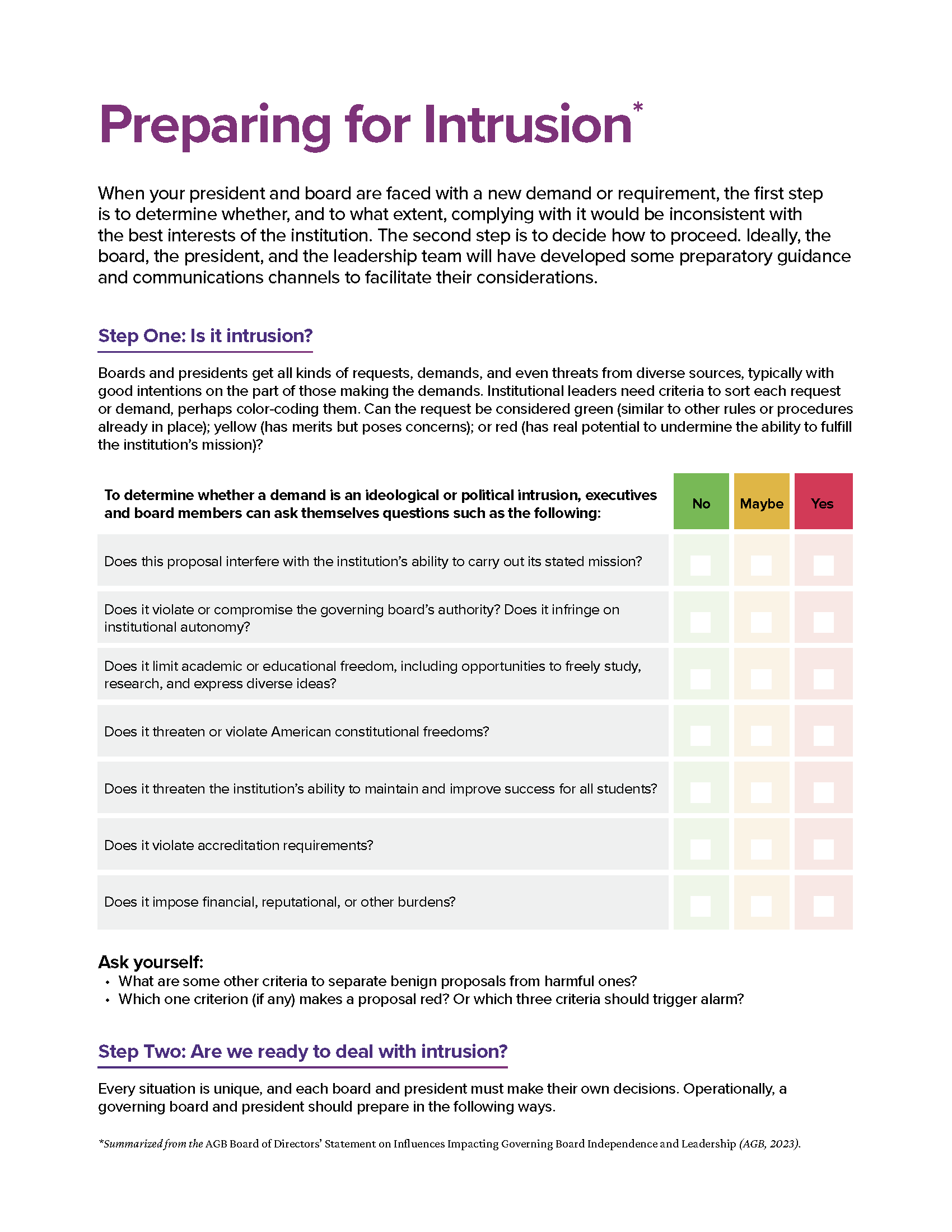
| To determine whether a demand is an ideological or political intrusion, executives and board members can ask themselves questions such as the following: | No | Maybe | Yes |
|---|---|---|---|
| Does this proposal interfere with the institution’s ability to carry out its stated mission? | |||
| Does it violate or compromise the governing board’s authority? Does it infringe on institutional autonomy? | |||
| Does it limit academic or educational freedom, including opportunities to freely study, research, and express diverse ideas? | |||
| Does it threaten or violate American constitutional freedoms? | |||
| Does it threaten the institution’s ability to maintain and improve success for all students? | |||
| Does it violate accreditation requirements? | |||
| Does it impose financial, reputational, or other burdens? |
Ask yourself:
- What are some other criteria to separate benign proposals from harmful ones?
- Which one criterion (if any) makes a proposal red? Or which three criteria should trigger alarm?
Step Two: Are we ready to deal with intrusion?
Every situation is unique, and each board and president must make their own decisions. Operationally, a governing board and president should prepare in the following ways.
| Check up to three items that your institution has in place and check up to three bullets that need work. Add them to your action plan. | In Place | Needs Work |
|---|---|---|
| Ensure all board members clearly understand the extent of the board’s duties and authority and that of other entities that can advance or harm the institution, such as the legislature, governor, sponsoring religious organization, or foundation board. Clarify the roles, duties, and authority of each entity, as well as establishing agreements on dispute resolution processes, can help prevent or resolve issues when potential intrusions arise.
» Do you have a resource institutional leaders can use to get a clear picture of all participants in major decisions—their roles, their authority, their limits, and other key variables? (Try to answer the question: “Can they really do that?”) |
||
| Create or review/revise written policies that will guide potentially difficult decisions, such as defining what values, topics, or principles are ”required” or “important” for the board to protect.
» Is ____ required for mission fulfillment? Is ____ important but could be negotiated? |
||
| Foster a strong and candid relationship between the board and the president, with explicit agreements on roles and expectations in the event of ideological or political intrusion. Plan ways to help maintain mutual understanding and agreement.
» Now is the time to spend time resolving any serious friction points. Sometimes it helps to write a board-president compact that allows both sides to be ready if “X” happens. |
||
| Develop contingency plans, such as establishing in advance a small task force with a clearly defined, board-approved charge and carefully selected members.
» A robust internal and external communication plan should be in place, and tabletop exercises can be conducted to practice response strategies. |
||
| Stay informed about relevant incidents at other institutions and maintain connections with state, regional, and national sources of information, support, and inspiration. Build alliances with other postsecondary institutions and counterparts such as schools and libraries. Alliances can be bolder than individual entities.
» The decision of each institution in a critical situation affects many or all other similar entities. Red intrusions that are not rejected or ameliorated may spread. Can your institution help stop that? |
||
| For governing boards of public institutions with sunshine laws, address the fact that thoughtful and candid discussions that include faculty members, staff, members of the public, and other important stakeholders lead to better decisions than votes based on undisclosed, untested, and less-informed opinions. The risk of being candid in engaged public discussion is often far less than the risk of failing to halt a threatening intrusion.
» Wise courage is a hallmark of successful board decisions. |
||
| Expand board members’ relationships with community and state leaders or sponsor a public symposium series featuring thought leaders on higher education governance, academic freedom, and democracy. Mobilize alumni and donors. Ask students to tell their stories in every setting that could be affected by a dangerous intrusion.
» Every board member has a fiduciary duty to advocate for the institution. Across the country, alumni can be mobilized to protect their alma maters. Prepared students are always impressive. |
*Summarized from the AGB Board of Directors’ Statement on Influences Impacting Governing Board Independence and Leadership (AGB, 2023).