
 Chat with AGB Board Bot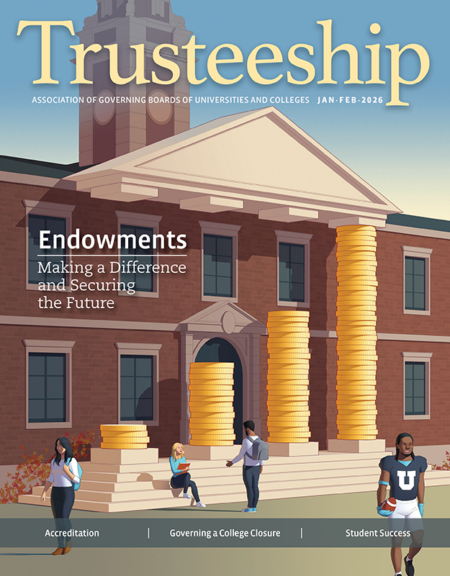
Listen to this article on the AGB Soundboard App
Endowments are critical to the success of an institution to help ensure its viability for decades to come. New federal tax changes to endowments may impact a college or university, depending upon the endowment’s size. Trustees and institutionally related foundation board members have a responsibility to understand how endowments operate, how an endowment functions at their own institution or foundation, and how tax laws may affect some endowments.
Civic and community leaders across Riverside, California, turned out in force at the La Sierra University kickoff event to raise money for a new scholarship program for former foster care students, some now homeless. At the end of the night, the university had collected $70,000.
That money will not be expended immediately but will go instead into a newly created Home@LaSierraEndowment fund where it will grow along with more gifts. The Seventh Day Adventist university is pursuing a goal of raising $2 million for these young people aging out of the foster care system.
The scholarships would not only cover tuition but let these students live on the campus for free. “That’s why we call the endowment ‘Home at La Sierra,’” said President Christon Arthur.
“We want to start small because you know (they) require a lot more than classes. They need all kinds of emotional support, psychological support, social support, academic support. So we want to start small and once we do that well and have that reputation, we’ll expand beyond that,” said Arthur.
If this new endowment earns as much as college endowments typically do—almost 7 percent annually over the past decade—it will be able to award in perpetuity far more than that original $70,000 and keep growing rather than pushing that money out the door all at once.
While the schools with endowments in the billions and tens of billions of dollars draw much of the attention, almost every institution, large or small, is intensifying efforts to build endowments.
Institutions often have large professional staffs to raise money, but trustees play a crucial role in setting the goal of capital campaigns, deciding what the funds should be used for—including capital projects and immediate needs—and how much to put into endowments. (Not infrequently they are also looked to for major gifts.)
Almost all boards of trustees have investment committees that keep a close eye on how its endowment is managed, whether in-house or by outside investment firms.
While those committee members usually have deep expertise and connections in the financial world, every trustee shares responsibilities as a fiduciary to attend to the institution’s financial health. Knowing the ins and outs of endowments is part of the job.
Bates College President Garry W. Jenkins recently calculated that a $100,000 gift for immediate use can fund 1.6 need-based scholarships at the Lewiston, Maine, private school, which charges $70,146 in tuition and has an endowment approaching half a billion dollars. But put that $100,000 into the endowment and in 30 years, assuming growth of 7.5 percent a year, that principal will have grown to $243,000 while spinning out $214,000 for the college’s operating budget along the way.
That’s the way endowments are supposed to work. As a fundraising pitch for the University of Texas at Austin put it, “When you establish an endowment, you are making an everlasting gift in support of our students, faculty, and programs.”
Some 658 institutions surveyed by the National Association of College and University Business Officers (NACUBO) reported that their endowments at the end of fiscal 2024 were worth $874 billion.1 The average endowment was $1.3 billion, but the median was just under a quarter-billion dollars. Twenty-one universities had endowments above $10 billion, but nearly 30 percent of the colleges NACUBO surveyed had $100 million or less in their endowments.
When NACUBO first surveyed 136 institutions in 1974, their combined endowments were under $7 billion.
Endowments may have hundreds or even thousands of separate funds created for specific purposes, and most have restrictions to honor the wishes of donors who gave specific instructions on how the money can be used, whether for student aid, faculty salaries, or supporting the football team.
Almost half of spending from endowments goes toward student aid, according to NACUBO. The figures it gathered showed that the 658 colleges and universities covered 14 percent of their operating budgets with payouts from the endowments. That share was even larger at some of the largest, research-intensive universities.
Colleges and universities don’t just invest in solid but stolid treasury bills and bonds. Nearly a third of the assets are invested in stock markets in the United States and abroad, and nearly 30 percent in private venture capital and private equity. Ten percent is in fixed income investments and 11 percent in real estate, according to NACUBO.
To keep the endowment growing, colleges typically withdraw no more than 4 to 5 percent a year but usually make that up and more with investment gains and new gifts. The endowments that NACUBO tracks grew 6.1 percent annually over the past quarter century.
They aren’t always winners in the markets. They lost 18 percent in fiscal 2009 during the Great Recession before bouncing back in a big way.
Questions for Boards to Ask About Endowments
Protecting college and university endowments for future generations is one of the primary obligations for trustees in their role as fiduciaries. While those sitting on finance and investment committees customarily are most deeply involved in stewardship of endowments, every trustee should be deeply knowledgeable about how the endowment is managed, whether in-house or outsourced, what types of assets it holds, how much the institution draws from it each year, and how its returns compare to other institutions.
Here are some questions for trustees to ask, including some drawn from the AGB Endowment Management for Higher Education (2022) guide:
- Does each board member understand his or her fiduciary responsibility? Do board meetings include regular educational sessions on fiduciary responsibilities?
- What have committee members done to ensure that the size of the endowment, the expected investment returns, and the level of annual spending from the endowment are aligned with the institution’s current and future needs?
- How is the right asset mix determined given the endowment’s return objectives and tolerance for risk?
- Are investment policies in place for all managed assets, including cash, planned giving assets, reserves, and pension plans? Is the accountability for these assets clear?
- What steps are taken to ensure all board members understand the interplay of operational, financial, and investment considerations at the institution?
- What percentage of the endowment is invested in alternative assets? What is the appropriate level for alternative investments? Does the investment committee have access to the necessary expertise to effectively incorporate alternative investments into the endowment?
- Does the board have a rigorous investment and operational due-diligence process for hiring and firing investment managers?
- How do the returns the endowment has generated in the short and long terms compare to peer institutions’ returns and to national averages?
- Has the investment committee measured the cumulative impact of manager selection on the market value of the institution’s endowment over the past 10 years?
- Has the committee undertaken a strategic exercise to determine which model of investment (consulting, an outsourced chief investment officer, chief investment officer) will be best for the institution? How frequently does the committee revisit this decision?
- How frequently do committee members weigh the merits of using indexed approaches to manage all or part of the portfolio?
- Does the board support and invest in fundraising and demonstrate philanthropic leadership?
The size of endowments at top private institutions has made them vulnerable to attacks by conservative politicians who believe they indoctrinate students with liberal views and charge way too much, although almost half of spending from endowments goes toward student aid, according to NACUBO.
Harvard University, with a $57 billion endowment, has been a particular target of the Trump administration. That endowment, made up of 14,675 discrete funds, provided $2.5 billion or more than a third of Harvard’s operating revenues in fiscal 2025. Princeton drew two thirds of its $2.9 billion operating budget from its $36.4 billion endowment as of June 30, 2025.
The public “sometimes assume that an endowment is like a savings account and that universities can ‘dip into it’ to pay for unexpected needs or special projects,” Princeton President Christopher Eisgruber recently wrote. “An endowment is nothing like a savings account. It is more like a retirement annuity that must provide income every year for the remainder of the owner’s life.”2
And for colleges and universities, that lifespan is a long, long time, including at the College of William & Mary (W&M), the nation’s second oldest, founded in 1693. Its endowment reached $1.45 billion in 2024. But it’s had ups and downs over the centuries, most notably during the Civil War when the entire endowment was invested in Confederate war bonds that became worthless.
“We lost all of our money and became fairly destitute,” said Matthew T. Lambert, senior vice president for university advancement. “We started the 20th century essentially with no endowment and in 1906 became one of the very few universities that went from being private to public.”
When W&M launched its first capital campaign in the 1970s, the W&M endowment was a meager $15 million. During its last campaign, which ended in 2020, it raised $1 billion. “That made us the only public university our size, and one without a school of medicine or engineering, to complete a billion-dollar campaign,” said Lambert, a W&M graduate.
William & Mary’s endowment is dwarfed by the University of Virginia’s (UVA) $10.2 billion, but it also has far fewer students and alumni. Its enrollment is under 10,000 to UVA’s 26,000 students.
A major new campaign is in the works and funding more scholarships will be a principal objective. “The overwhelming number of endowments we’ve created is for support of our students, and there’s no question that we still need more money to make sure that a William & Mary education is affordable for those students,” said Lambert.
Stanford University’s endowment reached almost $41 billion in 2025 after it booked a 14.3 percent gain. It has long been a pacesetter for philanthropy, mounting the first $100 million capital campaign in the early 1960s and the first billion-dollar one in the late 1980s. In 2012, it became the first to raise $1 billion in a single year, although Harvard now does that with regularity and pulled in nearly $10 billion in its last multiyear fundraising drive.
The ten-figure capital campaign list keeps growing. The University of California at Berkeley raised $7.4 billion in a campaign that ended in 2024 and Northwestern pulled in $6 billion. The University of Mississippi closed a 10-year campaign recently that raised $1.75 billion with nearly 95,000 donors. Michigan State University (MSU) recently embarked on a $4 billion drive.
Seventy miles north of MSU’s East Lansing campus, Central Michigan University (CMU), a mid-sized, regional public university in Mount Pleasant in the heart of rural Michigan, is weighing how high to set the bar on a campaign of its own.
CMU faces enrollment challenges similar to many other regional public schools as more students apply and enroll at flagship public institutions. Its enrollment of 14,500 is down 10,000 students from a decade ago. President Neil MacKinnon, who took office in 2024, has launched an intensive, campuswide initiative to turn that around. “The status quo was not acceptable,” he said.
CMU boasts an endowment approaching $300 million; only about 300 institutions in the country have larger ones. It also has the gratitude and loyalty of alumni such as Jon and Terri Voigtman, who have made several six-figure gifts to their alma mater over the past 20 years. Voigtman, class of 1984, turned his degree in marketing into a career on Wall Street and in global banking. He is not a trustee but serves on the investment advisory committee.
He takes a personal hand in selecting winners of the endowed scholarship for business students that he and Terri set up in 2005. The recipient also gets an internship on Wall Street and the prospect of a job after college. Voigtman was once in their shoes, needing help that allowed him to stay in college. The Voigtmans’ initial gift has grown to $200,000 and their names appear on buildings on campus they helped build or renovate. His loyalty is unbounded. “Central is one of these schools that typically get overlooked, but there’s a lot of great things happening there,” he said. “Some of these schools have it figured out, and we’re just in the process of figuring out how to build up the endowment.” In November, CMU’s trustees secured two $40 million gifts from two health systems to strengthen medical education, improve patient outcomes, and expand access to care in the Great Lakes Bay region.
President MacKinnon, in a written response to a question, said: “CMU is grateful for the continued support for higher education that comes from our state leaders, especially the recent investment in the Michigan Achievement Scholarship program. However, there is still a great deal of financial need among our students …. (R)emaining accessible and affordable is a key part of our mission of student and alumni success. For that reason, we rely more and more on the financial support of our alumni, donors, and partners.”
Endowed student scholarships will be a primary focus of its next comprehensive campaign, MacKinnon said. In many states, the share of revenue provided for public colleges and universities has declined over the years, in some places sharply, which makes raising the endowment all the more important. State appropriations accounted for a 33 percent share of the revenues for public higher education in 2022, according to the State Higher Education Finance report by the State Higher Education Executive Officers Association (SHEEO).3
Endowments are all about looking to the future for college presidents and trustees and fundraising is among the most important part of chief executives’ jobs.
Although public confidence in higher education has been falling, colleges and universities raised $61.5 billion in fiscal 2024, the Council for Advancement and Support of Education reported.4 Colleges and universities of all sizes mount fundraising campaigns not just to bolster their finances but also to demonstrate their contributions to the community and regain public support.
According to federal data analyzed by Bellwether, a nonprofit group that studies higher education finance, public four-year colleges get 20 percent of their revenues from states and 2 percent from local governments.5 Community colleges rely on states and localities to cover half their budgets.
Typically, the cost of endowing a university professorship begins at $1 million—which might generate $60,000 a year or more—to several times that much. At the University of North Carolina at Chapel Hill, which had a $5.6 billion endowment as of 2024, there’s a price list that runs from $1 million for a visiting professorship to $5 million for an eminent professor and athletic coach to $25 million for a chancellorship. It also costs $100,000 to endow need-based or merit-based undergraduate scholarships and $500,000 for athletic scholarships.
But endowments are important to institutions with much more slender means. Holyoke Community College in Massachusetts puts its $18.9 million endowment to use primarily to help its 4,600 students, most attending college part-time while holding down jobs. “We are proud that 91 cents of every dollar supports scholarships or programs that directly impact the student experience,” said Amanda E. Sbriscia, vice president of institutional advancement and executive director of the foundation.
Holyoke was founded in 1946 and is the oldest community college in the Commonwealth. It plays an important part in the life of that small city (population 38,000) and the surrounding Pioneer Valley. Its foundation was first established in 1968 as the Friends of Holyoke Community College to help rebuild after a devastating fire and awarded its first scholarship from the endowment in 1987.
The money it generates has gone in part to open a Scholarship Resource Center on campus where students can apply for aid, get help writing essays, “and hear from guest speakers on financial literacy and money management,” Sbriscia said. The endowment has helped send students to their first-ever professional conferences, funded a faculty mentorship program, and even provided free feminine products in high-traffic restrooms.
As with seven- and ten-figure endowments, most gifts are donor-restricted. “There’s certainly increased need for unrestricted support,” said Sbriscia. “At a community college, flexibility to respond to student needs is essential to our mission.”
Thanks to an amendment to the Texas constitution that voters approved overwhelmingly in November 2025, Texas State Technical College is getting a newly created $850 million endowment to meet employers’ demands for more skilled workers. The two-year college has 11 campuses across the state enrolling more than 16,157 students, including nearly 7,000 online, but had to turn away 500 applicants last fall because two dozen programs were over capacity, according to the Texas Tribune.
At Central Michigan, Mary Hill, vice president of finance and administrative services, said that unlike universities that tap endowment earnings to pay a share of the operating budget, “almost all of ours is going toward scholarships for students.”
“In the last few years there’s been a shift where a lot of folks want to see their money spent right away. They want to see it do good in their lifetime so sometimes they give to annual scholarships versus the endowment,” she said.
CMU posts on its website a 26-page list of yearly “spendable distributions” from some 900 endowments, ranging from $71 to more than $1 million.
Out at La Sierra University—which already boasts a $150 million endowment, largest of the 13 Adventist colleges in North America—President Arthur expects to raise the entire $2 million endowment for scholarships for foster care youth in 12 months in time for a gala already scheduled for October 2026 to celebrate the feat.
Arthur, in his second year as president, believes there is good reason to have that confidence.
“The case really is at the heart of who we are,” said Arthur. “Most people say, ‘We make a claim for diversity, for justice, for access, for affordability,’ what have you. It’s an easy sale (for us) because that’s our brand, extending our arms to a very vulnerable population on the margins.”
Taking a Bite Out of the Very Biggest Endowments
Congress, under Republican control, imposed a 1.4 percent excise tax in 2017 on the earnings of endowments of private institutions with at least 500 students and endowment assets of at least $500,000 per student. The tax hit 56 institutions that paid $380 million in 2023, according to Internal Revenue Service data analyzed by the Tax Foundation.6 The vast majority of private colleges never had to pay the tax.
But Congress changed the law in 2025 to make a dozen or more institutions with the very biggest endowments subject to an even more punitive tax as high as 8 percent, while letting colleges and universities with fewer than 3,000 students off the hook entirely.
Yale University President Maurie McInnis said her institution is now facing a $280 million tax in the first year alone on its $44 billion endowment.
This revenue goes straight into the Treasury’s coffers, not for student aid.
Some lawmakers wanted to hit colleges even harder. Then-senator and now Vice President J.D. Vance, branding elite universities “the enemy,” proposed in 2021 a 35 percent tax on their endowment earnings. The House voted last May for a 21 percent tax—a 1,400 percent increase—as part of President Trump’s “big beautiful bill,” but the Senate modified that to a tiered tax of 1.4 percent, 4 percent and 8 percent on institutions with endowment assets of $500,000, $750,000 or $2 million per student.
It also applied the tax going forward only on private schools with more than 3,000 tuition-paying students, which let 30 or more institutions escape this taxation.
The combined effects of fewer colleges paying the tax at all while some pay a lot more means it will raise just $761 million extra over 10 years, according to the congressional Joint Committee on Taxation, all at a time when the bill’s tax and spending cuts will increase deficits by $3.4 trillion.
“It’s a bizarre policy,” said Sandy Baum, a senior fellow at the Urban Institute and professor emerita of economics at Skidmore College. “It’s really just part of the administration’s being out to get these few institutions that they don’t like.” Combined with cuts in federal research funds, it puts them in a bind because they cannot simply take restricted money out of endowments to replace all those lost grants. “The principal has to be maintained in perpetuity,” she noted.
Christopher Connell is a Washington, D.C.-based education writer and frequent contributor to Trusteeship.
1. National Association of University Business Officers, 2024 NACUBO-Commonfund Study of Endowments® (2024).
2. Christopher L. Eisgruber, State of the University, January 29, 2025, https://www.princeton.edu/news/2025/01/29/president-eisgrubers-state-university-letter-2025.
3. Kelsey Kunkle and Rachel Burns, State Higher Education Finance FY 2024, State Higher Education Executive Officers Association, 2024, https://shef.sheeo.org/wp-content/uploads/2025/05/SHEEO_SHEF_FY24_Report.pdf.
4. Ann E. Kaplan, CASE Insights on Voluntary Support of Education, 2024 Key Findings, Council for the Advancement and Support of Education, 2024, https://www.case.org/resources/case-insights-voluntary-support-education-2024-key-findings.
5. Matthew Richmond and Carrie Hahnel, “How Are Public Institutions of Higher Education Funded,” Bellwether, April 2024, https://bellwether.org/wp-content/uploads/2024/04/DollarsAndDegrees_1_Bellwether_April2024.pdf.
6. Garrett Watson and Daniel Bunn, “New Efforts on Taxing Endowments Raise Questions on Neutrality and Revenue Collection,” Tax Foundation, January 28, 2025, https://taxfoundation.org/blog/taxing-endowments-revenue-analysis/.