
 Chat with AGB Board Bot
The following case study is based on interviews and information collected in 2025, unless noted otherwise.
Description of the Institution
Hostos Community College is an educational agent for change that has been transforming and improving the quality of life in the South Bronx and neighboring communities for over half a century. Since 1968, Hostos has been a gateway to intellectual growth and socioeconomic mobility, as well as a point of departure for lifelong learning, success in professional careers, and transfer to advanced higher education programs.
Hostos offers 28 associate degree programs and one certificate program that facilitate transfer to [CUNY’s] four-year colleges or baccalaureate studies at other institutions. The institution is one of only six national recipients of the U.S. Department of Education’s inaugural Postsecondary Success Recognition Program for promoting equitable access, success, and positive post-college outcomes for underserved students and a two-time Aspen Prize for Community College Excellence finalist. The college has an award-winning Division of Continuing Education and Workforce Development that offers professional development courses and certificate-bearing workforce training programs. Hostos also boasts both men’s and women’s basketball teams, which have won multiple CUNY Athletic Conference and National Junior College Athletic Association championships, with the women’s team making history in 2025 as the only team ever to secure eight consecutive titles in CUNY’s history.
Excerpted from CUNY Hostos Community College, “About Hostos,” accessed September 24, 2025, https://www.hostos.cuny.edu/About-Hostos.
Mission, Purpose, Students Served
Hostos Community College was one of six recipients of ED’s inaugural 2025 Postsecondary Success Recognition Award. The press release from ED on January 8, 2025, included this tribute:
“Hostos Community College, part of the [CUNY] system, enrolls a diverse student body of over 5,000 students in the South Bronx with over 90 percent underrepresented students of color and over 65 percent of students receiving Pell Grants. At Hostos, 56 percent of students transfer or graduate within 8 years, and students earn on average 1.4 times more than high school graduates in the state after college. Hostos puts student needs at the top of its priorities and offers resources to help students overcome potential barriers to their success, including their One Stop center, food pantry, and childcare center. Student Government President Dainma Martinez says, ‘Hostos has been more than just an institution for me: it has been a community that understands the challenges students like me face. The support provided by Hostos goes beyond academics; it empowers us to find our voice, pursue our goals, and serve as leaders in our communities.’”87
Description of the Board and System
CUNY was established in 1961 by state statue and is funded primarily by the state and the city of New York. It is governed by a board of 17 members, 10 appointed by New York’s governor and five by New York City’s (NYC’s) mayor with the advice and consent of the state senate, and two ex officio members—the chair of the university student senate (with a vote) and the chair of the university faculty senate (nonvoting). The CUNY board, supported by the chancellor and system administration, oversees seven community colleges, 11 senior colleges, and several specialized or professional schools across the five boroughs of NYC.88
Their deep experience in higher education leadership, public elementary and secondary education, and NYC politics is evident in the long-serving leaders of the CUNY board, system, and Hostos Community College. William C. Thompson Jr., chair of the board since 2016, was reappointed to the board in 2023 and serves as chair of the executive committee and the board’s subcommittee on enrollment. He previously served five terms as president of the NYC Board of Education.89 CUNY System Chancellor Felix Rodriguez was appointed in 2019; he previously served as president of Hostos Community College (2009–2014) and Queens College (2014–2019).90 CUNY Hostos Community College President Daisy Cocco De Filippis was appointed in 2020 and previously served as president of Naugatuck Valley Community College (2008–2020) and as Hostos’s chief academic officer (2002–2008).91 Each of these key leaders understands the relationships among the colleges in the system and of CUNY colleges to NYC public schools, employers, and government. The chancellor and president have deep experience at Hostos.
Leaders and Contributors to this Case Study
We had the generous support and cooperation of more than a dozen key administrators and board members from CUNY and Hostos Community College in conducting this study:
CUNY
- William C. Thompson Jr., board chair (and member, board of directors, AGB)
- Felix Rodriguez, chancellor
- Gayle Horwitz, former senior adviser to the chancellor and secretary to the board
- Anne Fenton, associate vice chancellor and former deputy secretary to the board, now secretary to the board
- Alicia Alvero, interim executive vice chancellor and university provost
- Wendy Hensel, former provost (and as of January 2025, president, University of Hawaii System)
Hostos Community College
- Daisy Cocco De Filippis, president
- Esther Rodriguez-Chardavoyne, senior vice president of administration and finance
- Shiang-Kwei Wang, provost and vice president of academic affairs
- Althea Sterling, vice president of student development and enrollment management
- Evelyn Fernandez-Ketcham, vice president of continuing education and workforce development
- Colette Atkins, vice president of institutional advancement
- Babette Audant, assistant vice president of institutional effectiveness, research, and assessment; project liaison
Strategic Plan Focused on Student Success
Hostos is at the midpoint of a five-year strategic plan. The “Six Goals and 21 Strategies” that provide the structure for the “Hostos Strategic Plan Framework 2023–2028” embody the principles of equitable student success. Metrics for student success are included and relate to strategic plan goals.
Key Data, Metrics, and Dashboards
CUNY follows a performance-management process (PMP)92 that links planning and goal setting by the system and its colleges and professional schools, measures annual progress toward key goals, and recognizes excellent performance.93
Measurable college-wide key performance indicators (KPIs) represent indicators of progress toward the collective activities of this plan. They are largely pulled from the PMP indicators, which are tracked across CUNY colleges.
CUNY offers an interactive Student Data Book (trend data available from 1990 to present, sortable by year, institution, degree/certificate, and student demographic characteristics).
Hostos Community College Strategic Plan 2023–2028 and KPIs
The following KPIs are excerpted from the current CUNY Hostos strategic plan, “Hostos: Elevating Justice.” These Hostos KPIs are closely tied to student success outcomes: enrollment, retention, persistence, graduation, first-year credit accumulation, gateway course success, transfer rate, and wages postgraduation.
Table 2: Hostos Collegewide KPIs 2023–2028
|
Total headcount enrollment (including first-time freshmen, transfer, readmits, and nondegree students) |
|
Student retention rates (fall to spring/1 term, 1-year, and 2-year) |
|
Student persistence rates |
|
Graduation rates (2-year and 3-year) |
|
First-year credit accumulation (20 credits or more, 30 credits or more) |
|
Gateway course success (English and math) |
|
Student transfer rate (postgraduation) |
|
Graduate wages (1 year, 3 years, and 5 years postgraduation) |
Excerpted from Hostos Community College, “Hostos: Elevating Justice,” accessed October 14, 2025, 7, https://hostos.cuny.edu/getattachment/Administrative-Offices/Office-of-the-President/Institutional-Research/Strategic-Planning/2023-2028-Strategic-Planning-Process/Hostos-CC-SP-2023%E2%80%932028-Digital-Version.pdf.
Description of the State
The University of the State of New York (USNY) consists of all elementary, secondary, and postsecondary education institutions, and other libraries, museums, institutions, schools, organizations and agencies for education. University is a broad term encompassing all the institutions offering education in the state. USNY’s board of regents is responsible for the general supervision of and setting policy for all education activities within the state and presides over USNY and the state education department. The education department’s Office of Higher Education administers federal programs, oversees college outreach, authorizes institutions, and registers academic degree programs. New York State has two public higher education sectors/systems: CUNY and the State University of New York (SUNY). Governing boards have primary authority over the policies, procedures, and operations of their systems and appoint the chancellors. The Higher Education Services Corporation, which is not part of the education department, administers student financial aid programs.94
Every eight years, the board of regents, in collaboration with the higher education community, develops and adopts the Statewide Plan for Higher Education. The plan sets system goals and objectives and addresses priority matters of statewide concern to the state’s residents, workforce, and community, as well as New York State’s institutions of higher education (IHEs). The plan includes the long-range master plans of CUNY, SUNY, and New York’s independent and proprietary IHEs.
The following information provides useful context for the structure of public higher education in New York.
- Coordinating Board?
- Yes. The USNY, led by the board of regents, serves as a broad coordinating umbrella—including both public and private institutions, libraries, museums, and more. It operates through the New York State Education Department.95
- Governing Boards?
- Yes. There are distinct governing boards for each major public system:
- SUNY is governed by the SUNY Board of Trustees.96
- CUNY is governed by its own CUNY Board of Trustees.
- Yes. There are distinct governing boards for each major public system:
These boards directly oversee institutions within each system.97
New York’s governance model features one or more systemwide governing boards without a single statewide board solely overseeing all public institutions. Additionally, it includes a state-level coordinating/regulatory agency (USNY) alongside SUNY and CUNY governing boards.
Table 3: Higher Education Structure
|
System |
Description |
Number of Institutions |
Students Served |
Governing Board |
Website / Notes |
|---|---|---|---|---|---|
|
USNY |
Umbrella coordinating body across public and private institutions, K–12, libraries, museums, credentials, and policy via New York State Education Department (NYSED) |
More than 500 entities including approximately 250 colleges98 |
N/A (coordination, not enrollment) |
Board of Regents (17 members) |
|
|
SUNY |
State University of New York system: includes university centers, comprehensive colleges, statutory colleges, and community colleges |
Approx. 64 campuses99 |
Approx. 1.4 million students100 |
SUNY Board of Trustees (18 members)101 |
|
|
CUNY |
City University of New York system: urban public university system in NYC with senior, community, and professional colleges |
26 colleges102 |
Approx. 240,000 students103 |
CUNY Board of Trustees |
For more information, visit AGB’s state profiles.
Barriers to Student Success
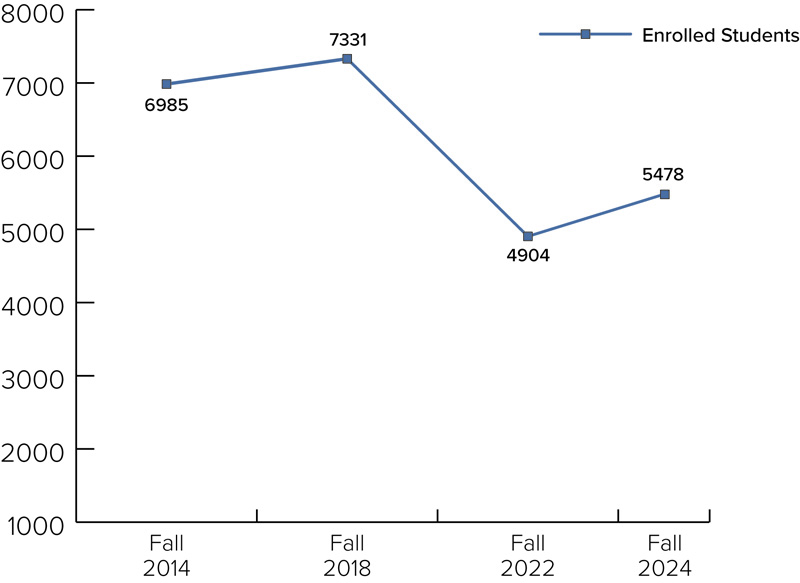
The COVID pandemic in 2020 had a devastating impact on all aspects of life for several years, including higher education, with lingering effects today. The pandemic negatively affected CUNY’s enrollment, which fell to a low of 225,881 in fall 2022, but has rebounded by almost 12,000 students since. Overall enrollment in the CUNY system in fall 2024 was almost a quarter of a million students, with a headcount of 237,671, down from 275,132 in fall 2014, but the highest enrollment over the past decade. Enrollment at Hostos Community College grew from 6,985 in fall 2014 to a high of 7,331 in 2018, then fell dramatically to 4,904 in 2022, recovering to 5,478 in fall 2024, the most recent fall enrollment data available.
Figure 9: Enrollments
Credit: CUNY Hostos Community College
Hostos Community College is in the Bronx, one of the poorest congressional districts in the United States. Over 90 percent of its students are from underrepresented minority groups and over 65 percent receive Pell Grants. College leaders have cited their commitment to meeting human needs as part of the college mission and have recognized the overall challenge of affordability of college and living expenses for students. These challenges included food and housing insecurity, childcare needs of students who are parents, transportation challenges, costs of books and educational materials, clothing for interviews and internships, internet and computer access, and more.
Access and affordability are core parts of the CUNY mission and have been priorities in years past as well as during the pandemic. Interviewees identified several barriers to student success: cost of tuition; application fee and process; multiple applications for federal, state, and institutional aid; transportation; online options lacking for certificates and degrees; costs of study abroad; unfairness of unpaid internships; and loss of credits toward degrees for transfer students. An underlying challenge was prospective students’ lack of familiarity with college and the need for strategies for navigating the first year for these largely first-generation students. Each of these barriers have been addressed with changes in policies and practices to support student success.
Actions Taken That Made a Difference
Reflecting a holistic approach to addressing student needs and an understanding that the institution needs to change to remove barriers and provide systematic support, at Hostos we found solutions that reflected each of these key areas, combined in a variety of ways: data-based decision-making, holistic advising, recognition of students’ basic needs, attention to affordability/access, and changes in leadership/governance. We have categorized these solutions as “Structuring the Institution for Student Success” and “Identifying and Removing Barriers to Access and Progression.” Strategies were informed by data, policies were changed to support new practices, and the cabinet, president, and board were guided by a shared focus on a strategic plan that centered on student success. Although not an exhaustive account of their efforts, what follows are highlights of actions for improved student success at CUNY and Hostos.
Structure the Institution for Student Success
The CUNY board was restructured, and a new educational policy committee was created in fall 2022, along with a subcommittee on enrollment, chaired by the board chair. Form follows function and reflects the importance of these areas. Then-Board Secretary Gayle Horwitz commented that the new board structure also reflected other changes in board culture—a more engaged board, more robust agendas, data-driven reports, and data-informed board decisions.
CUNY leaders—the board chair, system chancellor, and Hostos president—all prioritize student success. This is evident in the strategic plan, priorities of the board, and the KPIs for every institution in the system, including Hostos. The board, system, president, and cabinet were driven by the need to understand student issues and learn from data as well as from students’ firsthand accounts. For example, the student trustee on the board is credited with raising issues in a board meeting about internet and computer access when the pandemic hit, and the board responded by ordering 100,000 laptops for CUNY students and arranging delivery to campuses in the Bronx. The system made the transition to online instruction a week after the pandemic was declared.
The Hostos president and cabinet members also recognized the importance of communication with students. President Daisy De Filippis meets with the student government association monthly, along with Senior Vice President Esther Rodriguez-Chardavoyne, who commented, “The cabinet gets along well and Daisy fosters working together.” Other administrators also echoed the expectation that all cabinet members will work together to support student success—noting the president expects collaboration. Evelyn Fernandez-Ketcham added that making the vice president for continuing education and workforce development a cabinet position gave her a seat at the table and has increased matriculation of continuing-education students.
CUNY has also invested in data systems to identify barriers to student success and inform board decisions. These include platforms to map degree pathways and monitor applicants during the matriculation process and to continue to monitor students’ progress in communicating with students, faculty members, and advisers. This included contracts for data systems for each institution as well as training for advisers. The Hostos cabinet employed these data systems to develop many of the strategies used to remove barriers at the college. This focus on data was a common practice across case-study institutions.
These leaders focused on identifying and removing barriers to student success using a variety of methods:
- CUNY Transfer Initiative—A board resolution in 2023 set a timetable and directed the system administration to institute seamless transfer within CUNY and eliminate credit loss during transfer. Working with Wendy Hensel, the system’s chief academic officer at the time, disciplinary faculty groups aligned two-year and four-year college-degree pathways, and administrators implemented timely decision-making on transfer applications. This led to an increase in credits accepted in degree pathways for the most popular degrees. This will benefit approximately 15,000 “upward transfer” CUNY students annually (transferring from community colleges to senior institutions), starting in fall 2025. A key to success was taking a competency-based approach to evaluating required learning, rather than looking for identical texts and courses. Provost Hensel cited the sense of urgency created by “catastrophic” drops in enrollment during the pandemic and persuasive data supporting such change, along with personal stories of student government leaders. A clear board resolution contributed to the sense of urgency in achieving changes within 18 months; the board chair was quoted as saying, “this won’t take two years” in setting a timeline. As the provost described it, this change was not tinkering around the edges; policies that got in the way were changed. This included changes in courses offered and timely transfers out of community colleges by advising students not to accumulate additional credits that would not count toward degrees.
- Investment in Technology—CUNY implemented an online platform to show students which courses are part of bachelor’s degree pathways, as well as predictive analytics to identify students’ needs and proactively reach out to them with timely and targeted advising. Triggers included not registering on time, registering for too many highly demanding courses at once, not opening course materials online, failing a test in the first few weeks of a gateway course, and failing to pay fees. Training was also included for advisers.
- Auto-admit for Qualified NYC High-school Graduates and Waiver of Application Fees—This change and an agreement reached between CUNY and the City of New York led to an immediate increase in applications and enrollment. The board approved a waiver of application fees and instituted a process for timely acceptance letters to be sent to graduating students at public high schools in NYC. This practice will be expanded to private high schools in NYC in the 2025–2026 academic year. More than a dozen other states have instituted an auto-admit process for qualified high school students to public colleges, and New Jersey is proposing to do so.104
- College Now—CUNY’s dual-enrollment program for high-school students from NYC public schools was extended to include independent and parochial schools, developing new enrollment pipelines. CUNY’s board authorized a tuition structure and initiative for this in May 2024.
- CUNY Online—Using $8 million in federal stimulus funds during the pandemic, in 2022 CUNY expanded online course offerings, degrees, and programs throughout the system. This included support for development and instructional delivery of online courses, as well as student-support services and enhanced technology. This included completing the formulation of more than a dozen new degree programs by 2023. Online courses and complete online programs are designed to increase access, especially for adult learners in high-demand fields.
- CUNY CARES—Robust advising and holistic approaches to student needs; advising was integrated to encompass academic, career, mental health, financial, transportation, housing, food, and other needs, all considered essential parts of academic needs. The system invested in targeted aid, including public transportation passes, food pantries, childcare, on-campus employment, need-based scholarships, and paid internships.
- CUNY Comeback Program—This initiative erased more than $100 million in unpaid tuition and fees for more than 57,000 students and distributed $455 million in emergency grants to students from federal stimulus funds.
- Eliminated Hold on Transcripts for Debt—In August 2021, CUNY ended the policy that banned CUNY colleges from releasing transcripts for students and graduates with unpaid tuition and fees. By January 2022, CUNY had released transcripts for 42,852 students.105 See highlights of this policy change on the chancellor’s webpage.
- CUNY Fast—In 2024–2025, this CUNY program worked with high schools and colleges to increase completion of the Free Application for Federal Student Aid (FAFSA), Tuition Assistance Program, and New York State Dream Act applications for incoming CUNY students.106 When there were delays in the FAFSA application process in 2023 and 2024, CUNY nonetheless proudly saw an increase in completed financial aid applications.
- CUNY Reconnect—There are four million working-age adults in New York without a postsecondary credential. In FY23 and FY24, CUNY Reconnect included increased outreach, in-person and virtual enrollment counseling, and spent $2.8 million for Forgiveness and Completion Grants to attract older students to college. On July 1, 2025, New York’s Governor Kathy Hochul approved free community college for CUNY and SUNY starting in fall 2025 for adults between the ages of 25 and 55 who seek to pursue credentials in high-demand career fields. Said NYC Council Member Eric Dinowitz, “Governor Hochul’s program will significantly expand the reach and impact of CUNY Reconnect, which launched in 2022. As of fall 2024, CUNY Reconnect has supported over 40,000 New Yorkers in their efforts to return to college. Drawing from the proven strategies of outreach, re-enrollment, and support services that made Reconnect successful, the governor’s program expands this work by providing tuition-free pathways specifically aligned with labor market needs.”107
- Fundraising and Philanthropy—In addition to efforts to reduce student costs and forgive debts, fundraising and philanthropy directly support student needs through scholarships, mentoring, and other support programs. According to Collette Atkins, vice president for institutional advancement and executive director of the philanthropic foundation for Hostos, its board is focused on student needs such as emergency grants for utilities and housing, a food pantry, support for parents and expectant parents, paid internships, a scholarship endowment for students who have run out of other aid, mentoring for STEM students, and peer mentoring for transfer students. The foundation board is focused on emerging needs and supporting the institutional strategic plan. The percentage of alumni giving to the foundation and the amounts raised are important metrics. In addition, in 2021, a $15 million gift from MacKenzie Scott was the largest gift Hostos had ever received. It led to the creation of a multifaceted plan, the “President’s Initiative for Student Success, College Growth, and Stakeholders’ Engagement,” that included establishing a research center for improving student success, mentorship through on-campus jobs, financial aid, internships, and research grants. The research center provides grants to faculty for research that includes student research assistants and has resulted in many high-impact student experiences.108
More information about these initiatives is available on the CUNY Board of Trustees website.
Notes
87 U.S. Department of Education, “U.S. Department of Education Announces First-Ever Postsecondary Success Recognition Program Winners,” press release, January 8, 2025, https://web.archive.org/web/20250119062102/https://www.ed.gov/about/news/press-release/us-department-of-education-announces-first-ever-postsecondary-success-recognition-program-winners.
88 “City University of New York—Board of Trustees,” NYC Green Book, accessed September 24, 2025, https://a856-gbol.nyc.gov/GBOLWebsite/GreenBook/Details?orgId=2907.
89 “The Board of Trustees,” The City University of New York, accessed September 24, 2025, https://www.cuny.edu/about/trustees/the-board-of-trustees/.
90 “Chancellor Félix V. Matos Rodríguez,” The City University of New York, accessed September 24, 2025, https://www.cuny.edu/about/chancellor/.
91 “Office of the President,” CUNY Hostos Community College, accessed September 24, 2025, https://www.hostos.cuny.edu/Administrative-Offices/Office-of-the-President.
92 Office of Institutional Research and Assessment, “Performance Management Process 2020–2021 Data Book,” City University of New York, accessed September 26, 2025, https://www.cuny.edu/wp-content/uploads/sites/4/page-assets/about/administration/offices/oira/institutional/data/current-student-data-book-by-subject/PMP_2021_University_Databook_FINAL_2021-09-13.pdf.
93 City University of New York, “Executive Compensation Plan Performance Appraisal Tool,” accessed September 26, 2025, https://www.cuny.edu/wp-content/uploads/sites/4/media-assets/Executive-Compensation-Plan-Evaluation-11.4.24.pdf.
94 Education Commission of the States, “Postsecondary Governance Structures 2020,” accessed September 24, 2025, https://reports.ecs.org/comparisons/postsecondary-governance-structures-2020-overviews-01.
95 New York State Education Department, “About the University of the State of New York (USNY),” accessed September 26, 2025, https://www.nysed.gov/about/about-usny.
96 State University of New York, “SUNY Governance,” accessed September 26, 2025, https://system.suny.edu/academic-affairs/suny-governance/.
97 “New York State Profile,” Education Commission of the States, accessed September 26, 2025, https://www.ecs.org/wp-content/uploads/NewYorkPSG.pdf.
100 State University of New York, “You’re Accepted! Governor Hochul Launches New Initiative to Help New York Students Enroll at Public Colleges and Universities,” press release, October 24, 2024, https://www.suny.edu/suny-news/press-releases/10-24/10-24-24/top10promise.html.
102 City University of New York, “About CUNY,” accessed September 26, 2025, https://www.cuny.edu/about/.
104 Liz Rosenberg, “Top N.J. students would automatically get into colleges under plan to stop ‘brain drain,’” NJ.com, July 25, 2025, https://www.nj.com/education/2025/07/top-nj-students-would-automatically-get-into-colleges-under-plan-to-stop-brain-drain.html.
105 “Governor Hochul Announces CUNY Formally Discontinues Practice of Withholding Transcripts from Students and Grads with Unpaid Balances,” CUNY News, January 31, 2022, https://www.cuny.edu/news/governor-hochul-announces-cuny-formally-discontinues-practice-of-withholding-transcripts-from-students-and-grads-with-unpaid-balances/.
106 “Board of Trustees, The City University of New York, Summary of Actions Taken by the Subcommittee on Enrollment at its September 30, 2024 Meeting,” accessed September 29, 2025, https://policy.cuny.edu/policy/wp-content/uploads/sites/6/page-assets/documents/academic-policy/ENROLLMENT202409-30Summary.pdf.
107 “ICYMI: Governor Hochul Launches New York’s Free Community College Program for In-Demand Fields,” CUNY News, July 1, 2025, https://www.cuny.edu/news/icymi-governor-hochul-launches-new-yorks-free-community-college-program-for-in-demand-fields/.
108 “Ms. MacKenzie Scott’s Gift: President’s Initiatives for Student Success, College Growth and Stakeholders’ Engagement,” CUNY Hostos Community College, accessed September 29, 2025, https://www.hostos.cuny.edu/Administrative-Offices/Office-of-the-President/PISSIG/.