
 Chat with AGB Board Bot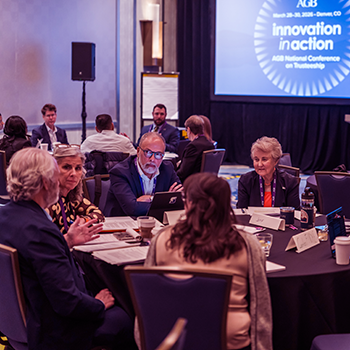
Opinions expressed in AGB blogs are those of the authors and not necessarily those of the institutions that employ them or of AGB.
In late March, AGB hosted the annual National Conference on Trusteeship, which brought together board chairs, trustees, presidents/chief executives, board professionals, and other experts from across the higher education sector.
As a member of the AGB Consulting team, I’m in the fortunate position to hear about members’ unique challenges and their discussions in the conference’s plenary and concurrent sessions. I spoke with dozens of AGB members, and their questions and concerns reflect the challenges most boards and presidents face.
Here are the five questions I heard them ask most frequently. If you or your governing board are asking these same governance and leadership questions, AGB can help you and your team.
1. We have a new leader coming, or we know we’ll need one soon. How does our board prepare?
At times, it felt like every institution and system in the room was searching for or onboarding a new president or chancellor. Presidential terms have been shrinking for years, putting many boards in a seemingly perpetual state of transition. For instance, the longest serving Big Ten president or chancellor, President Darryl Pines at the University of Maryland, College Park, has been in that seat for only six years.
Hiring a new president presents opportunities—and risks—so it’s important to get the transition right. However, boards are divided in their approaches. Unprepared boards are relying on the hope that their new president can turn things around. Better-prepared boards have multi-step transition plans that start 90 days before a president departs and run for months after.
However, some of the most prepared boards are drafting new strategic plans before searching for a new president. They’re finding leaders to fit the institution’s strategy, not strategies to fit their leader. Not every board gets this opportunity, but those who do should seize it.
If your board is asking this question, AGB and AGB Search can help you prepare for your upcoming transition.
2. How can we prepare our board leadership and our senior leadership for continued change?
Transitions aren’t just presidential. Board officers, board members, and senior leadership teams are in a constant state of flux.
If you’re a governing board officer or committee chair, ask yourself: After I leave my role, who’s next? If you don’t have a clear answer, work with your board chair to get an answer. If there’s no one on your board ready to step into your role, talk to the nominations or governance committee chair. Your institution needs you to be ready for transition.
That thinking should extend to your senior leadership team. Frequent presidential transition means senior leadership teams will also churn. Even if you have a president who is stable in their position, other institutions may recruit your senior leaders to take on new roles. Who at your institution can serve as an acting or interim vice president or dean? Who might be ready to take the role permanently? How can you prepare that person?
3. How can our faculty members become engines for innovation?
In 2016, I left my campus-based role to work in consulting to help answer this question. Ten years later, presidents and boards are still hearing it, but with greater urgency than ever before. An innovative faculty can help transform the institution’s academic portfolio and approach into one that better serves today’s students—one key to unlocking financial sustainability.
Healthy board-president-faculty governing relationships can drive innovation. When faculty feel supported and incentivized to participate in student success and innovation, they will. Our recent webinar on flexible strategy with Arizona State University President Michael Crow reinforced that message.
But it’s easier said than done. Every campus has its own faculty structure, culture, and relationship with its president and board, and every innovative faculty looks a little different. They share a few characteristics, though. Innovative faculties have a stable and trusting relationship with their president, the administration incentivizes adaptability, and successful educational initiatives can be scaled rapidly.
Transforming faculty governance and innovation requires customized support, and AGB’s senior consultants can help.
4. How do we protect our autonomy while focusing on financial sustainability?
Colleges and universities face existential threats, including attacks against their autonomy and weakening revenue streams. Those threats operate at different levels, making them hard to tackle at the same time. All higher education institutions face challenges to their institutional autonomy, while every institution’s revenue struggle is different—some institutions are seeing enrollments climb, while others must confront increased competition for students.
Colleges and universities need a strategy to address both at the same time, and they need presidents who can jump between the 10,000-foot level of institutional autonomy and their institutions’ immediate strategic and operational reality.
5. How do we onboard new governing board members and help them act as governors, not managers?
This question gave rise to AGB 103 years ago, and it’s still relevant today. Boards need to know about more aspects of higher education than ever before, and because presidential terms are shrinking, they often need to support a broader range of decisions than ever before.
I spoke with board chairs struggling to rein in an overactive board member, board professionals struggling to onboard new board members, and presidents wanting their boards to provide strategic and philanthropic direction.
The National Conference on Trusteeship helped answer those questions, and AGB has many supplemental resources, including an online onboarding program, primers for each committee in the library, and custom workshops and retreats on effective board leadership. AGB’s newest publication, Top Strategic Issues for Boards 2026–2027, also provides critical context and related questions to help guide strategic board-level conversations about all these topics.
Justin Kollinger is associate vice president of AGB Consulting and a co-author of Risk Management: An Accountability Guide for University and College Boards, Second Edition. Contact him at jkollinger@agb.org or AGB’s membership team at Membership@agb.org to discuss how AGB can support you.