
 Chat with AGB Board Bot
The following case study is based on interviews and information collected in 2025, unless noted otherwise.
Description of the Institution
Kean University leaders take great pride in the deep roots the institution has established in the community. Leaders describe Kean as an urban anchor university that is widely recognized as integral to the community’s vitality and is actively engaged in helping the community overcome its challenges and forge partnerships. Kean University has evolved from its founding as a teachers college in 1855 into a comprehensive, global institution that today serves a diverse population of over 17,000 students. In February 2025, Kean University achieved an R2 research designation from the Carnegie Classification of IHEs, meaning that Kean is recognized for its doctoral programs and high level of research activity. In 2025, Kean was ranked number 81 nationally for social mobility by U.S. News & World Report (the institution has been ranked among the top universities in social mobility for seven consecutive years).109 Kean’s President, Lamont O. Repollet, EdD, said that “Reaching this tremendous milestone has been my goal since I became president.” In terms of student success, Repollet believes that building a research culture at Kean “will shape the future of Kean and drive meaningful change for our students and communities.”110
Kean offers over 50 undergraduate programs, 70 graduate programs, and 23 online programs that provide students with opportunities to learn on their own schedule. Additionally, Kean offers numerous opportunities for students to study abroad, including at a fully English-speaking campus in China, Wenzhou-Kean University.111
Leadership
President Repollet began his tenure as president at Kean University in July 2020, during the height of the COVID crisis. Despite this initial challenge, Repollet led Kean into a period of transformative growth and innovation that has elevated its national profile and expanded its global impact. Since his appointment, Repollet has championed initiatives that have advanced research capacity, strengthened workforce pipelines, created innovative dual-degree partnerships with institutions such as Howard University, expanded international exchange opportunities, and established Kean as a national model for student success. Under Repollet’s leadership, Kean achieved a historic milestone with its Carnegie R2 designation and received national recognition from U.S. News & World Report for advancing social mobility, which further reflects its expanding role as a driver of opportunity and excellence.112
Before arriving at Kean, Repollet made history as New Jersey’s first Black commissioner of education. He also held other leadership positions in education, including as a former member of Kean’s board, public-school superintendent, principal, teacher, and coach.113
Description of the Board
“Kean is a public university governed by a board of trustees and managed by a president duly appointed by the board. The board currently consists of 15 members appointed by the governor of New Jersey, as well as a student trustee representative elected annually by the student body. Pursuant to the Higher Education Restructuring Act of 1994 [state-level], the board has general supervision and oversight over the university. The president is responsible for the day-to-day operations of the university and the implementation of policies established by the board.”114
The Kean University Board of Trustees has nine standing committees, which report to the board “to aid it in carrying on the business of the University.” Although the business conducted by all the standing committees is vital to student success, the academic policy and programs committee has the primary responsibility for oversight and guidance of the university’s student success initiatives/efforts.115
Leaders and Contributors to this Case Study
This case study of Kean University’s support for student success had the generous support and cooperation of 11 board members and key administrators from the university and the Kean University Foundation, as well as their overall boards of trustees and directors:
- Lamont O. Repollet, president
- Felice Vazquez, senior vice president for planning and special counsel to the president
- Steve Fastook, chair, board of trustees
- Linda Lewis, vice chair, board of trustees
- Thomas J. Bistocchi, secretary, board of trustees
- Joseph Youngblood, senior vice president for external affairs
- Katherine Gallagher, senior vice president for student success and retention, special counsel to the president
- Michael Salvatore, vice president for administration
- Mathew Caruso, chief advancement officer
- William H. Miller, president and CEO, Kean University Foundation
- Edward Ahart, chief development officer, Kean University Foundation
Description of the State
The governance of higher education in New Jersey is managed by a tripartite system established by the state’s Higher Education Restructuring Act of 1994. New Jersey has a dynamic higher education environment that is coordinated by the Office of the Secretary of Education, a Presidents’ Council, and individual trustee boards of colleges and universities.116
The State of New Jersey Office of the Secretary of Higher Education “leads statewide planning and policy development, advocates for institutions’ postsecondary issues, administers state and federal programs, produces data analysis and research reports, licenses institutions, and oversees accountability programs. The secretary of higher education, who is appointed by the governor with consent of the senate, advances statewide goals and submits recommendations on the higher education budget and student aid levels to the governor and legislature.”117
The presidents’ council consists of New Jersey college and university presidents, who focus on collaboration and shared goals. Individual trustee boards of universities and colleges provide institutional oversight and strategic direction. New Jersey has 11 public institution governing boards. State statute gives each one the authority to determine its board size as long it has between seven and 15 members, excluding the president.
In recent years, New Jersey has launched several initiatives to improve college affordability through the State Plan for Higher Education that have been designed to “enhance postsecondary opportunities while promoting equity and access for all through programs such as the state’s Community College Opportunity Grant.”118 Other programs and initiatives include NJ STARS, which provides free tuition for top high school graduates attending community colleges, and the Edward J. Bloustein Distinguished Scholar Program that awards scholarships to high-achieving students. The New Jersey Higher Education Student Assistance Authority administers state financial aid programs.
For more information, visit AGB’s state profiles.
Strategic Plan Focused on Student Success
Kean University is in the final year of a five-year strategic plan, “Beyond 2020: Kean University Strategic Plan 2020–2025.” This strategic plan reflects Kean’s commitment to inclusive excellence and student success:
Kean University maintains its focus on ensuring the success of all students from enrollment through graduation and beyond in its new strategic plan, “Elevate 2030,” that was announced in September 2025. The plan builds on the accomplishments of Kean’s past five years, during which it has emerged as New Jersey’s first urban research university, a designation that was approved by the New Jersey legislature in November 2021. This classification recognizes Kean’s commitment to conducting research and finding solutions for issues that are specific to urban environments and the people who live there.119 Additionally, this status provides additional funding for and aligns with the university’s efforts to advance student success, drive economic growth, and foster innovation nationally.
Key Data, Metrics, and Dashboards
Kean University’s “Beyond 2020: Kean University Strategic Plan for 2020–2025” measured success using KPIs based on its stated objectives. The stated objectives and KPIs specific to student success are listed here.
Academic Excellence and Student Success
- Student performance:
- Graduation rates;
- Retention rates;
- Student achievement in gateway courses; and
- Use of advising and early-alert platforms.
- Curriculum redesign: Redesign of the curriculum that would enhance support for student success in and after college.
- Hight-impact practices (HIP): The implementation of HIPs in core curricula and assessment of results by tracking student-learning outcomes.
- Student support services: Enhancement and strengthening of student-support services and measurement of their usage (such as students accessing more academic support services and financial aid).
- Wellness framework: Development and implementation of a comprehensive wellness framework and measurement of students’ increased access to wellness resources, as well as surveys of campus climate assessing students’ sense of belonging.
Figure 10: Kean University Dashboard
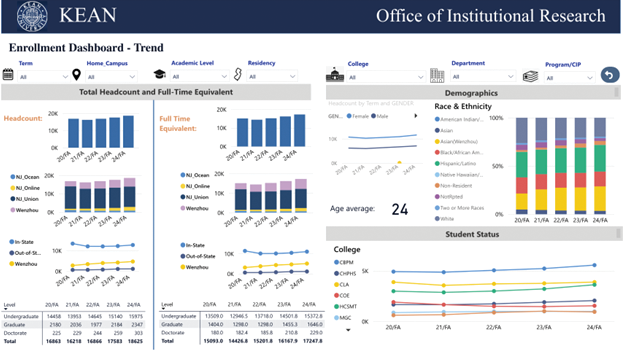
This dashboard of Kean’s Enrollment Trends illustrates metrics used to measure performance.
Credit: Kean University
Kean improved four-year, five-year, and six-year student retention and graduation rates across cohorts (see figure 10). The fall 2020 freshman cohort achieved the highest four-year graduation rate in the past decade.
Barriers to Student Success
Kean University faced several associated challenges that hindered the success of its students. Early in his tenure, President Repollet recognized that Kean’s traditional approach to student success assumed that its structures, teaching methods, and support systems were fixed and had not been adapted to meet students’ needs, suggesting that much of the responsibility for student success rested with the students. Referencing Carol Dweck’s book, Mindset: The New Psychology of Success,120 Repollet determined that a broader shift in the institutional mindset was needed—one that prompted the executive team, faculty, and other administrators to examine how institutional practices could evolve to better support students.
Another significant challenge was the issue of mental health and well-being. President Repollet began his tenure during the height of the COVID-19 pandemic, a period when students, faculty, and staff experienced high levels of anxiety and isolation. Like many colleges, Kean lost the sense of community on campus and feelings of disconnection were heightened during the pandemic.
Academic structures also contributed to institutional challenges. An assessment of Kean’s general education curriculum described it as a “sprawling curriculum with a vast array of course choices” that creates “course chaos.” This lack of coherence increased costs and negatively impacted student outcomes.
The university’s enrollment pressures were intensified by the pandemic. A large proportion of Kean’s students—31.6 percent—receive Pell Grants, which underscores the financial vulnerability of the student body. As one administrator noted, “Many of our students are one flat tire away from having to drop out of school.” This reality draws attention to the fragile relationship between student persistence and attrition.
Finally, “data silos” were barriers to collaboration, transparency, and data-informed decision-making. Without integrated access to data, Kean struggled to generate insights that could guide strategic action, improve outcomes, and build accountability across the university.
Actions Taken That Made a Difference
Participants in this case study found that institutional leaders assessed emerging needs and responded by establishing new administrative units and programs designed to address the challenges and strengthen organizational capacity. Kean also leveraged a partnership to launch the Moonshot for Kean initiative which helped the institution “to accelerate the elimination of equity gaps and strengthen proactive advising, student navigation, and administrative reform to bolster retention and graduation rates,” said Michael Salvatore, vice president for administration. These actions required significant financial investment and were supported, in part, by resolutions passed by Kean’s board of trustees.
Division of Student Success and Retention (DSSR)
This was the first of the new administrative units established to advance student success. DSSR provides comprehensive services and support to all students as they matriculate at Kean University. DSSR staff use data-informed, high-impact practices to help students persist to graduation. Committed to every student’s success, the departments within the division work to help students feel a sense of belonging within the Kean community. Over the last five years, Kean expanded student-support systems, including call centers which improved the university’s outreach operations. DSSR consists of the following departments that are essential elements of Kean’s student success and retention strategies:
- Dean of Students Office: Provides strategic leadership and management for success programs and services.
- Center for Advising, Persistence, and Success: Provides culturally responsive advising, programming, and planning that support successful student transitions at Kean.
- Educational Opportunity Fund: Promotes access to financially disadvantaged students defined by the State of New Jersey, including support services, required workshops on skill development, and other strategies critical to academic success.
- Office of Student Retention and Educational Innovation: Coordinates support services Focus on First Gen (Resources), Pop Up Shop (Professional Wardrobe), 1/2 Way to Graduation Ceremony.
- Office of Financial Aid and Scholarship Services: Provides financial support.
- SUPERA: Provides educational access for Spanish-speaking students who are learning the English language.
- Bridge to Success Program: Provides access for students who do not fully meet admission requirements but show the potential to succeed at Kean.
- Center for Veteran Student Success: Provides guidance and support to students who are military veterans.121
Division of Strategic Analytics and Data Illumination (SADI)
This unit was established to foster data-driven decision-making. The division was established to lead the effort to “create a data-centric culture, moving from insight to action” and tell Kean University’s story. SADI serves as “a central hub for university data acquisition, reporting, analysis, governance, assessment, and accreditation.”122
General Education Curriculum (GEC)
“The new GEC aims to recreate general education at Kean University so that we give our students a unique inquiry-based and place-based experiential-learning opportunity that will launch them into their major areas of study.”123 Kean formed a GEC taskforce in 2022. Its charge was “to explore how to apply the vision of a more distinctive, legible, and linear General Education Program to Kean.”124 The taskforce consisted of representatives from all colleges and members representing students’ interests.
The GEC taskforce has worked collaboratively to:
The taskforce’s work culminated in summer 2025 with the “Proposal to Revise General Education” at Kean. According to the proposal, the revised “General Education Program will support a range of institutional needs and mandates” including fostering a sense of belonging, decreasing achievement gaps, support increased student persistence, retention, and completion rates, improve students’ preparedness for academic programs, and strengthen the sense of community at Kean.125 In fall 2025, nearly half of the incoming freshmen are enrolled in the revised general education program pilot which consists of thematic learning communities and experiential-learning opportunities for students. Opening hearings in collaboration with the university senate to solicit feedback on the proposal will also be held during fall 2025. This feedback along with the findings from pilot faculty and student surveys will be used to inform revisions to the proposal. After the review and approval process, which includes the university senate, office of the provost, president, and board of trustees, the General Education Implementation Committee will develop plan to enroll 2000 freshmen in the program for fall 2026.
Board Engagement
The study found that the active engagement of the university’s board of trustees, especially through its committees, has been essential to advancing student success at Kean University. Board members demonstrate a clear understanding of governance and their fiduciary responsibilities. Board leaders and cabinet executives consistently attributed Kean’s success toward improving student outcomes to President Repollet’s leadership. The trust Repollet established as a board member carried over to his presidency. Remarked Steve Fastook, chair of Kean’s board, “President Repollet’s combination of charisma and ability” inspires action and drives success. The board of trustees’ commitment to supporting the mission of the institution and the vision for student success is evident and clearly articulated in Goal 3 of Kean University’s 2020–2025 Strategic Plan.
President Repollet plays a crucial role in maintaining this goal’s focus and ensuring that the leadership team and the board are aligned. Board Chair Steve Fastook praised President Repollet for his ability to build and lead a high-performing executive team that integrates new professionals recruited to Kean and leaders from the prior administration.
Board members at Kean understand the difference between the board’s oversight role and wading into the murky waters of operations, which is the role of administrators. Board members have been successful, said Fastook, at “resisting the natural tendency to get into institutional operations.” Instead, he said, “the board focuses on asking the right questions, taking a practical approach to decision-making that is informed by information provided to them by the president and other administrators.” Kean’s board of trustees, he continued, is guided by its vision of “what the university should be like and feel like.” When asked about the board’s role in advancing student success, Linda Lewis, board vice chair, commented that its focus on students “has been consistent over the years” and that the board “works with the leadership team to pinpoint challenges and determine direction toward improving retention and success.”
Led by Repollet, the leadership team has built and nurtures strong relationships with board members, creating a climate of mutual trust and accountability. Administrators consistently highlighted their appreciation for board members’ preparation for committee meetings and for challenging them to expand the scope of their thinking. When asked about his time commitment to “board work,” Tom Bistocchi, secretary of the board and chair of the academic policy and programs committee, said he sometimes spends five hours or more to prepare for a committee meeting. “I read everything,” said Bistocchi. “I take and review notes, draft questions, and can’t wait to praise the team on the work they’re doing.” Bistocchi is a former public-school superintendent and recognized that he likely spends more time on preparation than is typical for board members but added that fellow board members are also well-prepared for committee meetings. “We are loaded with information and no one on our board ever says, ‘I wasn’t aware of it,’” regarding university business.
Fastook commented that regular engagement with AGB resources and a sustained focus on trustee education and development have contributed to the effectiveness of Kean’s board. These practices ensure that trustees remain informed about national trends, governance best practices, and their own performance. Kean has built a highly engaged model of governance. Their committees provide a strong foundation for progress and offer support to Kean’s president and executive team. This has been a key driver in the institution’s ability to remove barriers to change, implement new initiatives effectively, and improve outcomes aligned with the university’s mission.
Fundraising and Philanthropy
Fundraising and philanthropy support student success at Kean University by creating financial access to higher education through scholarships. Philanthropic gifts fund merit-based and need-based scholarships for students, which reduce the costs for students and their families for such items as tuition, housing, books, and other fees. The staff at the Kean University Foundation lead the fundraising and philanthropic efforts. The foundation has become an important partner in advancing student success through its mission to pursue private support to benefit Kean’s students, faculty, programs, and facilities at the university. Kean’s compelling, student-focused story as told by President Repollet has “opened the donor pool,” reported Fastook. The foundation’s efforts complement the broader institutionwide strategies to improve student outcomes. For example, private scholarships for Kean students such as the Climb to Success Scholarship and the Climb Higher Scholarship support Kean’s student success initiatives. Kean has increased scholarships by 22 percent in one year to remove financial barriers for students and expand access to the university, noted Salvatore.
Notes
109 Kean University, “Kean Recognized by ‘U.S. New & World Report’ for Advancing Social Mobility,” September 23, 2025, https://www.kean.edu/news/kean-university-recognized-us-news-world-report-advancing-social-mobility.
110 Kean University, “Kean University Earns Prestigious R2 Research Designation,” accessed October 3, 2025, https://www.kean.edu/news/kean-university-earns-prestigious-r2-research-designation.
111 Kean University, “About,” accessed October 3, 2025, https://www.kean.edu/about.
112 Kean University, “‘U.S. News & World Report’ Ranks Kean University Among Top in Nation for Social Mobility,” September 18, 2023, https://www.kean.edu/news/us-news-world-report-ranks-kean-university-among-top-nation-social-mobility.
113 Kean University, “About Dr. Lamont O. Repollet,” accessed October 3, 2025, https://www.kean.edu/about-dr-lamont-o-repollet.
114 Kean University, “Leadership and Governance,” accessed October 3, 2025, https://www.kean.edu/about/leadership-and-governance.
115 Kean University, “Members,” accessed October 3, 2025, https://www.kean.edu/about/board-trustees/members.
116 AGB, “State Profile: New Jersey,” January 21, 2020, https://agb.org/state-profiles/new-jersey/; State of New Jersey, “Higher Education: Assessing the Past, Looking to the Future,” accessed October 3, 2025, https://www.nj.gov/highereducation//reports/assess.htm; and Education Commission of the States, “Postsecondary Governance Structures 2020,” accessed October 3, 2025, https://reports.ecs.org/comparisons/postsecondary-governance-structures-2020-overviews-01.
117 Education Commission of the States, “Postsecondary Governance Structures 2020,” accessed September 26, 2025, https://reports.ecs.org/comparisons/postsecondary-governance-structures-2020-overviews-01.
118 New Jersey Council of County Colleges, “New Jersey Community College Opportunity Grant,” accessed October 3, 2025, https://www.njcommunitycolleges.org/ccog/.
119 Kean University, “Elevate 2030: Kean University Strategic Plan 2025–2030,” accessed October 3, 2025, https://www.kean.edu/media/kean-strategic-plan-2025.
121 Kean University, “Division of Student Success and Retention,” accessed October 3, 2025, https://www.kean.edu/offices/student-success-and-retention.
123 Kean University, “Provost’s Launch 2022–2023,” accessed October 5, 2025, https://www.kean.edu/offices/academic-affairs/general-education-curriculum-task-force/provosts-launch-2022-2023.
125 Kean University, “Proposal to Revise General Education,” accessed October 5, 2025, 4 https://www.kean.edu/media/proposal-revise-general-education-kean-summer-2025.