
 Chat with AGB Board Bot
For the last two decades, the higher education sector has been expecting a large decline in student enrollment due to changing population trends. Now the predicted “demographic cliff” is here. Boards and higher education leaders need to be aware of the changes in student demographics to forecast how these numbers may impact their institutions—and what they can do to thrive when there are fewer traditional college-age students than in the last several decades.
Perhaps the most famous line in all of Ernest Hemingway’s novels is the answer that the belligerent Mike Campbell gives in The Sun Also Rises when asked how he went bankrupt. “Gradually, then suddenly,” the Scotsman replies.
That’s the fear in the back of the minds of college trustees of institutions that may already be struggling to keep up enrollments and stem losses or worried that their operating revenues could swiftly turn from black to red.
Exacerbating those concerns, the nation’s high school graduating Class of 2025 was the largest there will be for the foreseeable future. Those young men and women were among the 4.3 million babies born in the United States in 2007, even more than at the 1957 peak of the post–World War II baby boom. In 2010, that number had fallen to 3. 9 million, and it has generally continued to decline. In 2024, which had the lowest fertility rate on record, just 3.6 million babies were born, a staggering drop of almost 17 percent from the peak.
Unfortunately, that means that the number of high school graduates—and thus potential college enrollees—will most likely not increase much or even keep pace for a good while. In fact, experts predict that by the beginning of the next decade, enrollment will fall 5 percent nationally, including 16 percent fewer students in California and 14 percent fewer in New York, according to the National Center for Education Statistics.1
The long-feared demographic cliff is here.
That said, the situation is mixed, and the dreaded cliff will impact different institutions to different degrees. The number of births is expected to vary somewhat from year to year and even more from region to region. While the population is dropping in the Northeast and the Midwest, it is growing in the South—in Texas and Florida in particular. Other projected growth states are Iowa, Alabama, South Carolina, Tennessee, Idaho, Montana, Utah, and North and South Dakota.
According to the annual Knocking at the Door report by the Western Interstate Commission for Higher Education (WICHE), which has tracked enrollments since 1979, some 38 states will see declines in the number of high school graduates by 2041.2 “Declines in the West, Midwest, and Northeast regions are starker than originally projected, yet the South is anticipated to grow,” WICHE forecast.
Overall, however, while there may be fluctuations and variations, Nathan D. Grawe, a Carleton College economist and author of Demographics and the Demand for Higher Education (Johns Hopkins University Press, 2018), concluded, “you could make a good argument that we are beginning a slide that will last for at least the next 18 years.”
Apart from the number of babies being born, other troubling social forces and trends will continue to impact enrollment, including the steep fall in public confidence in higher education and the change in the belief that a college diploma is the surest path to a prosperous, successful life. Students and their families are also increasingly reluctant to go deeply into debt to pay for college.
Moreover, of the students who graduate from high school, significantly fewer are choosing to attend college right away. Less than 63 percent enrolled directly in two-year and four-year colleges in 2024 compared to 70 percent in 2016, according to the U.S. Bureau of Labor Statistics.3 Men in particular are rejecting college and immediately entering the workforce instead.
And while colleges and universities have stepped up efforts to enroll more older students to make up for the drop in traditional students, most undergraduates still are—and will probably continue to be—under 25, including 85 percent of full-time undergraduates at four-year institutions and 79 percent at two-year colleges, according to the National Center for Education Statistics.4
College may not be able to depend on international students to help fill empty classroom seats either. The U.S. State Department and the Institute of International Education will release in November its census of international enrollments for 2024–2025, but that won’t show the full effect of the Trump administration’s tighter immigration rules and slowdown in processing visa applications. A record 1,126,690 international students, or 5.9 percent of the 19 million students at U.S. colleges and universities, studied here in 2023–2024.5 (That number includes a quarter-million who earned their degrees and were allowed to gain work experience in their field afterwards for 12 months or longer.) But given such new federal regulations, whether international students will continue to enroll at the same pace remains a looming question.
Finally, too many people who start college never make it across the finish line. They continue to drop out—and sometimes quite soon after enrollment. Census Bureau data show that, as of 2024, only 40 percent of women and 37 percent of men age 25 and older hold a bachelor’s degree or higher.6
Taking all these trends together, the emerging situation will surely be a challenging one for many if not most colleges and universities moving forward. What will be the impact, both short-term and long-term? How can colleges successfully grapple with demographic and other enrollment issues, and how should their governing boards guide them? What strategies are institutions already pursuing or considering?
To provide some context for boards, what follows are further data, case studies, and a few recommendations gleaned from interviews conducted with leaders from both private and public institutions of various sizes in different areas of the country.
Winners and Losers
An ominous, headline-grabbing prediction by Harvard Business School professor Clayton Christensen in 2013 that 25 percent of all colleges “will disappear or merge in the next 10 to 15 years” didn’t happen. The number actually has been much smaller, including at least 16 mostly small, private institutions in 2024, according to Inside Higher Ed. However, many higher education leaders fear that number will start to multiply over the years ahead.
Public universities won’t be exempt from the pressure on enrollments either. While state flagship universities are attracting more students, some consolidation is already taking place among regional institutions struggling with sagging enrollments. The Pennsylvania State System of Higher Education (PASSHE), for example, merged six of its 10 regional institutions into two in 2022, but overall enrollment has continued to drop—from almost 120,000 students in 2010 to 82,500 in fall 2024, despite a long freeze on tuition and increased state support.
Indeed, going forward, there will be winners and losers, haves and have-nots, among all sorts of colleges and universities based on various factors like their type, location, and financial resources. Vanderbilt University in Nashville, Tennessee, for instance, received a record 48,000 applications in 2025, admitting 15 percent of the 5,800 early applicants but only 3.3 percent of the 43,000 others. That’s fewer than the 3.6 percent Harvard accepted in 2024. In addition, Vanderbilt’s endowment in fiscal 2024 was $10.2 billion, making it the 19th largest.
Like Vanderbilt, besides being located in a growing are of the country, many of the “haves” in the application race have endowments in the billions of dollars and provide financial aid that can cover full tuition and more even for families with six-figure incomes. The average tuition in 2024–2025 was $30,780 at four-year public colleges and $43,350 at private, nonprofit ones, according to the College Board.7 Also, while tuition alone tops $65,000—not including room and board—at some private institutions, they have thus far depended significantly on tuition discounting to lure applicants. On average, they discounted their posted tuition by an astronomical 56.3 percent in 2024–25, the National Association of College and University Business Officers reported.8
Yet as enrollments drop, private college budgets will be increasingly pressured, making it impossible for a growing number to offer more and higher discounts to attract students. “I don’t see how their discount rates can get any higher,” said Donald Hossler, a professor emeritus of educational leadership and former vice chancellor for enrollment services at Indiana University.
Even institutions with lower tuition may be facing enrollment challenges. The typical community college charged just $4,050. But while a relative bargain, community colleges suffered a steep enrollment decline in the 2010s, dropping from 7.8 million in 2010 to 6 million in 2017. They subsequently climbed to 6.4 million credit students in fall 2023, according to the American Association of Community Colleges.9 They, too, however, face an uncertain future when it comes to enrollment growth.
Ultimately, boards will have to consider a number of factors when determining how to tackle enrollment pressures. Some specific examples follow of how various institutions, both private and public, are approaching the issues given their particular situations.
A Private Liberal Arts Institution Recalibrates
Donald Hossler’s undergraduate alma mater, California Lutheran University, is one of many private colleges grappling with how to sustain its enrollment. The Thousand Oaks, California, university, one of three dozen in the United States affiliated with the Lutheran Church, has 2,300 undergraduates and 1,000 graduate students. It had almost 3,000 undergraduates in 2019 after a decade of growth.
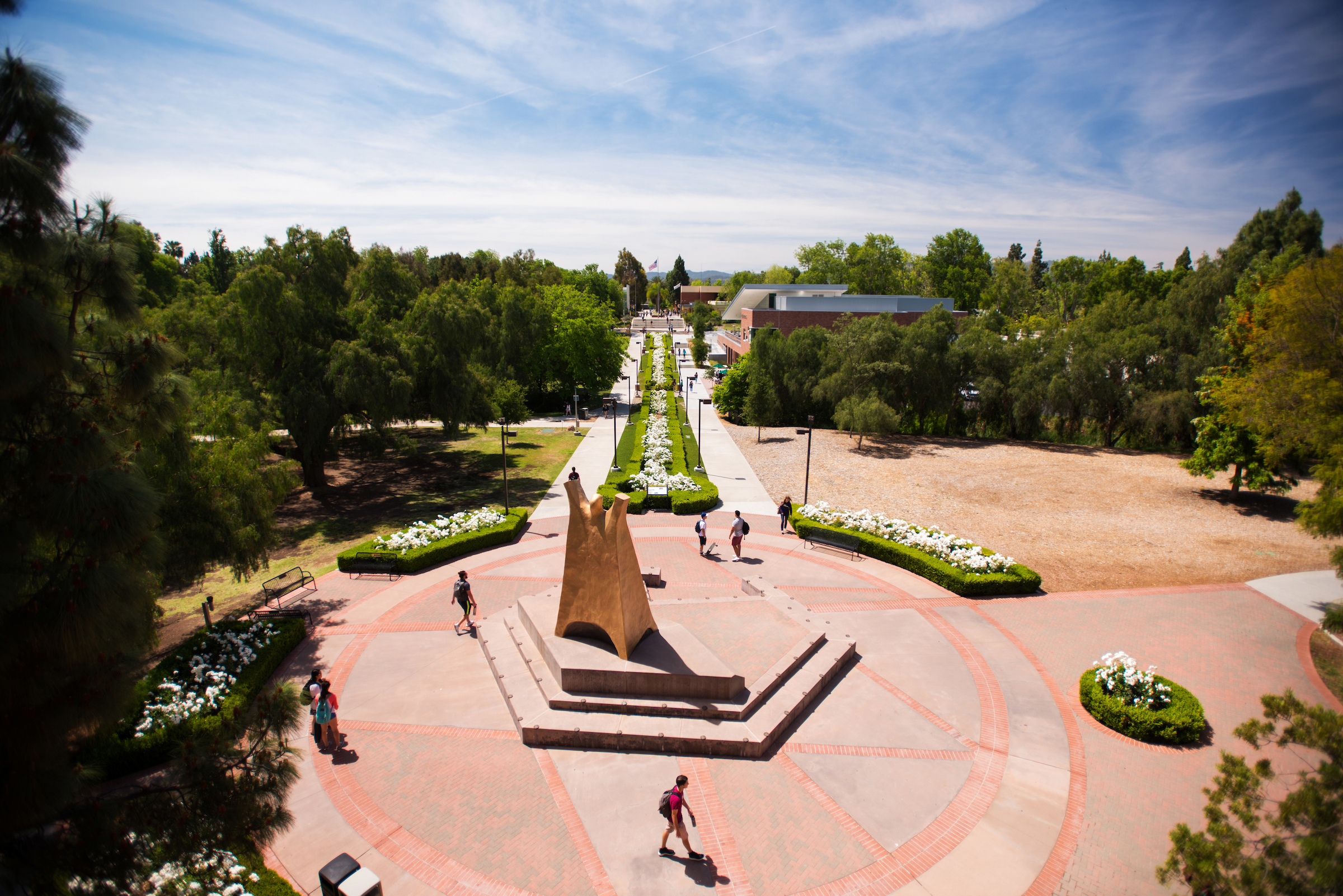
California Lutheran University
Credit: Courtesy of California Lutheran University
Falone Serna, dean of undergraduate admission and outreach, took on the challenge of growing back enrollment in 2022 after a decade directing admissions at Reed College, Pepperdine University, and Whittier College. Before that, he was associate director of admissions at Harvey Mudd College and is a graduate himself of a small, private college: the University of La Verne.
“Post pandemic, we’ve had our enrollment challenges that it’s been tough to put our finger on,” he explained. While the university made the switch to online instruction during COVID-19, “a big part of our value proposition is the residential, in-person experience. You’re not coming to Cal Lutheran to Zoom and stay in your room behind the screen.”
Serna continued: “We’re not a highly ranked, high-profile institution. We are a regional place. It’s a wonderful school, but we rely heavily on campus visits, and we had almost two years of no one being able to visit our campus. I’m sure a lot of institutions like us would say the same thing.” He added that the U.S. Department of Education’s FAFSA foul-ups did not help: “We’re still trying to pick up the pieces from that.”
Cal Lutheran’s tuition and fees top $54,000 before financial aid. The total cost of attendance, including room and board, is $77,710. The university’s tuition discount rate ranges between 60 and 65 percent, and 100 percent of its students receive financial aid, including grants and loans, which averages $40,625.
“We’d certainly like to keep the discount rate in check and under control,” said Serna. But with rival institutions also offering deep discounts, “the more important thing for us is net tuition revenue. We’re formulating a plan that is going to hopefully bring in the target headcount we’d like and the revenue we need to continue to function as a university.”
A strong athletics program is one of the university’s draws—more than 600 student athletes compete on 22 intercollegiate teams—and it offers degrees in sports management. The Los Angeles Rams have used Cal Lutheran’s stadium as their practice facility, and the campus is home to the largest training facility in professional women’s soccer.
Also, many people are optimistic about the university’s future under its new president, John A. Nunes, a scholar, author, former chief executive officer of the Lutheran World Relief agency, and former president of Concordia College New York. “We have a lot of great things going for us and a lot of things in our favor,” Serna said. “And once people find that out, it’s an easier sell.”
Highlighting Experiential Learning Outside Boston
New England is a mecca for college students who are drawn to its more than 250 colleges and universities. It lacks the 100,000-seat football stadiums found across the South and Midwest, but it has Boston, which boasts one of the country’s highest concentration of students enrolled at scores of mostly private institutions that compete intensely to fill their seats. One is Endicott College in Beverly, Massachusetts, with a seaside campus that is a half-hour train ride from Boston.
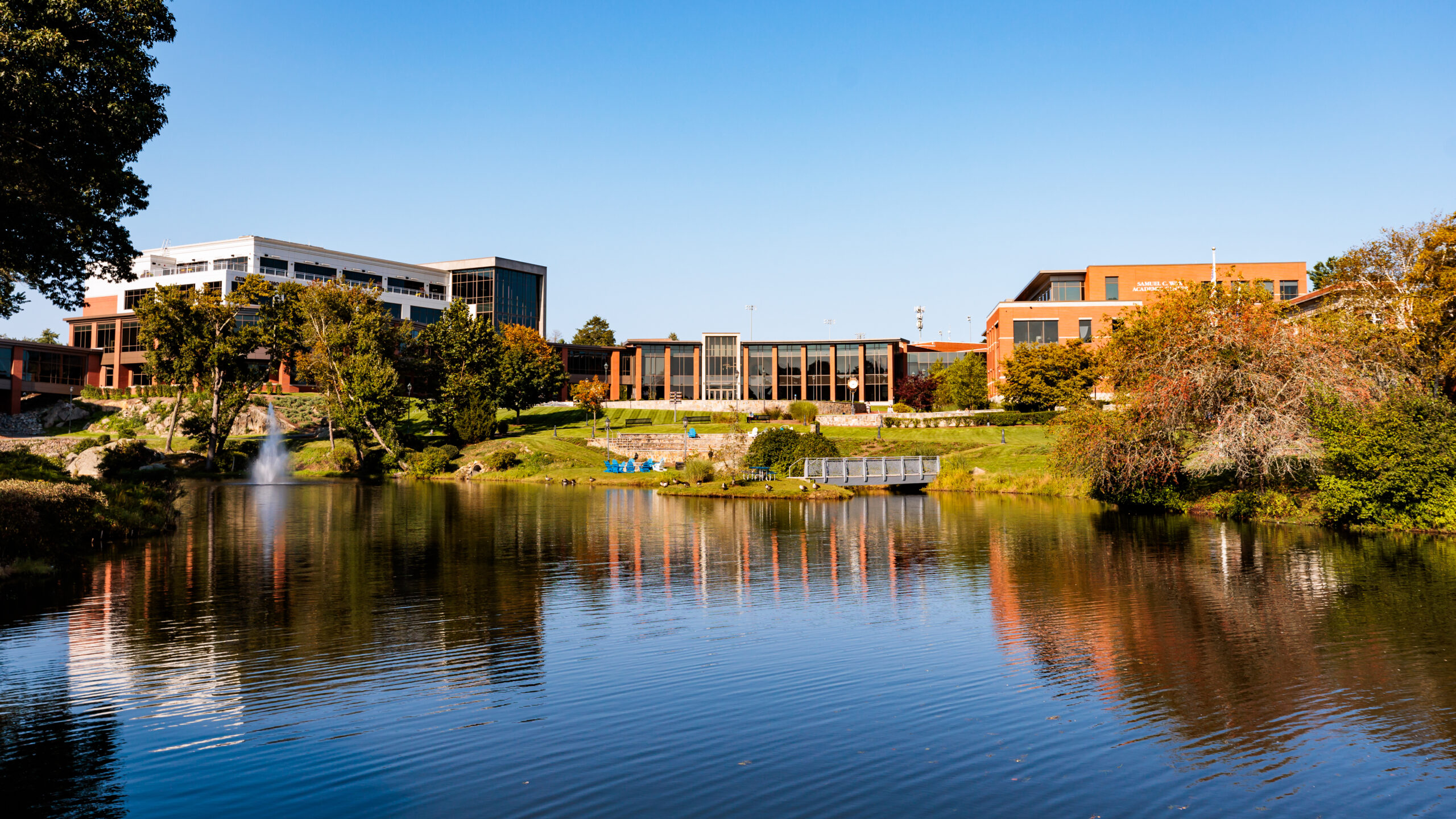
Endicott College
Credit: Courtesy of Endicott College
Endicott enrolled 3,360 undergraduates in fall 2024. Two decades earlier, it had 1,843 undergraduates. Total enrollment grew from 3,300 in 2004 to 4,560 last year. Two thirds of undergraduates are women, attracted by nursing, business, education, and other programs. It enrolled its largest ever freshman class in 2023, some 900 students, drawn to its robust program of internships, which wins over many parents and students.
Meghan Monaco, vice president of enrollment management, said, “I don’t think we’re even close to the potential that (we) have, but from an undergraduate standpoint, we’re kind of at our cap, not having a lot of residency spaces available.”
The key, she believes, is the college’s requirement that students complete three internships in order to graduate. “It’s called our Experiential Edge program, and it begins in their first year,” said Monaco, who was first hired in 2008 to work in both admissions and as the lacrosse coach, a dual role she relinquished in 2014.
“We’re combining the curriculum of a hands-on learning experience with a traditional classroom experience, and I think students and families really recognize (the value of) that,” she said. “As many as 99 percent of our students are employed or in graduate school within one year of graduation. I think that’s why we’ve been able to weather the demographic changes that we’ve experienced.”
“I’m often asked by prospective parents, ‘What do you do for career search and preparation in their senior year?’ and I say, ‘Well, it’s not their senior year. It starts their freshman year,’” she said.
Endicott’s tuition is $41,700 and total costs are above $61,000. While 95 percent of students get some aid, “We haven’t had to discount substantially to enroll a class … (while) most of our overlap institutions are discounting really significantly.”
Monaco believes its location is a big plus for Endicott, which while not in the heart of Boston is “not in the middle of nowhere either.”
Asked if Endicott has anything to fear from the demographic cliff, she said, “I wouldn’t be doing my job if I wasn’t aware of all of those challenges. We have a model that is working really well, but that could absolutely change at any moment, and we have to be prepared for that.” Monaco said Endicott is trying to recruit more students from outside New England and “looking at other places where high school graduates are growing.” Half of its students are from Massachusetts and 35 percent from the other five New England states. Her admissions team numbers 10, plus seven or eight in the financial aid office. “I think we’re probably a little bit understaffed,” said Monaco.
Yet if the demographic cliff and other pressures on enrollment do undermine Endicott’s position, she believes it will only happen gradually. “Maybe that’s the optimist in me,” she acknowledged, “but that helps me sleep at night.”
A Quaker College’s Efforts to Curb Enrollment Losses
Earlham College in Richmond, Indiana, still embodies the values of the Quakers who founded it and emphasizes its goal of turning out graduates who “can become catalysts for good in a changing world.”
Earlham’s endowment of $416 million is outsized for a small college, but it has struggled with declining enrollment for years. In 2013 it enrolled 1,159 students. A decade later it had 612, a drop of more than 50 percent. Its tuition is nearly $55,000 and total cost approaches $72,000, but almost all students receive substantial aid. Like many colleges, the opportunity to play sports is a major draw. Nearly half the students play on Earlham’s 21 Division III athletic teams with the oxymoronic nickname the Fighting Quakers.
Earlham took heart from enrolling in 2024 its largest entering class in five years, with more than one in five students coming from other countries. It also hired Paul Sniegowski, dean of the University of Pennsylvania’s College of Arts and Sciences, as its 21st president. Sniegowski, an evolutionary biologist, grew up in South Bend, Indiana, was educated at the University of Indiana and the University of Chicago and is also the parent of a 2023 Earlham graduate. He was on the Penn faculty for more than a quarter of a century, helped guide its undergraduate college through COVID, and pushed to attract more first-generation, low-income students.
In an interview for an Earlham magazine, the 66-year-old Sniegowski said he viewed this as “a rounding off” of his long academic career. “My whole life I’ve known about Earlham College.… This job is not a stepping stone to something else for me. It’s something I want to do to serve a college I’ve always admired, as have my son and many other people.”
“We have some difficult work to do. The environment for higher education, both in our state and nationally, is tough right now,” Sniegowski said. He and Provost Lori Schroeder “have talked really openly with the faculty … about the challenge of growing Earlham’s enrollment. We already have some plans in place to meet that challenge.” He pointed to a program that allows students to complete a bachelor’s degree and master of arts in teaching in nine semesters.
“Whenever I’ve talked with alums, I’m always told that what they ultimately loved about Earlham was the quality of the faculty and teaching, but what made them choose Earlham was the interactions that they had with faculty during the application and decision-making process,” Sniegowski said. “COVID eroded some of that. It eroded so many things. We’re going to keep expanding those kinds of efforts.”
Expanding Recruitment and Improving Retention in Texas
Since 2010, the population of Texas has grown by 6 million to almost 32 million currently or close to 25 percent. While California still has the most residents (39 million), Texas is among the fastest growing states, along with Florida, Utah, South Carolina, and Nevada, according to the U.S. Census Bureau.10
Stephen F. Austin State University (SFA), a public institution in Nacogdoches, Texas, near the Louisiana border, is among the beneficiaries of that growth. It enrolled its largest freshman class ever of 2,800 students in fall 2025, a jump of 31 percent. And it has boosted total enrollment by 7 percent, helped by its joining the University of Texas System in 2023, which has allowed it to provide free tuition to students from families earning $100,000 or less. The century-old campus in the pines of East Texas draws 98 percent of its 10,700 students from inside the state, who pay $10,000 in tuition.11 It also attracts transfer students in significant numbers from Texas community colleges.
Kent L. Willis, senior vice president for enrollment and student engagement, said: “Texas’s population growth certainly provides a stronger foundation than what we see in states with declining populations. Still, SFA’s enrollment gains are primarily the result of deliberate strategies.” Those strategies include partnering with local and regional schools to promote the Purple Promise free tuition program for many low-income and middle-income students.
“Growth in Texas sets the stage, but it’s SFA’s ability to turn that opportunity into applications, admissions, and actual enrollment that has made the real difference for our campus,” said Willis, who returned to his alma mater in January 2025 after two years as vice president for student affairs and enrollment management at California State University, Fresno.
Asked by email about the demographic cliff, Willis commented, “The demographic cliff is a real national concern, but with targeted strategies, sustainable growth is achievable.” And he explained, “This means broadening our recruitment efforts beyond just recent high school graduates” and focusing on student engagement to improve retention and graduation rates.
One wildcard for Texas state colleges and universities is that in June the legislature overturned the bipartisan 2001 Dream Act allowing undocumented Texas students to pay in-state tuition. Some 18,600 students paid the lower rate in 2024, and roughly that many undocumented students graduate from Texas high schools each year, according to the Texas Immigration Law Council.12 How this act will impact enrollment remains to be seen for institutions in Texas, which led the way in enacting such legislation. Twenty-one other states passed Dream Acts of their own after Texas did.
Thriving Flagships and Their Reach Beyond State Borders
A significant number of large public universities saw big jumps in enrollment this year. Among them is the University of Tennessee, Knoxville—the state’s flagship— which reported a record 40,421 students for the fall and a 92 percent retention rate for last year’s freshmen. The university received 52,000 applications and admitted 23,000 first-year students. Its graduation rates also rose for the fifth year, with two in three undergraduates getting their degrees in four years and 75 percent in six.
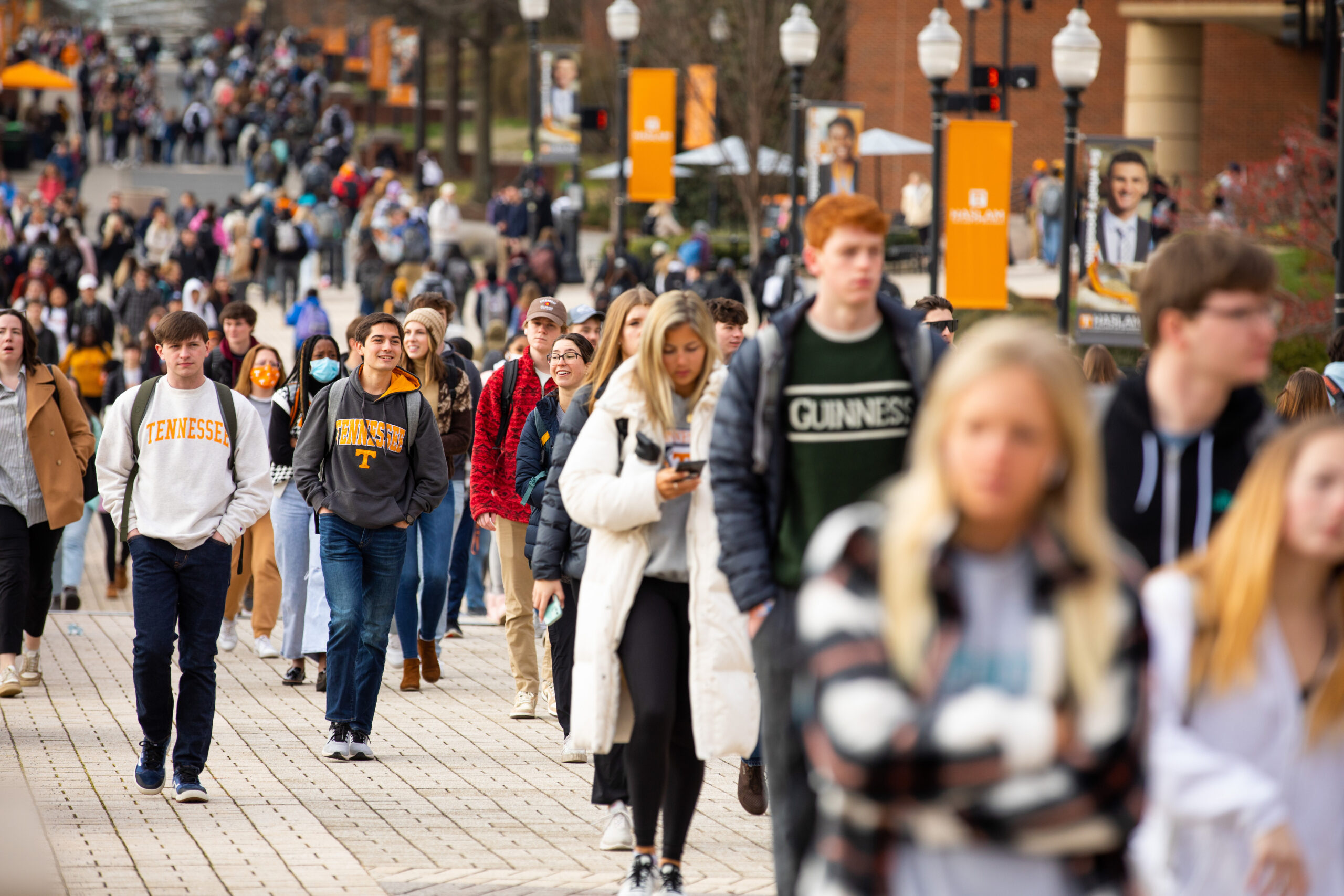
University of Tennessee, Knoxville
Credit: Courtesy of The University of Tennessee Knoxville
“These records are a testament to the innovative approach of our faculty and staff, and the hard work of our students,” said Chancellor Donde Plowman. “Every year, more students want to come to UT because they are looking for an experience that will change their lives and an education that will prepare them for the future. They know when they become volunteers that they will have the community, resources, and support they need to thrive both in and out of the classroom.”
Another example of a flagship that seems to be flourishing is the University of Connecticut (UConn) in Storrs, Connecticut. The institution received 63,200 applications for this fall, accepted 54 percent, and enrolled a record 6,550 first-year students, for a total of more than 25,000 undergraduates overall. More than a third of the newcomers are the first generation in their families to attend college.13
Despite such strong numbers, however, Nathan Fuerst, vice president for student life and enrollment at UConn, told the university’s board of trustees in June that, to keep growing, the university needs to enroll more out-of-state and international students due to the drop in the number of high school graduates in Connecticut. UConn faces a $134-million budget deficit and institutional leaders “see enrollment expansion as a potential way to close the gap. About 57 percent of UConn’s revenue comes from tuition,” the CT Mirror, a nonprofit Connecticut news organization, reported.14
Thirty percent of UConn students are from out of state. They pay $44,000 in tuition and fees, more than double the $17,000 that Nutmeg State residents pay. International undergraduates also usually pay the higher out-of-state rates. Time will tell if the university will be able to attract more such students and continue to thrive.
Abundant Growth in Arizona, North Carolina, and Idaho
Arizona State University (ASU), one of the nation’s largest education institutions, enrolled a record 42,900 new students this fall, including transfers and graduate students. Fifty-seven percent were from out of state. Of the total 194,000 ASU students, more than 80,000 signed up for ASU Online and 78,000 attend in person at one of its four campuses.
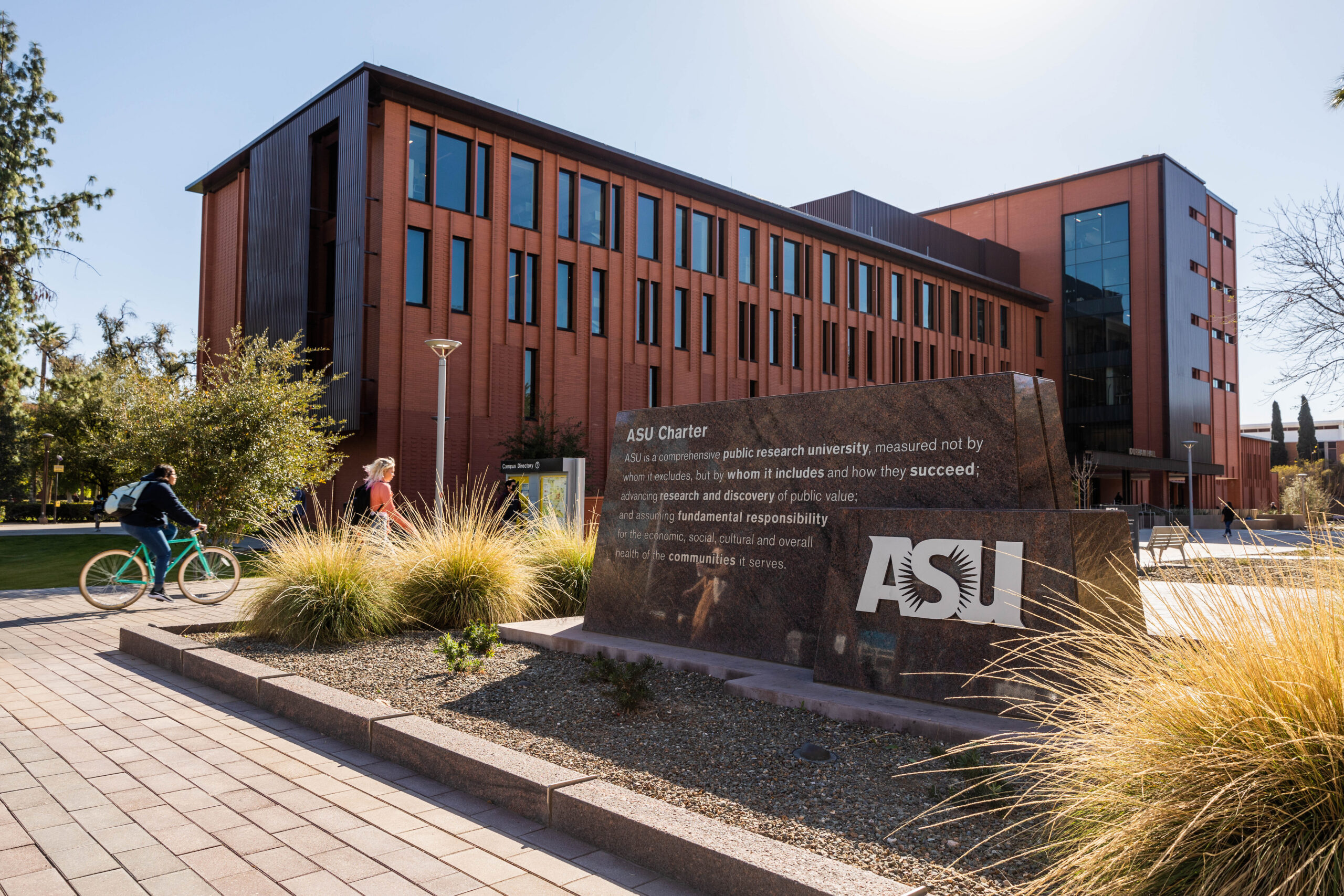
Arizona State University campus
Credit: Courtesy of the ASU Board of Regents
“The myth that a college degree is losing its value does not square with reality—the demand for ASU is only increasing,” said President Michael Crow.
Another institution with healthy enrollment numbers is North Carolina Agricultural and Technical State University (NCA&T). Already the largest public historically Black college and university, it reported record enrollment this academic year of 15,725, a 6.7 percent increase and nearly 1,000 more than fall 2024. First-year enrollment rose 10 percent and the university admitted 17 percent more transfers and almost 1,000 international students, half from African nations.
It marked the 12th consecutive year of growth for NCA&T, and “reaffirms our commitment to the people of North Carolina, our national appeal and impact as an exponential, doctoral research HBCU, and the promise that North Carolina A&T holds for students around the world,” said Chancellor James R. Martin II.
The University of Idaho (UI) also has a good story to tell: it registered its largest enrollment ever last spring, with 11,886 newly admitted students, up 4.2 percent from 2024 and 22 percent over four years ago. It also saw a single-year jump of 23 percent in international enrollments. The flagship campus is in Moscow, but the university also has campuses in Boise, Coeur d’Alene, and Idaho Falls, and it is Idaho’s only R1 research university.
The university has benefits from the fact that Idaho, the 38th most populous state with two million residents, has a distinct advantage when it comes to concerns about the demographic cliff. Its high school enrollment is projected to grow 11 percent between 2022 and 2031, far more than any other state, according to the National Center for Education Statistics.15
Idaho is also among the 15 states in a Western Undergraduate Exchange (WUE) program, organized by WICHE, which provides discounted tuition rates for outside students. UI’s tuition for 2025–2026 is $9,400 for Idaho residents and $28,636 for non-Idaho residents, but just $12,914 for students in the WUE compact.
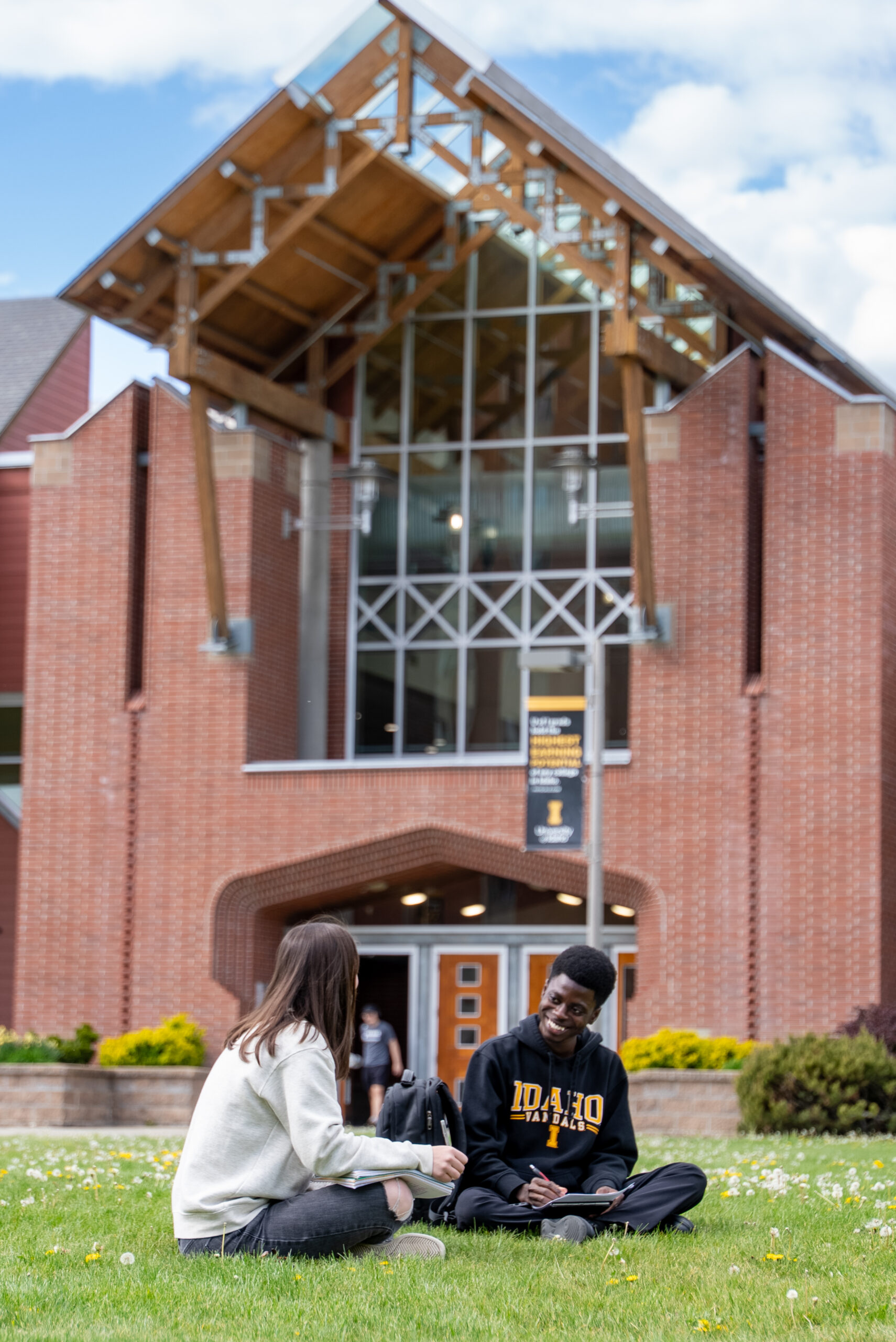
The University of Idaho campus.
Credit: Courtesy of the University of Idaho
Idaho’s growth is driven not by a high birth rate but by people moving into the state, according to Bas van Doorn, a senior research analyst for the Idaho State Board of Education.16 “This should be good news for Idaho’s public postsecondary institutions, but there are risks to keep in mind,” van Doorn said. They include the possibility that more Idaho students will go out of state for college and that high school enrollment declines elsewhere will mean fewer out-of-state students’ attending Idaho’s colleges and universities.
A Small Southern College’s Slow Death
The closing of any college is heart-breaking. Some deaths occur abruptly, but most occur after a long period of losing students and operating in the red.
Valiant efforts were made to save Birmingham-Southern College, a liberal arts undergraduate institution in Alabama’s second largest city. Its root go back to 1856, when the first of two Methodist colleges that later merged was opened. Yet after suffering a series of financial crises going back to the 2000s, at the end in March 2024, when an effort to secure a $30-million state loan failed, the Birmingham-Southern Board of Trustees voted unanimously to shut down the college. At the end of May, the institution closed in orderly fashion following extensive efforts to help students transfer to other colleges.
“This is a tragic day for the college, our students, our employees, and our alumni, and an outcome so many have worked tirelessly to prevent,” Reverend Keith D. Thompson, chair of the board and a 1983 Birmingham-Southern graduate, said in the announcement at the time of the closure. “Today is also a terrible day for Birmingham, for the neighborhoods who have surrounded our campus for more than 100 years, and for Alabama,” added Thompson, a Methodist minister. Beyond the loss of an estimated $90-million annual economic impact on Alabama, including $68 million in Birmingham, “the loss of a nationally ranked liberal arts college that has contributed so much to this state and to the world—and still had so much to give—is incalculable.”
Thompson, who also sent three sons to Birmingham-Southern and once worked there, praised the unstinting efforts of President Daniel B. Coleman to save the college and the “indomitable spirit” of faculty, staff, and students who stayed to the end. “I want you to know that I share your heartbreak, anger, and frustration over the devastating loss of this 168-year-old treasure,” he told them.
In a postmortem headlined, “The long, slow death of Birmingham-Southern: What killed an Alabama college with 168-year-old roots?” the digital news organization AL.com dissected what went wrong. By 2022, the college was running a nearly $40-million deficit with $80.6 million in expenses and only $42.7 in revenue, it wrote. The college’s endowment, $114 million two decades ago, had slumped to $25 million at the end.
“It was one of the few liberal institutions in the state,” novelist and graduate Charles Gaines told the news organization. Former New York Times executive editor and author Howell Raines, a 1964 graduate, said it “was always a fragile institution since it lost the backing” of a wealthy Birmingham family.
“Could they have survived? I don’t know. Would they have survived if they had not had 20 years of financial mismanagement beforehand? Possibly that’s true, too,” Raines told AL.com, which is part of an Alabama newspaper group.
The college cut $10 million a year and eliminated 29 faculty positions and five majors in a crisis in 2010, and years later, it sliced tuition in half. Near the end it also mounted a $200-million capital campaign that raised $57 million in pledges and cash. But it had run deficits 16 times over two decades and, at the end, enrolled just 731 students.
Strains with the increasingly conservative United Methodist Church—which the college was affiliated with but not directed by—worsened in 2019 when President Coleman issuing an emphatic statement “that Birmingham-Southern welcomes people of all sexual orientations and gender identities.” The denomination had just upheld its stance prohibiting the ordination of LGBTQ pastors and against same-sex marriages.
Thompson, in the closure announcement, again applauded all who stayed with the college to the end. “It is for all of you that my heart breaks.… Throughout this struggle, you have fully lived into this college’s watchword: ‘Forward ever!’”
Hard Choices Ahead
Each institution’s top administrators and board will have to develop their own strategies for grappling with the enrollment challenges confronting them. But some of the higher education experts interviewed shared basic advice.
“What I hear from board members is, ‘What are the questions we should be asking?’ If you don’t have an understanding of the basic business of higher education, it’s hard to ask those questions,” Dan Greenstein, the former chancellor of the Pennsylvania State System of Higher Education, said. He warned institutions about the “sprawl” of small academic majors and minors while only a handful of the most popular programs produce most of the degrees. “That’s really risky because if the market changes, you’re exposed,” he said.
Indiana University’s Hossler agreed and contended that senior administrators and boards will inevitably have to make tough decisions in the coming months about what courses their colleges offer and who teaches them. He believes colleges need to look carefully at their curriculum and the composition of the faculty to fit the interests of career-minded students and encourage them to enroll.
“As a firm believer in the liberal arts, I have to say that, in many areas, student interest in them is down dramatically, while in areas related to AI, informatics, public health, and fields like that, institutions need more faculty,” Hossler said. “Since institutions don’t get to print their own money, they’re going to have to look carefully at the composition of the faculty and their curriculum and make some hard choices.”
“This would take a strong president, strong provost, and supportive board, but they need to lay out the realities … [and tell liberal arts faculty] ‘We may not be able to keep all of you.… And you’re going to have to entirely change your interests in order to keep a job,’” he said. For instance, historians might have to take a semester off, he suggested hypothetically, and teach a course on the history of public health policy while language professors may need to teach business Spanish or French instead of literature.
Greenstein also recommended that when it comes to seeking out new enrollment markets, colleges and universities should look beyond the traditional college-age students and keep a close eye on potential students not only at feeder high schools but also even in the earlier grades. They should also do more outreach to and develop more new programs for working adults, as the demand for nondegree training and credentials is high. But he also advised: “The question nobody’s truly answered yet is, ‘Can you actually introduce new product lines into these traditional institutions, so that they don’t have to suffer from the enrollment decline?’ Otherwise, they’re just going to get smaller and smaller and close or combine.”
Grawe, the Carleton College economist and expert on the changing demographics, warned that the market for adult learners and those who never finished their degrees may be softening, too. “I’m always a little skeptical about those people,” he said. “They tasted our product, and they stepped away.” A paper published by the Federal Reserve Bank of Philadelphia in 2024 found the number of students over 25 has fallen by nearly half since the 2008 recession.17
Still, Grawe said, the adult market is one that colleges and universities can’t afford to ignore. “There over 100 million adults ages 25 to 54 in the workplace, all of whom could benefit from some sort of retooling or degree upscaling,” he said. “If you had just a small additional penetration into that market, say, a million students, it would more than equal the decline in the number of traditional age young people who come to college.”
At the same time, he recommended that colleges and universities pay more attention to keeping the students they have enrolled. “We can’t just recruit our way out of this mess,” he said, which makes retention increasingly important. “Higher ed does not have a tremendously strong track record with student retention, but if we can turn that around, we might be able to do ourselves a favor while also better fulfilling our missions and serving our students,” Grawe concluded.
Christopher Connell is a Washington-based education writer and frequent contributor to Trusteeship.
1. National Center for Education Statistics, “Public School Enrollment,” Condition of Education, U.S. Department of Education, Institute of Education Sciences, 2024, https://nces.ed.gov/programs/coe/indicator/cga/public-school-enrollment.
2. Patrick Lane, Colleen Falkenstern, and Peace Bransberger, Knocking at the College Door: Projections of High School Graduates, Western Interstate Commission for Higher Education, 2024, https://www.wiche.edu/wp-content/uploads/2024/12/2024-Knocking-at-the-College-Door-final.pdf.
3. U.S. Bureau of Labor Statistics, “College Enrollment and Work Activity of Recent High School and College Graduates Summary,” April 22, 2025, https://www.bls.gov/news.release/hsgec.nr0.htm.
4. National Center for Education Statistics, “Characteristics of Postsecondary Students,” Condition of Education, 2023, https://nces.ed.gov/programs/coe/indicator/csb/postsecondary-students.
5. Open Doors® 2024 Report on International Educational Exchange, U.S. Department of State’s Bureau of Educational and Cultural Affairs and the Institute of International Education (IIE), 2024, https://opendoorsdata.org.
6. “Educational Attainment in the United States: 2024,” September 3, 2025, U.S. Census Bureau, https://www.census.gov/newsroom/press-releases/2025/educational-attainment-data.html.
7. Trends in College Pricing 2024, College Board, https://research.collegeboard.org/trends/college-pricing/highlights.
8. National Association of University Business Officers, NACUBO Tuition Discounting Study, 2024, https://www.nacubo.org/Research/2025/NACUBO-Tuition-Discounting-Study.
9. “Fast Facts 2025,” American Association of Community Colleges, https://www.aacc.nche.edu/wp-content/uploads/2025/02/AACC2025_Fact_Sheet.pdf.
10. “Net International Migration Drives Highest U.S. Population Growth in Decades,” U.S. Census Bureau, December 19, 2024, https://www.census.gov/newsroom/press-releases/2024/population-estimates-international-migration.html.
11. “Fast Facts for Lumberjacks 2025,” Stephen F. Austin State University, https://www.sfasu.edu/docs/institutional-research/fast-facts-for-lumberjacks.pdf.
12. “Undermining Texas’s Future: Federal Court Ruling Undermines Texas Dream Act,” Texas Immigration Law Council, June 6, 2025, https://txilc.org/undermining-texass-future-federal-court-ruling-undermines-texas-dream-act/.
13. Stephanie Reitz, “Talented Newcomers and Returning Students Starting New Academic Year at UConn,” UConn Today, August 20, 2025, https://today.uconn.edu/2025/08/talented-newcomers-and-returning-students-starting-new-academic-year-at-uconn/.
14. Emilia Otte, “UConn Trustees Debate Enrollment as a Solution to Budget Shortfall,” Connecticut Mirror, June 25, 2025, https://ctmirror.org/2025/06/25/uconn-budget-deficit-student-enrollment/.
15. National Center for Education Statistics. “Public School Enrollment,” Condition of Education, 2024, https://nces.ed.gov/programs/coe/indicator/cga/public-school-enrollment.
16. Bas van Doorn, No Cliff in Sight? Idaho K-12 Enrollment Trends and Patterns and Their Potential Effect on Enrollment at Public Postsecondary Institutions, Idaho State Board of Education, June 5, 2024, https://boardofed.idaho.gov/wp-content/uploads/2024/06/Demographic-Projections-Final-B-van-Doorn-June-2024.pdf.
17. Robert Kelchen, Dubravka Ritter, and Douglas Webber, Predicting College Closures and Financial Distress, December 2024, https://www.philadelphiafed.org/-/media/FRBP/Assets/working-papers/2024/wp24-20.pdf.
RELATED RESOURCES



Trusteeship Magazine Article
Mergers and Acquisitions: Strong Roots Yield Fruitful New Partnerships


Reports and Statements
Collaborative Leadership for Higher Education Business Model Vitality
Listen to this article on the AGB Soundboard App