 Chat with AGB Board Bot
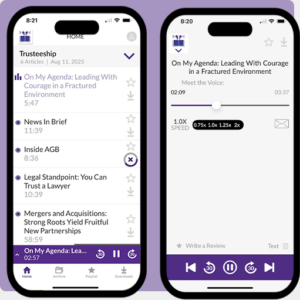
Listen to this article on the AGB Soundboard App
Cover Image Credit: ISTOCK / CGDEAW / STOCK.ADOBE.COM / SANYCH
Censorship on college campuses has risen drastically in recent years, with state and federal governments attempting to dictate what can and cannot be said on campus, what must and must not be taught in the curriculum. In this environment, it is essential that boards ensure the integrity and independence of their institutions.
Higher education has confronted overwhelming challenges since January 2025. Not only have individual institutions faced investigations, lawsuits, and coercive “offers” from the federal government, but whole swaths of the sector have had to adapt to rapidly shifting landscapes. Once stable structures for accreditation, financial aid, research funding, curricular standards, and visas for international students, researchers, and faculty now teeter. Even the principles of institutional autonomy and campus free expression are called into question.
In this climate, much attention has been focused on the impact of the federal administration’s moves, and with good reason. Whether one considers the impact of billions of dollars of cuts to research funding, the targeted attacks on some of the nation’s most storied private and public research universities, or the more than 8,000 student visas that have been revoked, the scale of the onslaught is staggering. The immediate and long-term consequences of these unprecedented federal initiatives reverberate outward from campuses, impacting local communities, international cooperation, and the health of many Americans.
But that is only part of the picture. The groundwork for the havoc on the federal level was laid over years of ongoing and coordinated attacks on all sectors of higher education coming from state capitals across the country. As reported in PEN America’s recent annual report, America’s Censored Campuses 2025: Expanding the Web of Control, 2025 was “a year of catastrophe” for higher education, with record-breaking levels of state legislation that directly and indirectly censors the education available to America’s college and university students.1
State Interventions
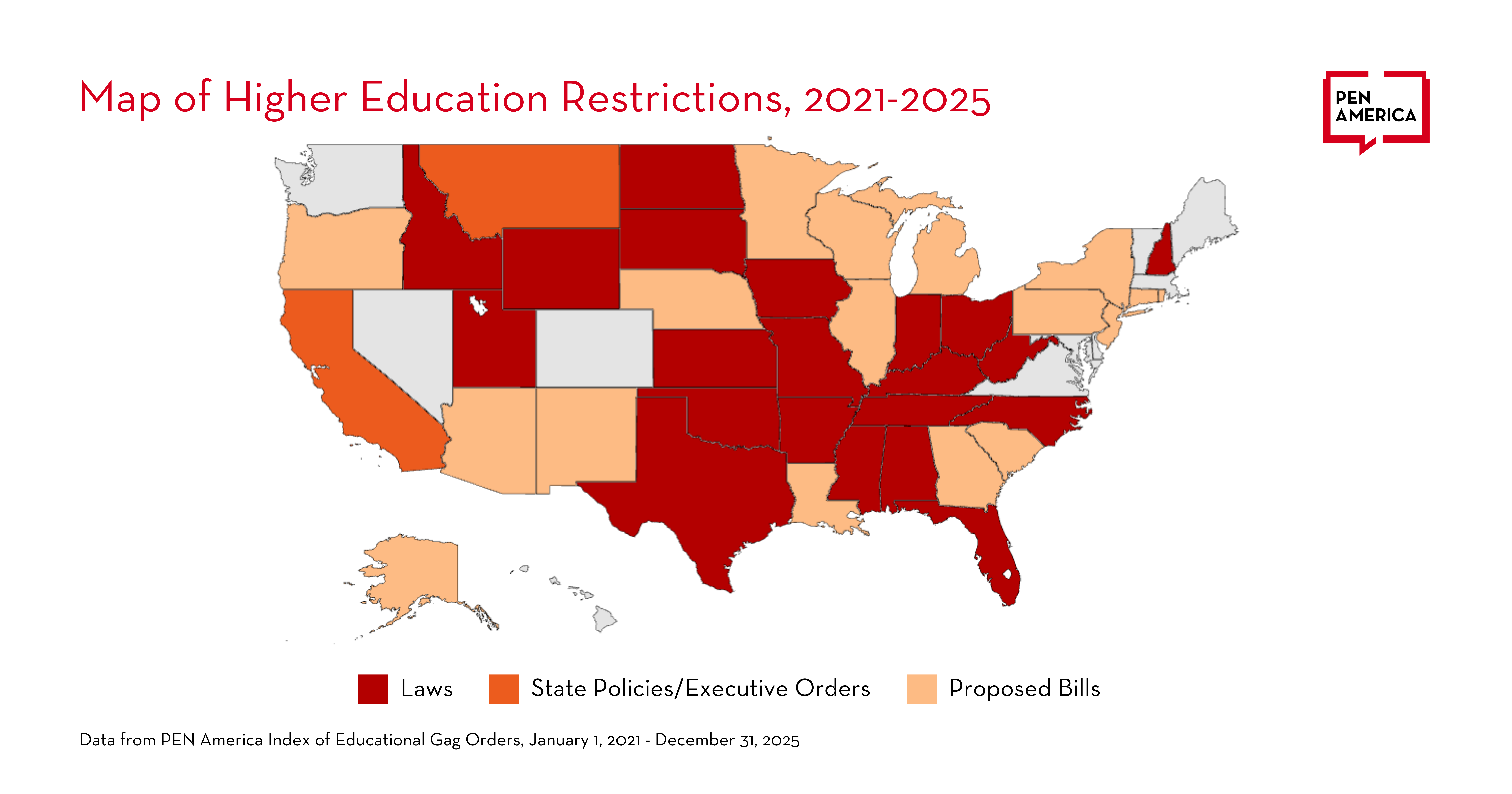
State legislatures set three troubling new records in 2025:
- the highest number of laws censoring higher education in a year (21)
- the largest number of states passing those bills (15)
- the highest number of states passing their first higher education censorship bill (8)
That last number in particular speaks to the dangerous spread of educational censorship across the country.
Credit: PEN America
Higher Education Restrictions, including educational gag orders and other restrictions, 2021–2025.
That last number in particular speaks to the dangerous spread of educational censorship across the country.
As a result, now over 50 percent of American college and university students attend school in one of the 23 states that have passed at least one higher education censorship bill since 2021, when PEN America first began tracking this legislation.
PEN America’s report details the rapid proliferation of state-level legislation impacting higher education and the amplification of those efforts on the federal level. As such, it’s an important resource for trustees. Its in-depth analysis maps out the most pressing challenges facing college and universities today: from challenges to institutional autonomy over tenure, shared governance and curricula, to the rise of jawboning demanding the firing of specific faculty and the dismantling of the accreditation system. It also includes a comprehensive overview of the higher education censorship laws and policies passed by states in 2025. While changes in state-level law and policy sometimes fly below the radar, they have immediate and long-term impact on students at both public and private campuses: limiting conversations on the quad and in classrooms, canceling classes and student-life programming, sidelining faculty in campus governance and curricular decision-making, and undermining tenure. To drive home the real and personal costs of these policies, PEN America also launched in December a blog series, Snapshots of Censorship, featuring the stories of faculty whose research, teaching, and service have been disrupted by government censorship.
What Counts as Censorship?: Direct vs. Indirect Tactics
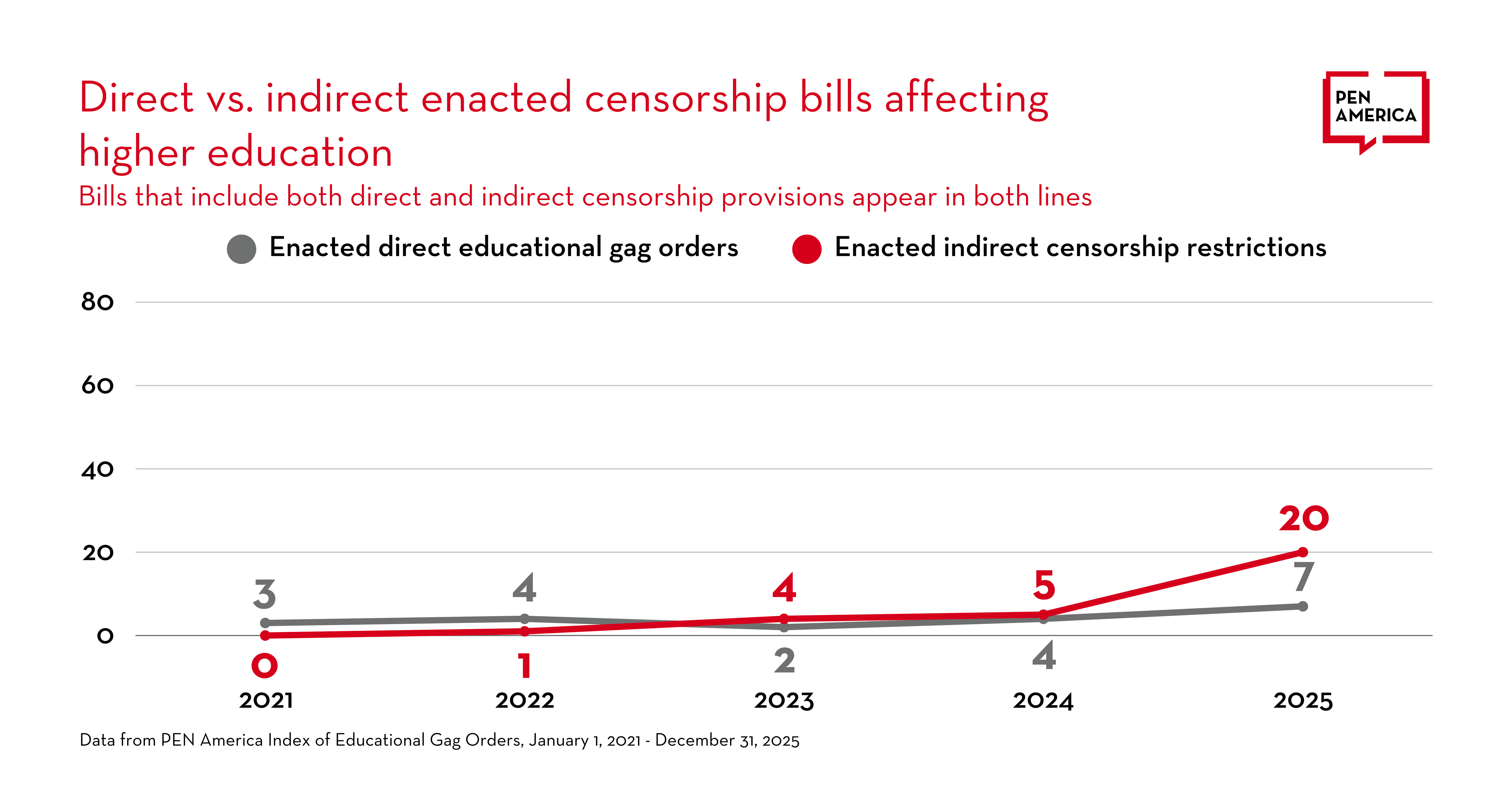
To explain the impact of state legislation on higher education, PEN America draws a distinction between “direct” and “indirect” censorship. Some state legislation is easy to identify as censorship, because the bills explicitly or directly limit or prohibit what can be taught or discussed in a college or university classroom. These “educational gag orders”—for example, Mississippi HB 1193 (2025), which restricts how race and gender can be discussed in both K–12 and higher education classrooms2—were the first sort of censorship measures that PEN America began to track. Gag orders are effective, as are sledgehammers, but they’re also open to legal challenges. A preliminary injunction was issued in August 2025 blocking implementation of certain provisions of Mississippi’s HB 1193, for example.3 And yet, there were seven gag orders passed in 2025, a significant rise over the four that were passed the year prior.
Credit: PEN America
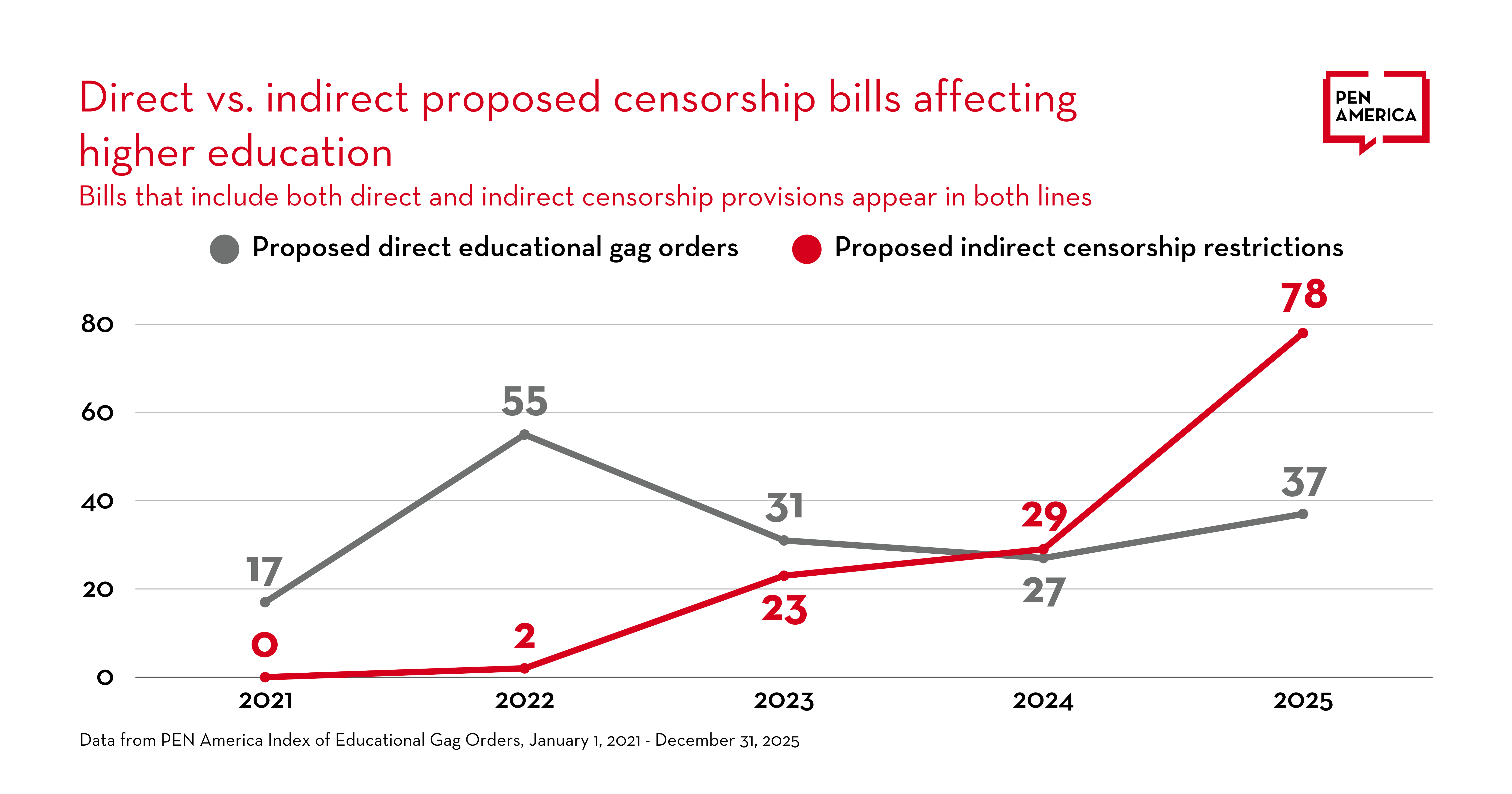
Direct vs. indirect proposed censorship bills affecting higher education
As predicted in PEN’s 2024 report, however, over the past two years there has been a real strategic shift from direct to indirect censorship, with state legislatures diversifying their approaches and, as we put it, “refining the art of censorship.”4 In 2025, the vast majority of censorship bills and policies introduced and passed across the country are what PEN categorizes as “indirect censorship.” These include measures that chill the climate for campus free speech and indirectly censor the curriculum by placing limits on general education or curriculum requirements, imposing “intellectual diversity” or “institutional neutrality” mandates, restricting faculty involvement in shared governance, limiting tenure, or undermining the accreditation process. All told, there were 78 state bills introduced across the country in 2025 that included “indirect” censorship provisions, more than double the number that included “direct” censorship measures, 37 (some bills, we note, included both direct and indirect measures). That ratio holds up, too, as we compare the bills that were signed into law: 20 indirect measures became law, or almost three times the number of gag orders that did. The rapid proliferation of these bills is in part explained by the circulation of model legislation authored by groups including the Goldwater Institute and the Civics Alliance.5
Credit: PEN America
Direct vs. indirect enacted censorship bills affecting higher education
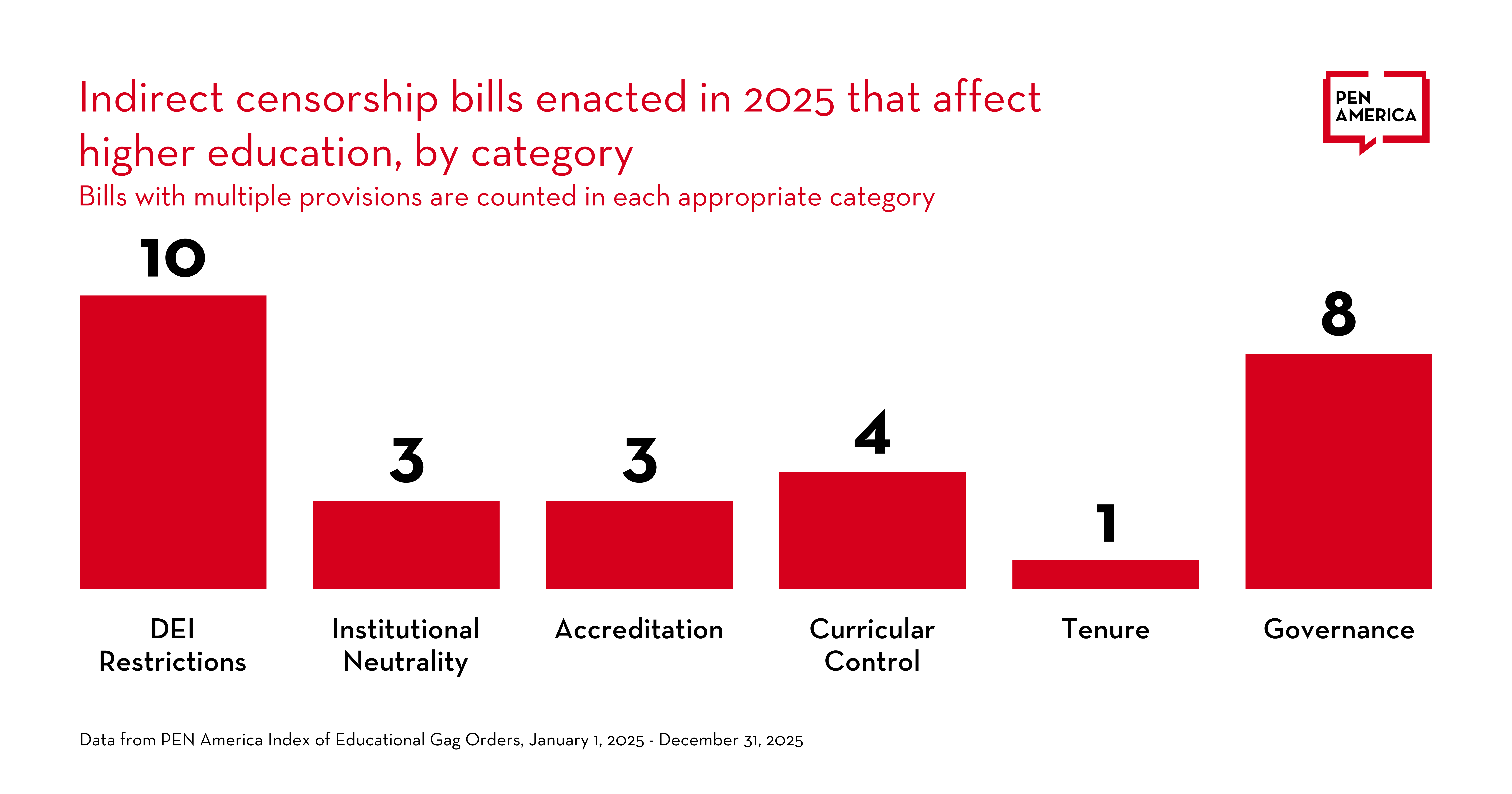
Examples of indirect censorship passed in 2025 include Indiana’s HB 1001, which relegates faculty senates in the state’s public universities to an “advisory” role only in academic affairs6—a move we’ve seen in legislation in Texas,7 Ohio, and Utah8 as well. Or consider Idaho’s SB 1198, which stops short of banning specific content, but instead stipulates that, with minimal exceptions, courses on “critical theory” cannot be required for completion of a major, minor, or certificate, thereby limiting opportunities for students to engage with meaningful or challenging content.9 Kansas SB 125 ominously expands the scope of previous “DEI bans” by micromanaging how state employees, including faculty, communicate, specifically prohibiting them from indicating their pronouns in emails or “any other form of communication.”10 Each of these provisions makes it less likely that faculty and students will be able to engage in free and open discussion in classes and across campus.
Credit: PEN America
Indirect censorship bills enacted in 2025 that affect higher education, by category
Challenges to Accreditation
Another tactic to indirectly censor education on campus—and one that has been replicated in multiple states in the 2026 legislative session—is to undermine the accreditation system. Florida was at the start of this push, passing SB 7044in 2022, which required public universities to switchaccreditors.11 In 2025, Florida coordinated the launch of a new accreditor, the Commission for Public Higher Education (CPHE),as a state-based alternative to regional accreditors. Nationally, the pivot to using accreditation to drive campus policy is championed by the Heritage Foundation, which markets a model bill for that purpose, “Rejecting Racism in Postsecondary Institutions and Postsecondary Accreditation.” Bills weakening the accreditation system were introduced in multiple states in 2025, including South Carolina12 and Michigan,13 and Tennessee passed SB 252814. In 2026, more states have jumped on the accreditation bandwagon, with bills introduced in West Virginia15, Oklahoma (HB 3132 and HB 3134),16 Missouri,17 and Iowa18. Trustees should expect to see more of these sorts of bills coming in the next year, upending the established system of independent accreditors and destabilizing institutions in the process.
The Responsibility of Trustees
What should college and university trustees be expected to do in the environment documented in the PEN America report? Getting consensus on a reasonable answer to this question involves asking: Why do we have governing boards overseeing higher education institutions in America?
The genius of American higher education since colonial times has been the absence of a Ministry of Education that controls the operation of colleges and universities. This arrangement grows out of the very American notion that in a democracy, people need access to reliable information. A free and autonomous higher education sector that leads in the discovery and dissemination of new knowledge is, like a free and independent press, essential for the health of a democracy, for the common good. We cannot afford to have colleges and universities reduced to being echo chambers for those who occupy elected office.
For colleges and universities to fulfill their mission, their governing boards need to work in tandem with faculty and administration to ensure that teaching, research, and community service serve the needs of the people broadly speaking, not impose the agenda of any political party or official. What can and can’t be said on campus; what must and must not be taught in the curriculum; which students to admit and which to expel; which faculty to hire and which to fire; what topics to research and how: these decisions should not be dictated by government.
Elected officials do have a clear interest in assuring that the public colleges and universities they help fund serve the public good. And let’s be clear: the combination of state and federal funding—which includes funds for student aid and loans and a robust program of research support across all fields—has guaranteed the global success and achievements of the U.S. higher education sector. To be blunt, the largest single source of revenue in the home institution of one of the authors of this article, the University of Wisconsin-Madison, one of the nation’s top-ranked public research universities, is federal dollars.19 But the success of the American system is predicated on both the interdependence between higher education and federal, state, and local governments and the independence of both public and private institutions from government overreach. Trustees who place the interests of the institution and its students above personal or political interest play a leading role in this. If governing boards merely rubber stamp decisions from above, why not just dismiss all the trustees and establish a centralized ministry to govern the sector? Does anybody think that’s a good idea?
We are not saying that colleges and universities have always gotten things right. Some colleges and universities, including some of the most prominent ones, have adopted policies and practices or permitted behaviors that can limit intellectual diversity on campus and stifle free speech, such as mandatory diversity statements from job candidates, speech codes that discourage honest questions, shout-downs of conservative speakers, and tolerance for antisemitic rhetoric. One of the purposes of higher education is to have students encounter views very different from their own, wrestle with them, engage in civil dialogue with the people who put them forward, and decide what they think and believe in a newly informed way. We think governing boards that work closely with faculty and administrators are in a better position to promote policies that will achieve this than are politicians far removed from campus who seek to impose a top-down, one-size-fits-all approach.
How Do Students Experience Campus Free Expression?
If you listen to what the great majority of students and alumni have to say about campus climate, you will hear a different story from the one that has been pressed on the public. The Gallup organization and the Lumina Foundation released a new report earlier this year entitled The College Reality Check: What Students Experience vs. What Americans Believe based on a survey of 4,000 undergraduates and 6,000 college graduates. Among its consequential findings:
- Between 64 percent and 74 percent of Democratic, Republican, and independent students say all or most of their professors encourage students to share their views and support speakers and audience alike during controversial discussions.
- Most students say they feel free to express their opinions on campus, including 76 percent of Democrats and 69 percent of Republicans.
- Just 2 percent of all college students, including 3 percent of Republicans, say they feel they don’t belong on their campus due to their political views.20
By and large, higher education’s “customers” do not believe that they are caught in some kind of progressive echo chamber.
Boards should always be supportive of more spirited debate and serious dialogue on campus. But they should never ally themselves with government efforts to control or structure or referee that back-and-forth. While most Americans don’t have a feel for or care much about academic freedom, they generally don’t much like censorship, especially not when it’s imposed by the government. They hate the idea of any government telling them or their kids how to think or what to say. And in all honesty, no amount of social pressure from your peers—or even the occasional faculty member—can justify legislation or policy that threatens to undermine educational institutions if they fail to comply with the will of the political party in power. There is no equivalence in these two threats to the mission and viability of higher education.
Trustees are the border runners between the party in power and government entities on the one hand, and the university on the other. At their best, they act as a conduit to bring public opinion—and sometimes public criticism—into the university, while at the same time buffering it from interference that gets in the way of its always messy search for truth, and its service to the commonwealth that derives from that mission. There is an inherent paradox in that mission. Higher education cannot fulfill its unique obligation to think ahead on behalf of society unless it is able to push society’s boundaries.
AGB’s Advice for Trustees
As AGB puts it in its Govern NOW toolkit, “We believe that governing bodies should act with integrity as stewards of mission and public trust, not as ideological operatives. We emphasize partnership, accountability, and independence.”21 When government influence and accountability turn into direct intervention, when they manifest as heavy-handed government prohibitions and mandates with the force of law and threats of devastating defunding behind them, trustees need to stand together in defense of academic freedom and the institution they serve.
The PEN America report makes the case that we are at a crucial juncture. Now is the time for trustees to articulate the values that undergird our higher education system and to hold to them: sector autonomy, intellectual rigor, and academic freedom for faculty and students. Political winds do change. It is incumbent upon trustees to take a longer, principled view, so that colleges and universities are not endlessly whipsawed between successive competing demands to promulgate the prevailing orthodoxy.
Trustees need to be able to criticize and defend and help change the institutions they oversee with the long view in mind, with bravery and steadfastness. They need to try to convince elected and appointed political folk that letting trustees do that is a better approach than imposing laws and policies in a short-sighted effort to gain control of colleges and universities that will inevitably boomerang. That’s what our democracy should be able to trust trustees to do.
The national landscape for higher education has shifted drastically over the past five years—and that means that the challenges and responsibilities of governing boards have shifted as well. The norms of shared governance that had allowed small colleges and large universities, both public and private, to function, if not always smoothly, at least with a reliable sense of stability have been challenged, leading to sector-wide uncertainty about the path ahead. Now more than ever, board members need to carefully weigh their responses to this moment so that the successful model of American higher education long admired around the world can continue to do its part to advance American democracy.
Kevin P. Reilly, PhD, is president emeritus and regent professor of the University of Wisconsin (UW) System, having served as president from 2004–2013, and is an AGB senior consultant and senior fellow. Reilly served as chancellor of UW-Extension from 2000 to 2004 and as provost and vice chancellor from 1996 to 2000. Reilly came to Wisconsin from the State University of New York (SUNY) System, where he was associate provost for academic programs and then secretary of the university.
Amy Reid, PhD, is the program director for PEN America’s Freedom to Learn Program. She works with other PEN America staff and with colleagues from across the country to push back against government censorship in higher education. She was formerly professor of French language and literature and director of the Gender Studies Program at New College of Florida. In 2023–2024, she served as chair of the faculty and as the faculty representative on the New College of Florida Board of Trustees, working to safeguard the principles of academic freedom in the Florida State University System.
1. Jeffrey Adam Sachs, Amy Reid, Jonathan Friedman, and Laura Benitez, America’s Censored Campuses 2025: Expanding the Web of Control (PEN America, 2026), https://pen.org/report/americas-censored-campuses-25-web-of-control/#heading-38.
2. Public K-12 and Postsecondary schools; prohibit DEI statements and practices, H.B. 1193, Mississippi State Legislature, 2025, (Enacted), https://legiscan.com/MS/text/HB1193/2025.
3. “Federal Court Extends Order Blocking Mississippi’s Anti-DEI Law, House Bill 1193,” Mississippi Center for Justice, August 19, 2025, https://mscenterforjustice.org/federal-court-extends-order-blocking-mississippis-ban-on-teaching-about-race-sex-and-similar-subjects-in-mississippis-public-schools-and-colleges/.
4. Jeffrey Adam Sachs and Jeremy C. Young, America’s Censored Classrooms 2024 (PEN America, 2024), https://pen.org/report/americas-censored-classrooms-2024/#heading-15.
5. Benitez, Friedman, Reid, and Sachs, America’s Censored Campuses 2025: Expanding the Web of Control.
6. State budget, H.B. 1001, Indiana State Legislature, 2025, (Passed) https://legiscan.com/IN/text/HB1001/id/3221769.
7. Emma Whitford, “Texas University Boards Abolish Faculty Senates, Create Toothless Councils,” Inside Higher Ed, August 22, 2025, https://www.insidehighered.com/news/faculty-issues/shared-governance/2025/08/22/tex-boards-abolish-faculty-senates-create.
8. Emma Whitford, “AAUP Report Defends Shared Governance Amid Political Attacks,” Inside Higher Ed, November 19, 2025, https://www.insidehighered.com/news/quick-takes/2025/11/19/aaup-report-defends-shared-governance-amid-political-attacks.
9. Adds to existing law to establish provisions to ensure freedom of inquiry in higher education, S.B. 1198, Idaho State Legislature, 2025, (Passed), https://legiscan.com/ID/text/S1198/id/3201410.
10. Making and concerning supplemental appropriations for fiscal year 2025 and appropriations for fiscal years 2026 and 2027 for various state agencies, authorizing certain capital improvement projects and fees, authorizing certain transfers authorizing the payment of certain claims against the state, S.B. 125, Kansas State Legislature, 2025, (Passed), https://legiscan.com/KS/text/SB125/2025.
11. Postsecondary education, S.B. 7044, Florida State Legislature, 2022, https://www.flsenate.gov/Session/Bill/2022/7044.
12. Rejecting Racism in Postsecondary Education Act, H.B. 3219, South Carolina State Legislature, 2025, https://legiscan.com/SC/text/H3219/2025.
13. Higher education: other; use of diversity, equity, and inclusion in accreditation decisions; prohibit. Creates new act, H.B. 5242, Michigan State Legislature, 2025, https://legiscan.com/MI/text/HB5242/id/3283425.
14. AN ACT to amend Tennessee Code Annotated, Title 49, Chapter 7, relative to accreditation, S.B. 2528, Tennessee State Legislature, 2025, (Passed), https://legiscan.com/TN/text/SB2528/id/2996201.
15. Selecting Neutral Accreditors Act, S.B. 476, West Virginia State Legislature, https://legiscan.com/WV/text/SB476/id/3323026.
16. Higher education; Selecting Neutral Accreditors Act; review for diversity, equity, and inclusion practices and procedures; Attorney General enforcement; effective date, H.B. 3132, Oklahoma State Legislature, 2026, https://legiscan.com/OK/text/HB3132/id/3381562; Higher education; Keep Accreditation About Academics Act; accrediting agencies; civil action; Attorney General; effective date, H.B. 3134, Oklahoma State Legislature, 2026, https://legiscan.com/OK/text/HB3134/id/3381397.
17. Prohibits higher education accrediting agencies from considering diversity, equity, and inclusion practices, S.B. 1192, Missouri State Legislature, 2026, https://legiscan.com/MO/text/SB1192/2026.
18. A bill for an act relating to postsecondary education institutions, including the membership and functions of the state board of regents and accreditation of public institutions of higher education, H.B. 534, Iowa State Legislature, 2026, https://legiscan.com/IA/text/HSB534/2025.
19. “University of Wisconsin—Madison,” US News and World Report, https://www.usnews.com/best-colleges/university-of-wisconsin-3895.
20. Lumina Foundation and Gallup, The College Reality Check What Students Experience vs. What America Believes (Lumina and Gallup Foundation, 2026), https://www.luminafoundation.org/resource/the-college-reality-check/.
21. AGB, “Models of Governance in Higher Education: AGB Principles vs. Ideologically Driven Initiatives,” AGB, 2025, https://agb.org/tool/models-of-governance-in-higher-education-agb principles-vs-ideologically-driven-initiatives/.
RELATED RESOURCES



Reports and Statements
Top Public Policy Issues Facing Governing Boards in 2025–2026:
Political Intrusion

Trusteeship Magazine Article
Accelerating Change in Accreditation
Reports and Statements
How to Govern for Institutional Autonomy: A Practical Guide for Higher Education Boards