
 Chat with AGB Board Bot
The following case study is based on interviews and information collected in 2025, unless noted otherwise.
Description of the Institution
Prairie View A&M University [PVAMU], the second oldest public institution of higher education in Texas, originated in the Texas Constitution of 1876. On August 14, 1876, the Texas Legislature established the ‘Agricultural and Mechanical College of Texas for Colored Youths,’ and placed responsibility for its management with the Board of Directors of the Agricultural and Mechanical College at Bryan. The A&M College of Texas for Colored Youths opened at Prairie View, Texas, on March 11, 1878.
The university’s original curriculum was designated by the Texas Legislature in 1879 to be that of a ‘Normal School’ for the preparation and training of teachers. This curriculum was expanded to include the arts and sciences, home economics, agriculture, mechanical arts, and nursing after the university was established as a branch of the Agricultural Experiment Station (Hatch Act, 1887) and as a Land Grant College (Morrill Act, 1890). Thus began the tradition of agricultural research and community service, which continues today.
The university’s enrollment now exceeds 9,000, including more than 2,000 graduate students. Students come from throughout the United States as well as many foreign countries. In the last five years, more than 10,000 degrees were awarded, including more than 2,000 graduate degrees. During the university’s 149-year history, some 84,000 academic degrees have been awarded.
Excerpted from Prairie View A&M University, “College History,” accessed October 6, 2025, https://www.pvamu.edu/about_pvamu/college-history/.
Description of the Board and System
Institutions in the A&M System are governed by one board of regents, which consists of:
The Texas A&M University System Board of Regents:
Description of the Governance Structure for Higher Education in the State
“Texas has [seven] system governing boards that oversee 37 academic institutions and 12 health science centers, and one technical college board which oversees 10 technical colleges. Four public universities have independent governing boards. Also, each of the state’s 50 community college districts is overseen by an elected governing board.”128
A&M System
The A&M System is one of the largest systems of higher education in the nation, with a budget of $8.1 billion. Through a statewide network of 12 universities, a comprehensive health science center, eight state agencies, Texas A&M-Fort Worth and Texas A&M-RELLIS, the A&M System educates more than 165,000 students and makes more than 25.3 million additional educational contacts through service and outreach programs each year. Systemwide research and development expenditures exceed $1.5 billion and help drive the state’s economy.129
In addition, the A&M System has established an array of advisory councils, committees, and communities of practice that address the shared needs and interests of its member institutions. These bodies play a vital role in advancing priorities and initiatives by leveraging the collective expertise and vast experience of faculty, staff, and students in the A&M university community.
Leadership
PVAMU, located approximately 57 miles from downtown Houston, is led by Tomikia P. LeGrande, EdD, the ninth president of the university. Before assuming the role of president at PVAMU on June 1, 2023, LeGrande served in other prominent leadership roles in higher education, including vice president for strategy, enrollment management, and student success at Virginia Commonwealth University; vice president for student affairs and enrollment management at the University of Houston-Downtown; and associate vice chancellor for enrollment management at Winston-Salem State University. LeGrande is known as a champion for student-focused innovation and is nationally recognized as a leading voice for strategic planning and leadership, and an unwavering commitment to expanding student access and success. After LeGrande was announced as the sole finalist to lead PVAMU, A&M System Chancellor John Sharp referred to her background in enrollment management and student success as “exactly what PVAMU needs at this juncture.”130
Since her arrival at PVAMU, LeGrande has led transformative initiatives and worked collaboratively with the A&M System Board of Regents and system office to advance student success and the value of a degree from PVAMU.
Leaders and Contributors to this Case Study
This case study had the support and cooperation of eight board members and key administrators from PVAMU, the A&M System, and the A&M System Board of Regents:
PVAMU
- Tomikia LeGrande, president
- Aashir Nasim, provost and senior vice president for academic affairs
- Michael McFrazier, senior vice president for strategy and transformation
- Sarina Willis, vice president for enrollment management
- John P. Gardner, assistant vice president for student success
- Ed Willis, vice president for student affairs
A&M System
- Shonda Gibson, senior associate vice chancellor and chief transformation officer
- Jaquavous S. Doucette, student regent
A&M System Board of Regents Strategic Plan Focused on Student Success
A&M System member institutions have been directed by its board of regents to fulfill the “Strategic Plan 2016–2021” that was launched in September of 2016. Under the leadership of Chair Cliff Thomas and Chancellor John Sharp, a 14-member strategic planning committee comprised of the board of regents, institutional leaders, and A&M System office staff participated in the planning process. The strategic plan is guided by three core principles: excellence, impact, and access and affordability.
The plan outlines six strategic imperatives:
Throughout the plan, the language reflects the board of regents’ strong focus on and commitment to student success with objectives established to guide member institutions in their efforts to design and implement strategies that align with the board and system’s strategic imperatives. Selected objectives that target student success include:
- Ensure that cost does not become a barrier for Texans to access the A&M System.
- Provide differentiated support services for student bodies that are increasingly more diverse.
- Develop educational experiences and experiential opportunities that provide improved immediate and long-term employment outcomes.131
Shonda Gibson, senior associate vice chancellor and chief transformation officer in the Office of Academic Affairs, leads many of the system’s student success initiatives. When asked about these initiatives under the new leader of the A&M System, Chancellor Glenn Hegar, Gibson maintained that Hegar considers students to be the top priority for the A&M System. She added that Hegar has emphasized a focus on student success, the college-going pipeline, and postgraduate outcomes. At the beginning of his tenure, Hegar commenced a statewide tour to visit the system’s campuses and agencies. His conversations with students through the Chancellor’s Student Advisory Council underscore the value he places on student voices and his focus on their academic journey. With the transition of leadership to Hegar, the board is set to resume its next strategic plan for the system.132
The board has increasingly prioritized student success through dedicated structures like the Council for Academic and Student Affairs which is “all about student success,” commented Gibson, reporting that time is allocated at each board meeting to focus on student success issues to ensure that leadership strategy and institutional strategies are aligned. The system’s Office of Academic Affairs provides leadership and support for academic programs and educational initiatives, including those that advance student success. The system office fosters and coordinates several systemwide initiatives and projects that promote collaboration on best practices across the institutions within the A&M System. The system is positioned to take initiatives to scale by leveraging the talent across institutions and using its policymaking authority. Gibson explained that James Hallmark, PhD, vice chancellor for academic affairs, is a respected and trusted leader and helps the board and institutional leaders maintain their strategic focus on student success.133
A&M System Student Success Initiatives
Quotations in this section are excerpted from the A&M System website.
PVAMU Strategic Plan’s Student Success Goals
PVAMU is in the second year of a ten-year strategic plan, “Journey to Eminence 2035.” The strategic plan offers a vision of PVAMU through creation of an institutional infrastructure that supports student success, and Goal 3 focuses on the programs and supports that have a direct impact on student outcomes.
Key Data, Metrics, and Dashboards
Over a decade ago, the A&M System launched EmpowerU, a systemwide initiative focused on student completion, affordability, access, and educator preparation. Through EmpowerU, the A&M System provides the public with information about the programs, projects, and initiatives that A&M System institutions offer or plan to provide that will “increase the number and quality of graduates” that are prepared for the workforce. A public dashboard on the “Analytics” page of the EmpowerU website contains student success data such as retention and persistence rates, graduation rates, degrees awarded, and financial metrics for all universities with the A&M System.140 These data and metrics not only help the board of regents and A&M System leaders hold member institutions accountable for effectively and efficiently fulfilling its mission but also are essential to informing institutional change efforts needed to enhance student success.
Figure 11: EmpowerU First-Year Persistence
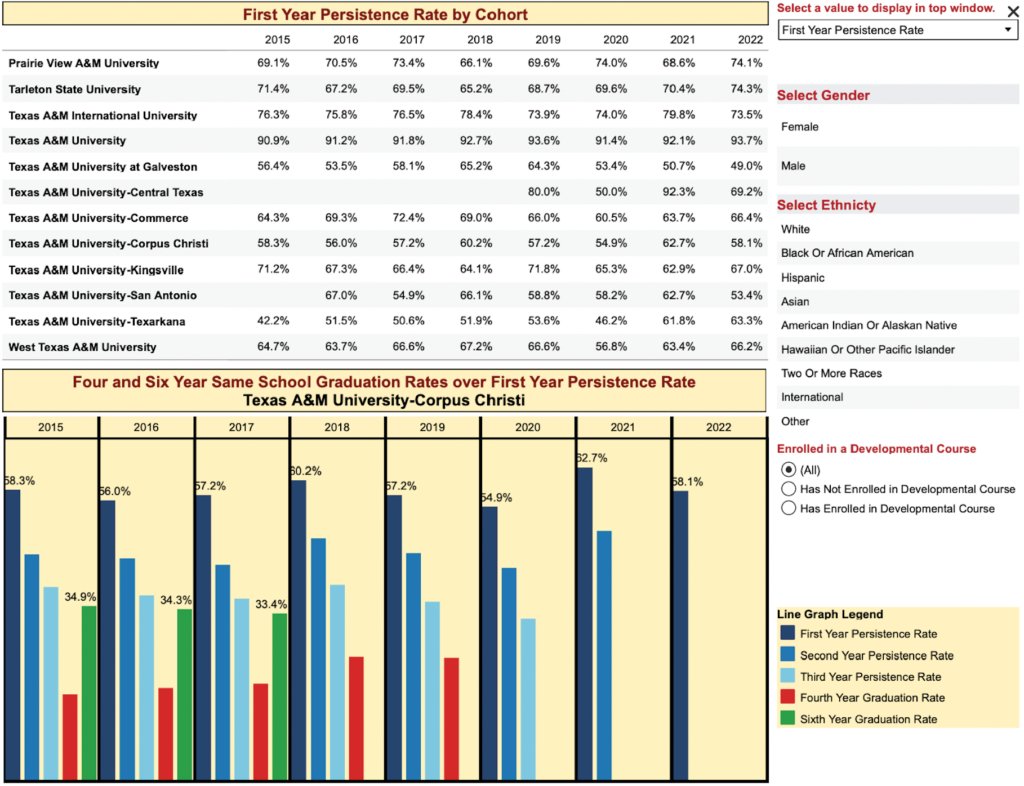
This EmpowerU chart shows the first-year persistence rate of students by A&M System member institution.
Credit: A&M System
THECB manages a robust data platform, “DataBridge,” that is the state’s main source of data and statistics for higher education. This interactive platform enables higher education leaders to gain insights from performance metrics related to state higher education and institutional goals. For example, tracking student debt and earnings is a critical part of Texas’s efforts to show a positive return on investment of a college degree and improving economic mobility for students from historically underserved populations.
Figure 12: Manageable Student Debt
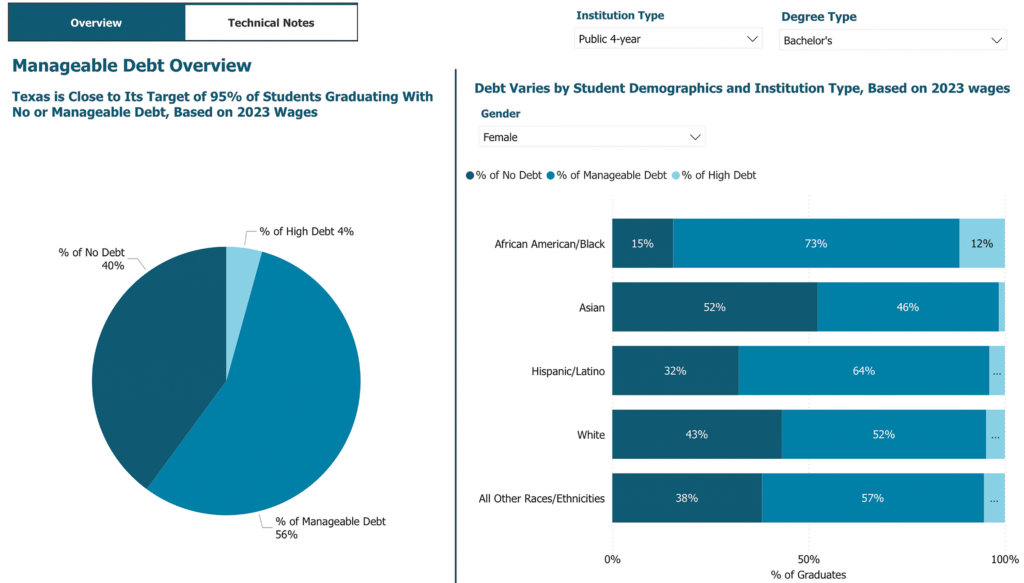
This DataBridge chart provides an overview of manageable debt for graduating students and how the debt varies across student demographics and institutional type.
Credit: THECB
Prairie View Student Success KPIs
PVAMU’s Office of Institutional Research and Effectiveness “provides management information and centralized reporting services to clients both within and external to the university. The information provided assists with decision-making, policy development, and the implementation of alternative solutions through a variety of analytic activities, data gathering, interpretation, assessment, and research projects.”141 Institutional data and dashboards are available online. PVAMU collects and reports on faculty data, faculty workload, and student enrollment. The Institutional Research and Effectiveness team also creates and maintains current dashboards that capture information ranging from enrollment by major, grade distribution in courses, to student-retention rates (see figure 13).
PVAMU has also identified the following metrics as KPIs of the campus’s progress toward improving student outcomes:
Table 4: PVAMU KPIs
|
Enrich Student Success and Holistic Student Development |
Baseline |
Good |
Better |
Best |
|---|---|---|---|---|
|
Undergraduate |
38.3% |
40% |
42% |
44% |
|
4-YR Graduation Rate |
21% |
25% |
28% |
32% |
|
6-YR Graduation Rate |
41% |
45% |
48% |
52% |
|
YR 1 Retention Rate |
73% |
75% |
78% |
80% |
|
Manageable student debt Avg. Debt Per Student (TX) $24,562 Percent with Debt (TX-Avg): 56.5% |
$30,058 81.6% TBD |
$27,000 70% 70% |
$24,000 60% 78% |
$21,000 50% 80% |
|
6-month postgraduate success rate |
TBD |
70% |
78% |
80% |
Excerpted from Prairie View A&M University, “Journey to Eminence 2035,” 20, https://www.pvamu.edu/wp-content/uploads/2025/03/Strategic-Plan-2024-.pdf.
Figure 13: PVAMU Cohort Data
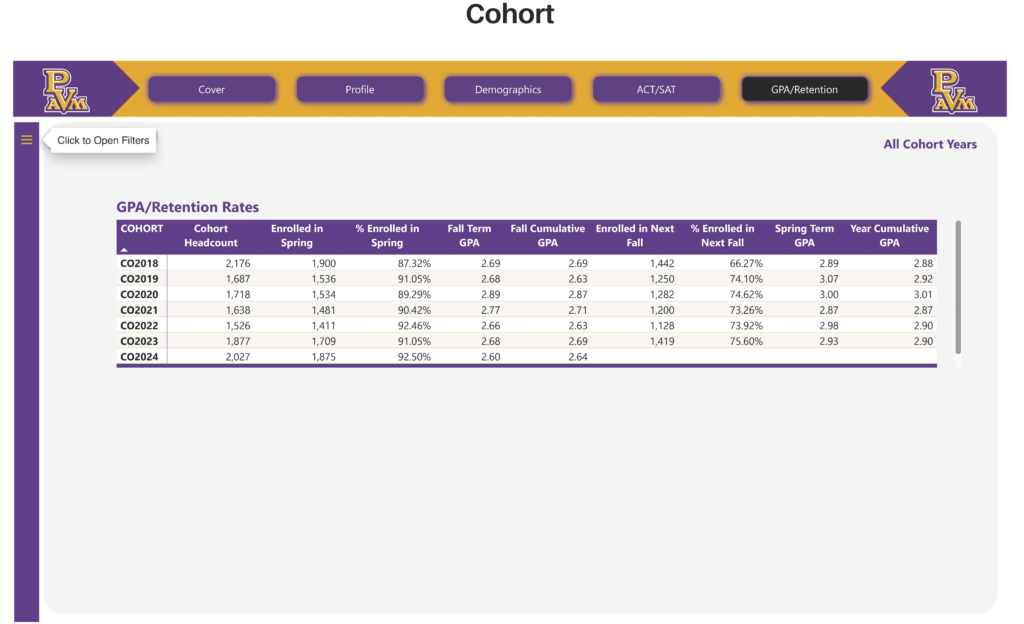
This chart shows semester-to-semester and fall-to-fall persistence rates and GPAs for PVAMU students by cohort.
Credit: PVAMU142
Barriers to Student Succes at Prairie View
Several persistent barriers have been identified by PVAMU leaders as constraining student success and limiting PVAMU’s progress toward achieving its overall goals of improving affordability, economic mobility, and career outcomes for its students. A significant percentage of the student body are economically disadvantaged, with more than two-thirds of them being Pell-eligible. These financial realities heighten the barriers to persistence and college completion.
Students also struggle with the transition to college. Many students find it difficult to manage the academic workload and struggle to find a sense of belonging in the new academic and social environment of the institution. Like many college and university leaders nationwide, PVAMU administrators believe that a residual impact of COVID is the declining level of academic preparedness of entering students. Additionally, structural barriers such as limited course availability and scheduling issues create registration challenges that often delay students’ academic progress.
High student DFWI rates in key courses highlight broader concerns about curriculum alignment and instructional effectiveness, which might suggest a need to enhance instructional and academic support services for both faculty and students.
Actions Taken That Made a Difference
System and Board Action
Under the leadership of the immediate past president of the A&M System, John Sharp, and the guidance of the system’s board of regents, the A&M System prioritized student success, allocated resources to support this priority, and implemented accountability measures to monitor progress. Over the last 15 years, approximately $340 million has been invested in Prairie A&M University’s infrastructure and buildings. In addition, PVAMU has benefited from funding increases provided by the Texas Legislature in 2023 and 2025. In 2023, the system received a record $1.19 billion in new funding, which enabled a freeze on undergraduate tuition and fees, and full funding of a state match needed for Prairie View to qualify for federal funding for 1890 (historically Black) land grant universities.
Recruitment and Admission of Transfer Students and Consideration of Prior and External Learning Experiences
Through this policy the A&M System Board of Regents “endorses the recruitment and admission of transfer students from community colleges and other academic institutions to the universities (academic institutions) within the system, and the consideration of all documented learning experiences acquired in settings external to the institution.” Importantly, this policy expresses the board’s commitment to “admission policies and practices that are impartial and provide equitable access” for all students.143
Prairie View Actions
In 2024, PVAMU launched its new strategic plan, “Journey to Eminence 2035,” which not only reflects the institution’s strategic priorities, but also aligns with the A&M System regents’ goals focusing on academic excellence, strategic growth, resource stewardship, and student success. The broad mission of the A&M System guides all its member institutions, and PVAMU’s new strategic plan outlines how it will contribute to that mission. PVAMU’s strong relationship with the A&M System Office is integral to advancing its priorities.
The university has secured a significant increase in financial support which Gibson attributed to President LeGrande’s leadership. “She [LeGrande] is always prepared and presents clear strategic requests that are supported by data and tied to measurable outcomes.” The Prairie View plan was designed through a data-informed collaborative process with university stakeholders. The plan places student success at the center of the institution’s priorities and reflects President LeGrande’s vision of establishing PVAMU as a national model for student success. The strategic plan and its goals, especially Goal 3, bring the vision into sharp focus. The objectives tied to this goal and related actions and initiatives outlined here are tangible expressions of LeGrande’s vision. The student success initiatives stem from and are aligned with the “Journey to Eminence 2035” framework and ensure connections between institutional priorities and long-term strategic goals.
President LeGrande emphasized collaboration and shared accountability by requiring each member of her cabinet responsible for core functional areas to develop divisional strategic plans that also align with the university’s mission and strategic priorities. Additionally, each functional area was assigned primary or secondary responsibility for advancing specific goals and objectives outlined in the plan. The senior vice president for strategy and transformation led and managed this collaborative process. Although still in the early stages of implementation, PVAMU expects to see tangible results from leveraging new or enhanced administrative structures, innovative initiatives, and strategic partnerships. The Office of Student Success, formerly known as the Office of Academic Engagement and Student Success, was created in the fall of 2016. In the fall of 2023, the unit merged with the Division of Enrollment Management to create the Division of Enrollment Management and Student Success. The division is designed to help increase and sustain enrollment by making the student experience more supportive, appealing, and outcomes-oriented.
Holistic and Proactive Advising
The PV Cares Student Success Model provides Prairie View students with a dedicated team of professional advisers and career coaches to support their academic and career journeys. The program assigns a three-person care team to every undergraduate student to help navigate university processes and foster a sense of belonging within PVAMU. The care team includes an academic adviser, a financial counselor, and a career coach. Graduate students are assigned a financial counselor. It is important to note that given the urgency of the challenges and the extensive body of research demonstrating that advising is one of the most effective strategies for advancing student success, PV Cares was launched at scale across the university in fall 2024. PVAMU has invested over $2 million in the PV Cares initiative, so far. The institution has hired 20 new academic advisers, 11 new career coaches, and 11 new financial counselors, according to John P. Gardner, assistant vice president for student success.
Faculty mentors were added to the team in fall 2025 to enhance academic and professional growth. This program required a substantial financial investment to hire professional advisers, provide the administrative and technological infrastructure needed to support them effectively, and shift institutional culture. Faculty and administrators use Panther Navigate, a student success platform, to monitor students’ progress, identify risk factors, and coordinate support services. In a press release, Gardner explained, “This holistic model equips our students not only to succeed academically, but also thrive financially and professionally long after they leave Prairie A&M University. PV Cares reflects our deep commitment to building productive Panthers who are prepared to lead, serve, and excel in every arena of life.”144
Investment in Technology, Data Analysis, Data-Informed Decision-Making
The institution has also made significant investment in its technology infrastructure. The leadership team has made a commitment to use data analysis and technology to help students and staff make informed decisions about early interventions and ongoing support. This can be seen in the strategic allocation of resources toward PVAMU’s student success platform, which staff use to help students stay on track for graduation and provide them with timely guidance and support throughout their academic journey. Co-branded by PVAMU, Panther Navigate, the platform tracks data across the students’ time at the institution, which provides faculty and staff with a holistic understanding of students’ needs and facilitates interventions specific to those needs. University administrators commented that the system has helped to “power” communication and collaboration within and beyond the PV Cares team. Additionally, students can use Panther Navigate to create degree plans, schedule appointments with advisers, and access information about university resources, thus empowering them to better manage their experience at PVAMU.
Gardner noted that the Acadeum Course-Sharing Consortium also aids students in staying on track for graduation by allowing them to enroll in degree-applicable courses at partner universities. This option is especially valuable when required courses at PVAMU are either unavailable or at capacity during a given semester.
Student Success Scholarships
These scholarships provide targeted financial support to students at various stages of their matriculation. The scholarships are designed to meet immediate needs, alleviate stress in emergency situations, and remove financial barriers that might otherwise disrupt their enrollment. This support plays a critical role in fostering persistence and degree completion.
Summer Bridge Programs
PVAMU offers a variety of Summer Bridge Programs (13 in all) designed to support incoming freshmen with the transition to college. These programs provide students with a strong support network to build personal responsibility and encourage them to become involved in campus life. Summer Bridge Programs are an important component of PVAMU’s student success portfolio. The programs focus on helping students develop academic skills, engage in campus activities that promote independence and confidence, and learn about resources that will equip them with the tools they need to succeed.
Program for System Admission
“The Program for System Admission (PSA) is an alternative admission program for selected students not offered freshman admission to Texas A&M University. PSA provides students the opportunity to attend an [A&M System] institution with the goal of enrolling at Texas A&M in College Station after the successful completion of the first year.”145
Campus Involvement and Student Engagement
PVAMU has begun to emphasize the importance of students’ campus involvement, student health and well-being, and a transformative curricular experience. President LeGrande has highlighted the institution’s history of student success and its significant contribution to the Black middle class in Texas. The Office of Student Engagement at PVAMU is an intentional, student-focused resource that fosters meaningful involvement, leadership development, and community engagement. Engagement staff support students through purposeful programming and services that enhance success and enrich campus life. The new emerging leaders program is a student success initiative that is aligned with the goals of the university’s strategic plan. “The purpose of the Emerging Leaders Academy (ELA) is to provide students with the opportunity to develop or increase their leadership knowledge and skills. Students who participate in the [ELA] will attend a series of workshops, engage in community service projects, and create a portfolio documenting their journey of leadership growth throughout the program.”146
Fundraising and Philanthropy
Before President LeGrande’s appointment, Prairie View’s fundraising efforts were strengthened by an unrestricted $50 million gift from MacKenzie Scott, the largest in the university’s history. The gift has been used for scholarships, improvements to academic programs, and the creation of the Panther Success Grant program to assist students with financial challenges due to the COVID pandemic.147 Shortly after her arrival, President LeGrande established the Division of University Advancement because she recognized the need for and important role of fundraising and external partnerships in advancing the strategic priorities of the university. In June 2025, PVAMU and the Prairie View A&M Foundation announced the launch of a “reimagined partnership” designed to strengthen the university’s fundraising infrastructure and empower it to “invest more deeply in student success, faculty excellence, and innovative programs.”148 This partnership works within the framework of the Division of University Advancement and centralizes the management of all charitable gifts (from individual donors, alumni groups, corporations, and other foundations) through the foundation. This change streamlines the donation process, enhances stewardship, and ensures that every gift aligns with the university’s strategic goals. According to President LeGrande, the integrated approach is about more than fundraising—it “accelerates [PVAMU’s] path toward becoming a model 21st-century institution of excellence, innovation, and service outlined in our strategic plan, ‘Journey to Eminence 2035.’”
These changes and a sharpened focus on building PVAMU’s fundraising infrastructure have positioned it well to grow philanthropy to support its student success initiatives. Since 2023, the PVAMU Division of Advancement has driven growth through increased fundraising and major grants, which has supported historic enrollment growth. In 2024, the university received a $2.1 million gift for student scholarships, and the inaugural PVAMU Presidential Scholarship Gala raised over $600,000 to support students that year. An analysis by HBCU Money highlighted PVAMU’s long history of loyal alumni and vital mission, citing them as strengths upon which to build its capacity and strategy for increased fundraising.149
Figure 14: Ecosystem of Student Care
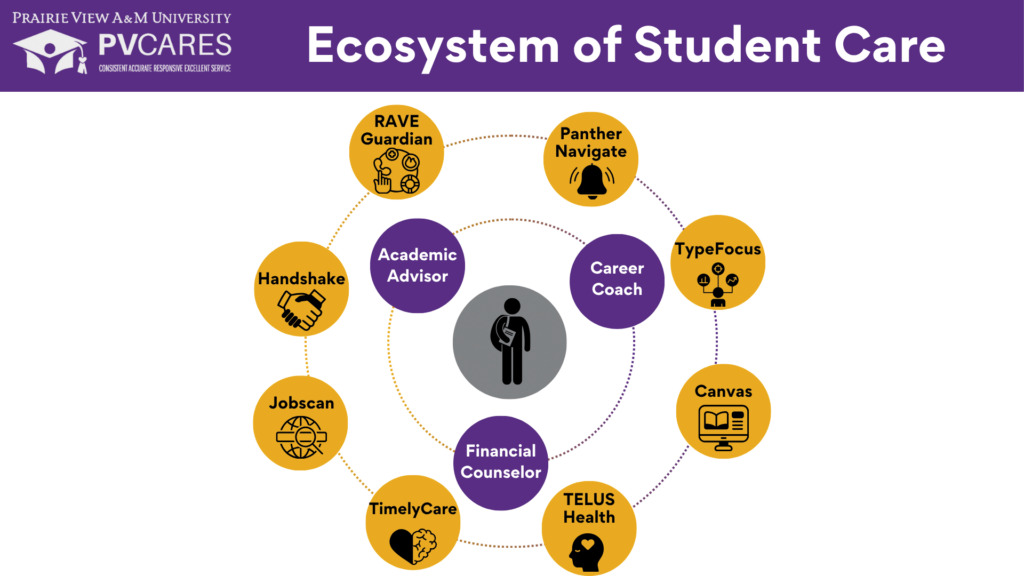
Gardner noted that this “outlines the human and technological resources available to students.”
Credit: PVAMU
Notes
126 Prairie View A&M University, “College History,” accessed October 6, 2025, https://www.pvamu.edu/about_pvamu/college-history/.
127 “Texas A&M announces plans to expand Riverside campus,” May 2, 2026, accessed October 9, 2025, https://theeagle.com/news/a_m/texas-a-m-announces-plans-to-expand-riverside-campus/article_f69bbd26-0e48-11e6-ad33-c705d484e3d2.html.
128 AGB, “State Profile: Texas,” January 8, 2020, https://agb.org/state-profiles/texas/.
129 Adapted from the A&M System, “About—A&M SYSTEM OFFICES,” accessed October 6, 2025, https://www.tamus.edu/system/about/.
130 Prairie View A&M University, “REGENTS NAME SOLE FINALIST FOR PRESIDENT AT PRAIRIE VIEW A&M UNIVERSITY,” press release, November 10, 2022, https://www.pvamu.edu/wp-content/uploads/2022/11/News-Release-PVAMU-President-Finalist-Named.pdf.
131 A&M System, “Board of Regents Strategic Plan 2016–2021,” September 1, 2016, 11, https://assets.system.tamus.edu/files/strategicplan/pdf/2016-2021-TAMUS_Long_FINAL.pdf.
132 Texas A&M International University, “New A&M System Chancellor Meets with TAMIU Students, Faculty, Staff,” July 7, 2025, https://www.tamiu.edu/newsinfo/2025/07/tamushegartamiu71725.shtml.
133 A&M System, “Office of Academic Affairs,” accessed October 14, 2025, https://www.tamus.edu/academic/.
134 A&M System, “ACUE Scaling Instructional Excellence for Student Success,” accessed October 6, 2025, https://www.tamus.edu/academic/initiatives/scaling-instructional-excellence/.
135 A&M System, “System-wide Initiatives & Projects,” accessed October 6, 2025, https://www.tamus.edu/academic/initiatives/.
136 A&M System, “Student Success,” accessed October 6, 2025, https://www.tamus.edu/academic/initiatives/.
137 A&M System, “Public Policy Scholars Program (PPSP),” accessed October 6, 2025, https://www.tamus.edu/academic/student-success/ppsp/.
138 A&M System, “A&M System Student Regent,” accessed October 6, 2025, https://www.tamus.edu/academic/student-success/student-regent/.
139 A&M System, “THECB Non-Voting Student Representative,” accessed October 6, 2025, https://www.tamus.edu/academic/student-success/thecb-non-voting-student-representative/.
140 A&M System, “Analytics,” accessed October 6, 2025, https://empoweru.tamus.edu/analytics/.
141 Prairie View A&M University, “Office of Institutional Research and Effectiveness,” accessed October 7, 2025, https://www.pvamu.edu/ir/.
142 Office of Institutional Research and Effectiveness, “PVAMU Data: Power BI Dashboards, Cohort,” accessed September 15, 2025, https://www.pvamu.edu/ir/pvamu-data-3/powerbi-dashboards/cohort/.
143 A&M System, “Recruitment and Admission of Transfer Students and Consideration of Prior and External Learning Experiences,” May 7, 2024, https://policies.tamus.edu/11-05.pdf.
144 Prairie View A&M University, “PRAIRIE VIEW A&M UNIVERSITY’S ‘PV CARES’ INITIATIVE EMPOWERS STUDENTS WITH HOLISTIC, PROACTIVE SUPPORT,” press release, October 2, 2025, https://www.prnewswire.com/news-releases/prairie-view-am-universitys-pv-cares-initiative-empowers-students-with-holistic-proactive-support-302574271.html.
145 Prairie View A&M University, “Program for System Admission,” accessed October 7, 2025, https://www.pvamu.edu/admissions/psa/.
146 Prairie View A&M University, “Student Leadership Development,” accessed October 7, 2025, https://www.pvamu.edu/admissions/psa/.
147 Prairie View A&M University, “A Gift to PVAMU: Donor Announces $50 Million Gift to Prairie View A&M University,” December 15, 2020, https://www.pvamu.edu/blog/a-gift-to-pvamu-donor-announces-50-million-gift-to-prairie-view-am-university/.
148 Prairie View A&M University, “PVAMU reimagines partnership with Prairie View A&M Foundation to power fundraising and impact,” June 11, 2025, https://www.pvamu.edu/blog/pvamu-reimagines-partnership-with-prairie-view-am-foundation-to-power-fundraising-and-impact/.
149 HBCU Money, “A Merger of (Potential) Might: Why Prairie View A&M and Texas Southern Should Combine Their Foundations to Challenge the Endowment Establishment,” September 1, 2025, https://hbcumoney.com/2025/09/01/a-merger-of-might-why-prairie-view-am-and-texas-southern-should-combine-their-foundations-to-challenge-the-endowment-establishment/.