 Chat with AGB Board Bot
Opinions expressed in AGB blogs are those of the authors and not necessarily those of the institutions that employ them or of AGB.
More than half of U.S. college students now attend school in a state with at least one law restricting what can be taught or how campuses operate.1 That single statistic, drawn from PEN America’s research, captures why AGB spent 18 months on an unusual experiment: teaching trustees, in real time, how to govern through a crisis nobody fully anticipated.
The result, funded by the Mellon Foundation and developed in partnership with PEN America, was the Govern NOW Leadership Academy (“the Academy”)—a pilot cohort of trustees, presidents, and board professionals (AGB’s term for staff at a campus, system, or institutionally related foundation who support the governing board) who spent 12 weeks working through the fiduciary, legal, and practical dimensions of academic freedom and free speech. The research behind it, now compiled into a full digital resource called Leading Through Disruptive Change, offers a candid look at what boards understand, what they don’t, and the best direction for the next round of trustee education.
What Worked
The Academy curriculum taught trustees how to prepare before a crisis by defining when a threat to academic freedom or free speech would trigger them to consider resistance or collective action. The Academy explored the costs of board inaction, the cultural considerations that involve more than compliance, the point where protected speech ends and obligations under Title VI of the Civil Rights Act of 1964 begin, and how to distinguish governance roles and responsibilities from management when a crisis hits.
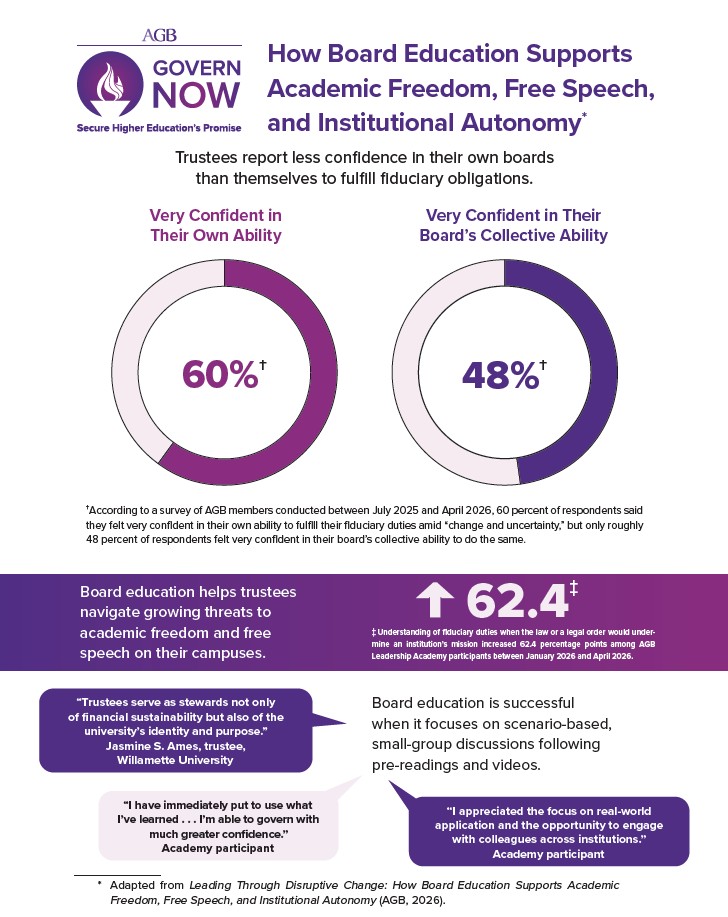
Trustees said the Academy’s interactive structure helped. Academy participants credited the interactive “flipped classroom” format in which participants studied pre-readings and videos at home that introduced substantive topics ahead of time so that the in-person virtual sessions freed up time for the scenario-based, small-group work that trustees said mattered most. They considered the in-person capstone, which featured scenario discussions, the single highest-value element of the experience. As one participant from a regional university put it, the Academy gave trustees “a better understanding of governance, fiduciary responsibilities, and especially the difference between academic freedom and freedom of speech.”
The Academy Moved the Needle Where It Mattered Most
AGB conducted two quantitative surveys of Academy participants to gauge their knowledge of fiduciary governance, academic freedom, and free speech both before the Academy began and after its conclusion.
The most striking result came from a single pre-test and post-test question of the Academy participants: Does a trustee’s duty of loyalty and obedience require following a law or order even if it undermines the institution’s mission? Before the Academy, only 15.4 percent of participants picked the legally correct answer: “it depends.” Afterward, 77.8 percent did. That 62-point swing suggests that nuanced fiduciary judgment is not intuitive; it has to be taught, and it can be.
Other gains were just as telling, if smaller. The number of participants who understood that academic freedom and freedom of expression rest on different constitutional foundations rose to 100 percent correct on one key survey item. Knowledge of academic freedom’s scope improved, though some confusion persisted about who holds it (faculty members do, not staff or students).
A Confidence Gap Worth Noticing
AGB also surveyed the full AGB membership regarding fiduciary governance, academic freedom, and free speech, which turned up a curious split. When asked about their own ability to fulfill fiduciary duties amid “change and uncertainty,” 60 percent of respondents said they felt very confident. However, when asked the same question about their board’s collective ability, only about 48 percent felt very confident—and the percentage expressing real doubt roughly doubled. Those individuals trust themselves more than they trust their boards as a unit. That gap is worth special focus, because boards govern collectively or not at all.
The Larger Point
Boards that understand the difference between legitimate oversight and undue influence, and between governing and managing, don’t just avoid headlines—they protect the space institutions need to keep teaching, researching, and questioning. That space doesn’t defend itself. It depends on trustees who have practiced, before a crisis arrives, the judgment the crisis demands. These data suggest that kind of judgment can be taught. The work now is making sure it reaches every board, not just the 24 individuals who finished the Academy.
* This post is adapted from Leading Through Disruptive Change: How Board Education Supports Academic Freedom, Free Speech, and Institutional Autonomy (AGB, 2026), i, iii–vi.
Artificial intelligence tools assisted in the development of this blog post.
Ellen-Earle Chaffee, PhD, is an AGB subject matter specialist and senior fellow. She is a former president of Valley City State University and Mayville State University. Earlier, she served as academic vice-chancellor for the North Dakota University System and director of organizational studies at the National Center for Higher Education Management Systems. She was president of the Association for Institutional Research and the Association for the Study of Higher Education, as well as the public member of the American Council on Pharmaceutical Education. She is a past member of Des Moines University’s board of trustees and served as board member and chair of a major health care system.
1. “PEN America Warns of Expanding Web of Control as Politicians Escalate Campaign to Censor U.S. Colleges and Universities,” PEN America, January 15, 2026, https://pen.org/press-release/pen-america-warns-of-expanding-web-of-control-as-politicians-escalate-campaign-to-censor-u-s-colleges-and-universities/.