
 Chat with AGB Board Bot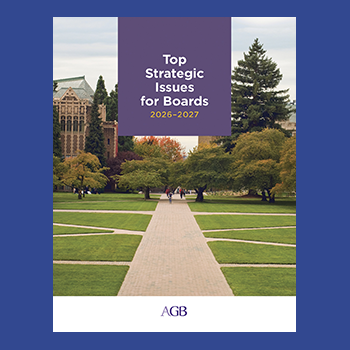
Opinions expressed in AGB blogs are those of the authors and not necessarily those of the institutions that employ them or of AGB.
The arrival of spring coincides with the release of the latest edition of AGB’s flagship publication, Top Strategic Issues for Boards. The new edition for 2026–2027 is the latest in a long series of biennial publications that frame the most important topics facing colleges and universities. Top Strategic Issues for Boards is separate from another important biennial AGB series, Top Public Policy Issues Facing Governing Boards, which focuses on the newest executive orders, legislation, court cases, and agency regulations affecting higher education. AGB publishes both resources in alternating years.
Top Strategic Issues for Boards sets the stage for the discussions that will take place in higher education boardrooms over the next two years. It describes the high-level, strategic issues that will impact every college, university, system, and foundation in 2026–2027, but it also highlights the most important questions that boards need to ask campus leaders (and themselves) to ensure student access and success, support groundbreaking research, and protect their missions.
To prepare this new edition, AGB gathered insights from a wide range of constituencies across the higher education sector, including current and former board chairs; trustees; college and university presidents; foundation executives; board professionals; accreditors; and AGB’s Advisory Councils and professional staff. AGB also convened an advisory group with representatives from these groups who provided additional input for this biennium. These experts shared the topics and key questions that they believe higher education governing boards must face.
Many governing boards are discussing immediate, practical questions about their enrollments, endowments, and funding. Other concerns include risks to institutional autonomy and academic freedom. Participants in AGB’s discussions also identified some longer-term trends that predate this new edition, including changing student needs and expectations, shortening presidential tenures, and public skepticism concerning the value of a degree (to name just a few such topics).
A set of themes emerged during our conversations:
- Reaffirming Boards’ Roles and Responsibilities
- Developing and Supporting Higher Education Leaders
- Supporting Student Access and Success
- Ensuring Institutional Vitality
- Renewing Higher Education’s Purpose
A recurring idea connected these themes. Governing boards must respond to today’s immediate challenges, but this does not abrogate their responsibilities for the future of their missions. Effective governing boards navigate a complex tension between legacy and possibility, as my colleague Jackie Gardina recently wrote. This dichotomy is inherent in good governance, especially now.
As the higher education environment shifts, some institutions, systems, foundations, and their governing boards will reach a new strategic inflection point, if they haven’t already. These governing boards may face changes in their accreditation requirements, athletics programs, business models, or all the above and more. These urgent issues will be felt on their campuses in the short term, but how boards respond to the issues of today will influence the strategic trajectories of their institutions for years (and decades) to come.
Top Strategic Issues for Boards provides context to help boards move their institutions forward. Although some of these issues in 2026 and 2027 might seem daunting, agile and resilient governing boards understand that there are also strategic opportunities to ensure the success of their current and future students, strengthen their missions, and promote the vibrant role of higher education in society.
A Strategic Roadmap for the Next Two Years
The pace of change in higher education is accelerating, but high-performing governing boards reserve time on their agendas to look ahead to what is coming over the horizon. Top Strategic Issues for Boards helps frame these boardroom conversations in this dynamic environment.
Throughout U.S. history, higher education trustees have been independent fiduciaries, yet concerns about board independence were prevalent in the conversations for this edition. Drawing from AGB’s Govern NOW initiative and its Board of Directors’ Statement on Influences Impacting Governing Board Independence and Leadership, this new edition of Top Strategic Issues provides context and resources to help board members understand the importance of this tradition of American higher education governance, describes the difference between appropriate input and unwarranted interference, and offers questions to guide boards in protecting free inquiry on their campuses.
Some institutions and boards feel as though they are in a perpetual state of leadership transition, as my colleague Justin Kollinger recently explained. Serving as a college president/chief executive is a difficult job, so hiring, developing, and assessing a president is a board’s most important task. There are also many other demanding senior administrative positions in the president’s office and cabinet that require special skillsets. Governing boards must develop supportive, inclusive cultures for their senior leaders. This edition explains how boards can nurture the talent needed to lead their campuses and related foundations today and in the future through thoughtful succession planning. It also helps governing boards consider their own composition to ensure they have the right mix of skills, experiences, and perspectives to lead their institutions, systems, and foundations into their next chapter.
The campus experiences that students expect and the workforce skills they will need after graduation are changing. Top Strategic Issues for Boards provides discussion questions, guidance, and examples from AGB’s decade-plus work on this topic. The proliferation of artificial intelligence, arrival of the enrollment cliff (a demographic decline in the number of 18-to-24-year-old, traditional-age college students), changes in federal policy, rising levels of student debt, and public skepticism regarding the value of a degree make this an urgent strategic focus. Board members need to ask how their institutions can sustain enrollments and best support their students, particularly those from underrepresented communities.
Governing boards have important decisions to make in the next two years to meet their institutions’ going concerns. The financial outlook for the higher education sector is uncertain. Demographic change is distributed unevenly—some institutions are seeing record numbers of applications and enrollments, while others are struggling to fill their classes. At some private institutions, tuition discounts are reaching unsustainable levels. Meanwhile, new pressures on endowments and cuts in federal funding are affecting colleges and universities of all sizes and types. Many institutions also will have to deal with the wild world of college sports in the era of the transfer portal, student-athlete pay, and NIL (name, image, and likeness) deals, which are straining athletics budgets (even at some smaller institutions without nationally televised games).
Renewing Higher Education’s Purpose
In this environment, a college degree remains a worthwhile investment and a pathway to a successful life after graduation. Research shows that college graduates generally are healthier, happier, and more civic-minded than individuals without a degree. The institutions that provide those degrees help create jobs and conduct research that saves lives. In short: Higher education has a central role in democracy and economic prosperity. Top Strategic Issues for Boards provides resources to aid governing boards in advocating effectively for their institutions over these next two years.
Colin Biddle is AGB’s director of publications and editorial operations.